Vergleich von Transfer-Arc- und Non-Transfer-Arc-PREP-Geräten
Introduction
The plasma rotating electrode process (PREP) is one of the important technologies for producing high-quality spherical metallic powders at present. It has unparalleled advantages over other powder production techniques in the preparation of spherical metallic powders with ultra-low oxygen content. The metallic powders produced by this technology feature high sphericality, few satellite powders, and almost no hollow powders. These powders have become the recognized high-quality powders in current advanced manufacturing fields such as additive manufacturing and hot isostatic pressing.
Differences of transfer arc and non-transfer arc types
PREP is divided into transfer arc and non-transfer arc types. The specific principle is as follows: The transfer arc type plasma arc is formed by establishing a direct conductive channel between the electrode rod and the cathode to generate plasma. Its core feature is that the plasma stably breaks through and arcs between the cathode (tungsten electrode) and the anode (metal), as shown in Figure 1a; the non-transfer arc type plasma (also known as plasma torch) is a discharge form established between the negative electrode and the positive electrode of the plasma gun itself, and the metal workpiece is not connected to the circuit for conducting electricity, as shown in Figure 1b.
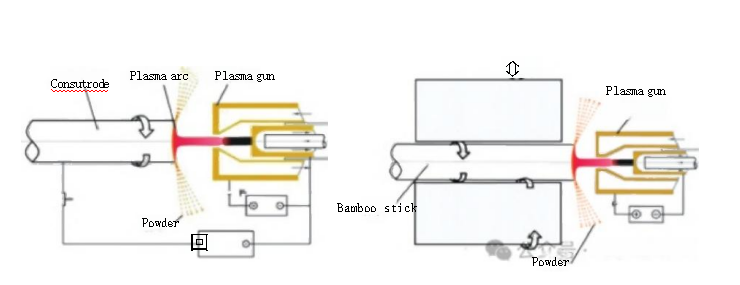
(a) Transfer arc (b) Non-transfer arc
Plasma gun
Transfer arc: the plasma arc at the electrode end has a high temperature (10,000 – 52,000 ℃), which enables the preparation of refractory metal powders. However, it is unable to prepare powders for non-conductive materials.
Non-transfer arc: suitable for preparing alloy powders such as high-temperature alloys and titanium alloys, but it can also be used for preparing powders of non-metallic and non-conductive materials.
Driving system
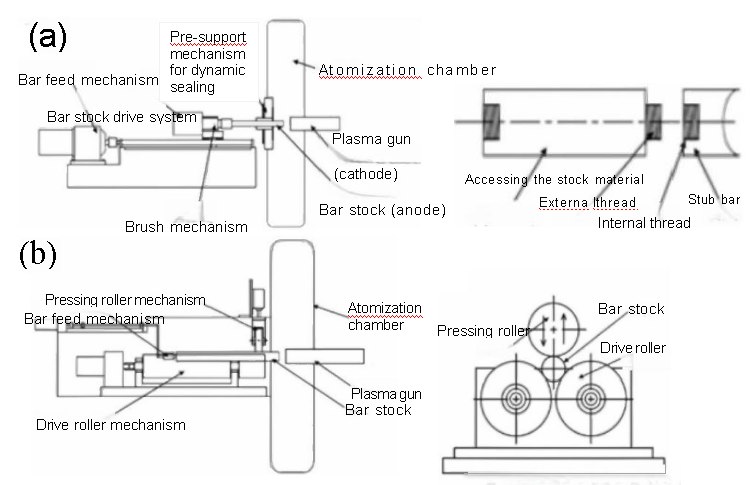
- Transfer arc: The direct drive method using an electric motor is adopted, as shown in Figure 2a. Since the motor is directly connected to the bar material, the normal operating speed range is 15,000 to 22,000 r/min, and the maximum speed can reach 30,000 r/min.
- Non-transfer arc: The three-roller drive method is adopted, as shown in Figure 2b. Since the diameter of the rollers is larger than that of the bar material, the rotational speed of the bar material is higher than that of the motor. The normal rotational speed range is 25,000 to 40,000 r/min, and the maximum rotational speed can reach 50,000 r/min.
Vakuum-System
Transfer arc: By using dynamic sealing, during the powder production process, oxygen is prone to leak from the driving system to the atomization chamber, resulting in an oxygen increment of the powder being less than 100 ppm.
Non-transfer arc: The equipment structure enables all systems to be in a connected and sealed state, thus allowing the oxygen content increment in the powder to be less than 50 ppm.
Feed system
- Transfer arc: The feeding system is mostly connected by a single cable, as shown in Figure 2a. It cannot achieve automated feeding and is suitable for small and medium batch production (150 kg/day).
- Non-transfer arc: By adopting automated feeding from the appropriate material box, high production capacity (1500 kg/day) can be achieved. Meanwhile, the non-transfer arc equipment can prepare powder for rods of different diameters without the need to replace components.

Schlussfolgerung
Transfer arc and non-transfer arc PREP technology is based on different plasma arc generation mechanisms, resulting in complementary technical characteristics: the transfer arc type is suitable for high-end customization and the preparation of refractory metals with high energy density, while the non-transfer arc type is characterized by high automation and high production capacity to meet the requirements of large-scale industrial production. The technological evolution of both is centered around the three core goals of “increasing rotational speed and power, refining powder particle size, and reducing manufacturing cost and quality”, and in the future, it will form more precise scenario adaptations in the aerospace and biomedicine fields.