The Effects of Graphite and Mo₂C Particles on the Sintering and Mechanical Properties of 18Cr4VNbMo Powder
18Cr4VNbMo is a high-carbon alloy steel commonly used in the manufacture of cutting tools. Its mechanical properties are significantly superior to those of traditional manufacturing through the super-solidification line liquid-phase sintering (SLPS) based on the temperature difference between the solidus line and the liquidus line. However, the process window is relatively narrow.
TRUER engineers, supported by professors from HNN University, added an appropriate amount of graphite and Mo₂C particles to the 18Cr4VNbMo powder, reducing the densification sintering temperature from 1450 °C to 1275 °C which expanding the process window.
1. Process scheme of powder metallurgy process
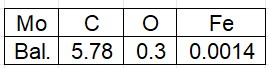
The chemical composition of 18Cr4VNbMo powder (wt%)

The chemical composition of Mo₂C particles (10 wt% added)

This study has designed three schemes for preparing composite powders.
Scheme 1: Add 0 wt%, 3 wt%, and 6 wt% Mo₂C particles to the 18Cr4VNbMo powder;
Scheme 2: Add 0.3 wt%, 0.6 wt%, and 0.9 wt% graphite particles to the 18Cr4VNbMo powder;
Scheme 3: Add 6 wt% Mo₂C particles to the 18Cr4VNbMo powder, and then respectively add 0.3 wt%, 0.6 wt%, and 0.9 wt% graphite.
The mixed powder was subjected to wet mixing, drying, and pressing. Then, it was heated under argon protection to 350°C for 1 hour for degreasing, followed by a temperature rise to 950°C at a rate of 5°C/min for 1 hour for preliminary densification.
Then, the temperature was raised at a rate of 3°C/min to the target temperature and maintained for 1 hour to achieve complete densification. The temperature was then cooled at a rate of 10°C/min to 500°C and the sample was cooled in the furnace.
2. 마이크로 구조

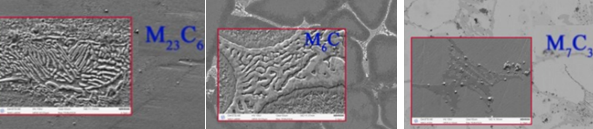
The main carbides detected in the sintered sample, including M23C6, M6C and M7C3. After introducing 0.6 wt% graphite powder, the formation of the M7C3 phase was detected.

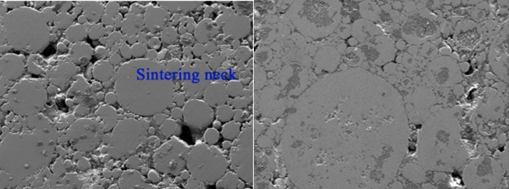
+ both graphite & Mo₂C at 1150°C + both graphite & Mo₂C at 1450°C
The 18Cr4VNbMo sample containing graphite and Mo₂C particles was difficult to achieve the densification at 1150°C, resulting in the formation of spherical particles along with a large number of sintering necks (left photo).
The elemental analysis at the particle boundaries revealed significant enrichment of oxygen and iron. This observation indicates that, under the current sintering parameters, the particle interfaces are still covered by a layer of metal oxides. This oxide layer severely hinders the atomic diffusion and metallurgical bonding between the particles, thereby inhibiting the densification process at this temperature.
When the sintering temperature rose to 1450°C (right photo), the original powder achieved densification. A stretched-like carbide structure was formed at the powder boundaries. Element analysis revealed a significant Cr segregation phenomenon in this area. Combined with XRD analysis, it was inferred that this phase was mainly the M23C6 phase.
The introduction of graphite promoted the transformation of the metastable M23C6 phase to the stable M7C3 phase. The formation of this phase significantly enhanced the hardness and wear resistance of the material, but simultaneously increased its brittleness. Subsequent mechanical property tests also have confirmed this.

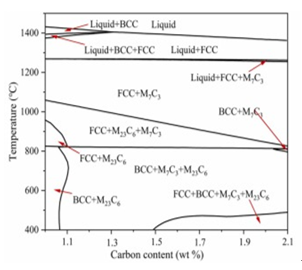
In the 18Cr4VNbMo powder system, the M7C3 and M23C6 phases are stably present within the high-temperature range. When cooled to the equilibrium state, the phase composition gradually transforms into a body-centered cubic solid solution dominated by M23C6.
3. Densifying

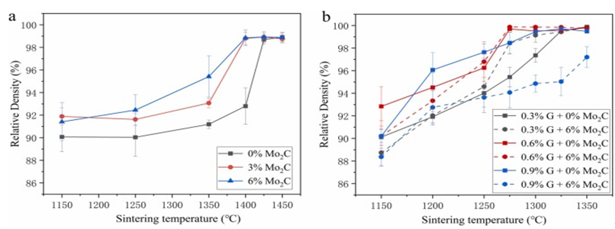
Within the temperature range of 1350 – 1400°C, the relative densities of the samples containing 3 wt% and 6 wt% Mo₂C increased sharply, achieving significant densification at 1400°C, the relative densities reached 98.87% and 98.99% respectively. When the temperature rose to 1450°C, the relative density of the original powder compact was 98.69%. The mechanism for this temperature difference in densification is that at high temperatures, some Mo₂C particles undergo partial decomposition and release free carbon. The free carbon participates in oxidation-reduction reactions, removing the oxide diffusion barriers covering the surface of the powder particles.
The relative densities of the compositions containing 0.6 wt% graphite + 0 wt% Mo₂C and 0.6 wt% graphite + 6 wt% Mo₂C rose sharply to 99.65% and 99.67% respectively, when the temperature reached 1275°C. At this point, the powders had completely sintered and formed, and their theoretical densities were 7.68 g/cm³ and 7.79 g/cm³ respectively.
In contrast, the compositions containing 0.3 wt% graphite + 0 wt% Mo₂C and 0.3 wt% graphite + 6 wt% Mo₂C only reached the maximum relative density at 1325°C (99.52% and 99.43% respectively).
So, adding 0.6 wt% graphite and 6 wt% Mo₂C particles to the original 18Cr4VNbMo powder resulted in a 12% reduction in the sintering temperature required for densification.
4. 기계적 특성

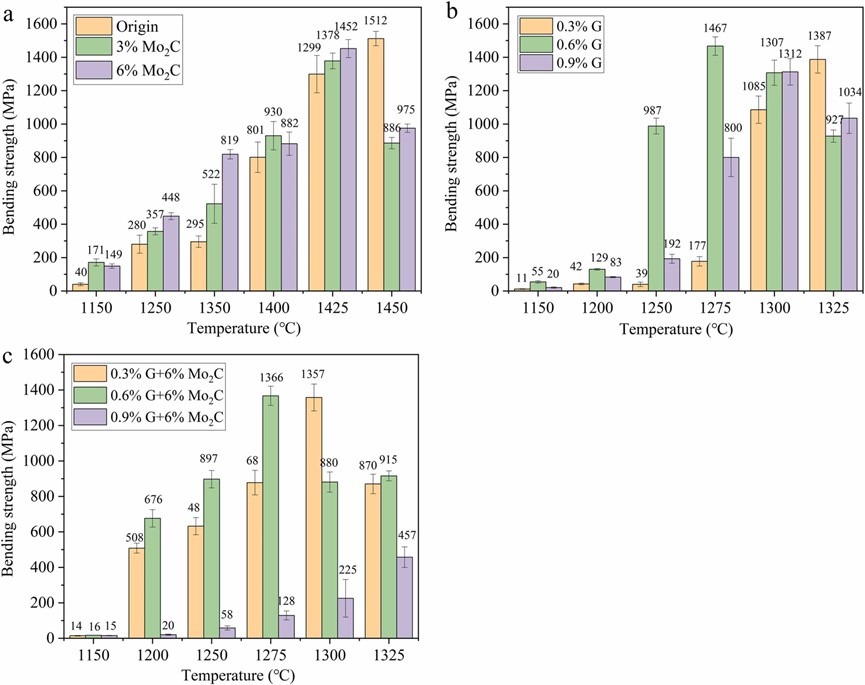
When the sintering temperature exceeds the optimal level and continues to rise, the bending strength of the Mo₂C-containing samples significantly decreases. This degradation is attributed to the excessive sintering temperature promoting the coarsening of carbides and the formation of a large amount of liquid phase, which subsequently leads to the generation of pores and the attenuation of bending strength.
After adding different amounts of graphite to the original powder, the material quickly reaches the peak of bending strength at a lower sintering temperature, mainly due to the strengthening effect of graphite on the densification kinetics. However, the addition of graphite powder results in a decrease in the bending strength of the material under the densification state: compared to the original powder, graphite powder causes significant precipitation of M7C3 carbides within the material, which excessively consumes the chromium elements in the matrix, weakening the solid solution strengthening and toughness, and the brittle carbide network formed at the powder boundaries provides a low-resistance path for crack propagation.
This phenomenon indicates that the rational control of carbide precipitation and distribution is of vital importance for improving the flexural mechanical properties of the material.

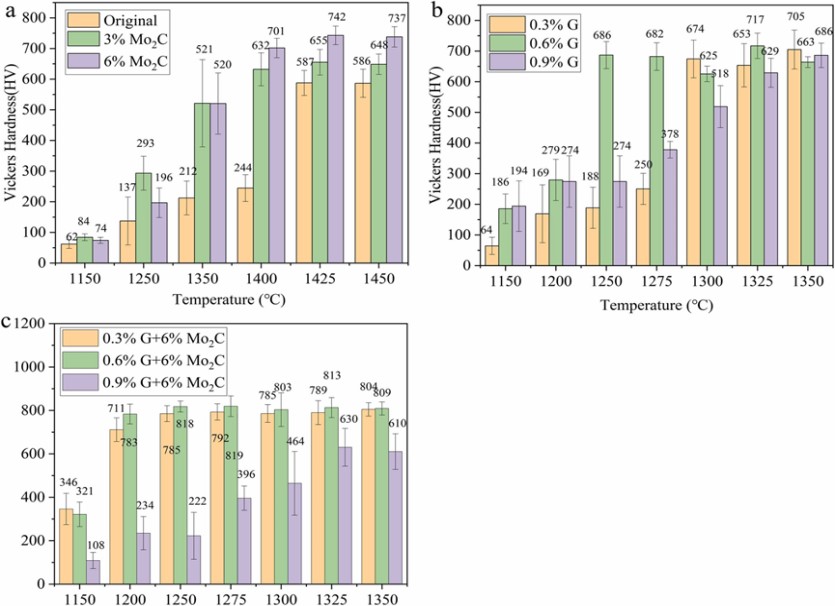
After densification sintering, the specimens containing 3 wt% and 6 wt% Mo₂C achieved peak hardness values of 655 HV and 743 HV, respectively, significantly higher than the 586 HV of the original powder.
This strengthening is attributed to the reinforcing phase introduced by the Mo₂C particles: The addition of Mo₂C promotes the massive precipitation of M6C carbides, and the hard carbides precipitated along the powder boundaries effectively hinder the movement of dislocations.
The addition of graphite powder alters the type of second-phase carbides that precipitate in the original powder. Since M7C3 has a higher hardness than M23C6, the samples with graphite added exhibit significantly higher hardness in the densified state compared to the unmodified original powder.
Under the combined effect of graphite powder and Mo₂C particles, the precipitation of high-hardness secondary carbides (especially M6C) further increases, and the overall hardness of the sample continues to rise.
Specifically: The specimens containing 0.3 wt% graphite + 6 wt% Mo₂C and 0.6 wt% graphite + 6 wt% Mo₂C reached peak hardness values of 819 HV and 813 HV respectively.
5. Fracture Analysis

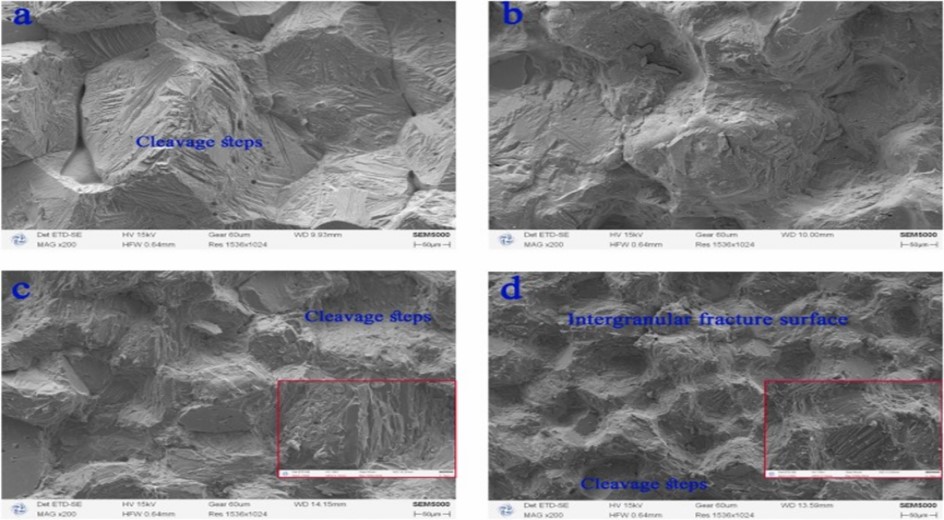
The fracture surface of the original 18Cr4VNbMo powder showed no significant anisotropy was observed in the bending test of different sections. Cracks preferentially extended along the powder boundaries, forming a characteristic Rock pattern, indicating a typical intergranular fracture mechanism.
In addition, a large number of M23C6 carbides precipitated at the powder boundaries in the densified 18Cr4VNbMo powder. Under the action of stress, these carbide particles themselves underwent particle cleavage fracture, presenting a parallel terrace pattern, and ultimately formed a mixed fracture mode dominated by an intergranular and cleavage within the carbides.
6. 결론
In this study, a composite (graphite/Mo₂C dual-phase added to 18Cr4VNbMo) material was fabricated using the SLPS technique. The synergistic effects of particles on the densification behavior, microstructure evolution, and mechanical properties under different sintering temperatures were systematically investigated. The main conclusions are as follows:
(1) The sintered raw powder undergoes the precipitation of the carbide phase at the powder interface. The addition of graphite causes the precipitated phase to transform into M7C3 phases.
(2) The densification temperature of 18Cr4VNbMo powder containing 0.6 wt% graphite and 6 wt% Mo₂C decreased from the original 1450°C to 1275°C (a reduction of approximately 12%), the hardness during the densification stage increased from 586 HV to 819 HV (an increase of 39.8%), and the bending strength reached 1366 MPa.
(3) The sintered sample of the original powder exhibited a mixed fracture mode of intergranular fracture along the powder boundaries and transgranular cleavage within the carbides.