Quick Answer
AlSi10Mg powder for 3D printing is a pre-alloyed aluminum-silicon-magnesium feedstock used mainly in metal powder bed fusion and related additive manufacturing processes. It is widely selected because it combines low density, good flowability, relatively stable laser processability, practical mechanical strength, and solid corrosion resistance in one alloy system. For engineers building lightweight parts with complex internal geometry, AlSi10Mg often provides the most balanced combination of printability, weight savings, dimensional accuracy, and post-processing flexibility.
What Is AlSi10Mg powder for 3D printing
AlSi10Mg powder for 3D printing is an aluminum alloy powder formulated for additive manufacturing processes that require fine, free-flowing, spherical particles. The alloy belongs to the aluminum-silicon casting family, with aluminum as the base element, roughly 10 wt% silicon as the dominant alloying addition, and a smaller magnesium addition that supports strengthening after thermal treatment.
In metal additive manufacturing, AlSi10Mg has become one of the best-known aluminum grades because it prints more reliably than many stronger wrought aluminum alloys. It offers a combination of good powder spreadability, comparatively low hot-cracking sensitivity, and a useful response to stress relief and aging treatments. That mix makes it a practical material for both prototyping and serial production.
Why this alloy became a standard AM material
Aluminum is attractive in additive manufacturing because it is light, corrosion resistant, and suitable for topology optimization. The challenge is that many aluminum alloys are difficult to print due to reflectivity, oxide formation, and crack sensitivity during fast solidification. AlSi10Mg gained traction because its silicon-rich chemistry improves melt behavior and reduces solidification problems that are more common in other aluminum families.
In that sense, AlSi10Mg is not simply a cast alloy used in a new machine. It is a material whose inherent metallurgical behavior aligns relatively well with the thermal cycling of laser-based additive manufacturing. That is why it often serves as the reference aluminum grade when users compare AM materials.
What distinguishes AlSi10Mg from other aluminum powders
Compared with purer aluminum powders, AlSi10Mg is stronger and easier to print consistently, though it sacrifices some conductivity. Compared with higher-strength aerospace aluminum families, it is usually more printable and less crack-prone, though it does not reach the same upper-end strength levels. The result is an alloy positioned around balanced engineering performance rather than a single extreme property.
For many applications, this balance matters more than peak tensile strength. A bracket, housing, duct, or thermal enclosure often benefits more from reliable build quality and low mass than from the last increment of strength achievable in a more difficult alloy.
Why spherical morphology matters for AM powder
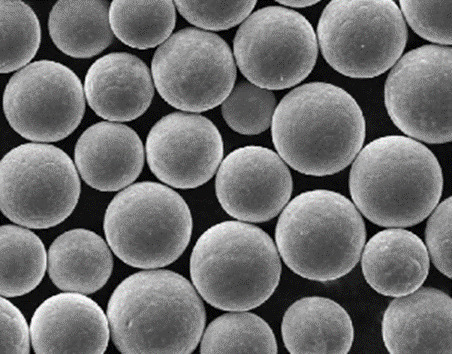
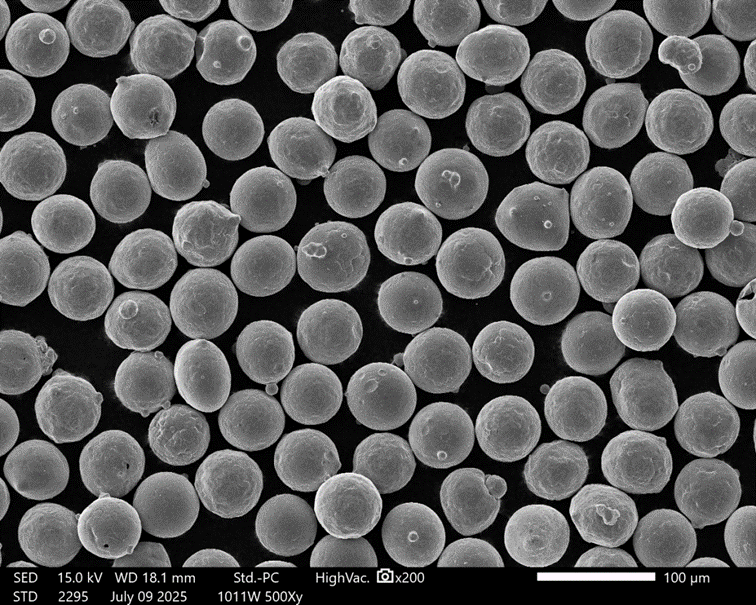
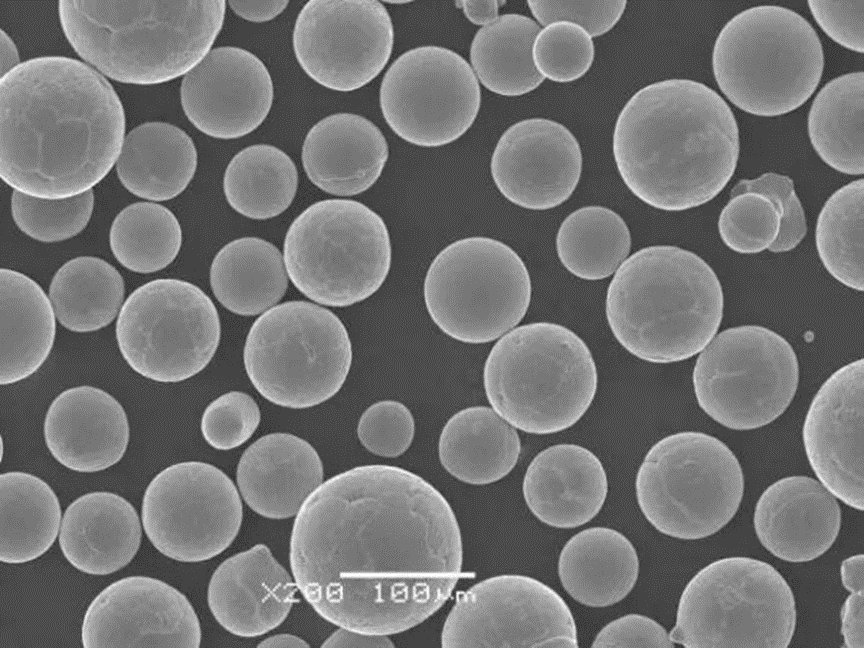
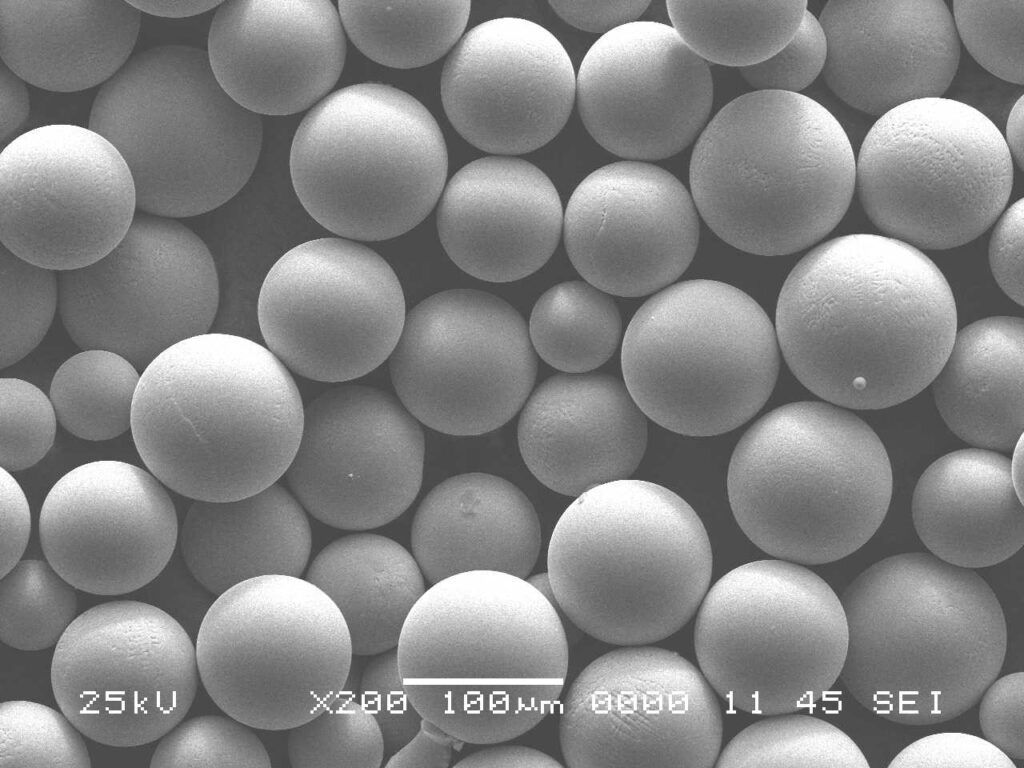
Particle shape is critical in powder-bed processes. A spherical particle moves and packs differently than an irregular one, helping create smooth powder layers with fewer voids and less recoater disturbance. That directly affects density, surface finish, and dimensional repeatability.
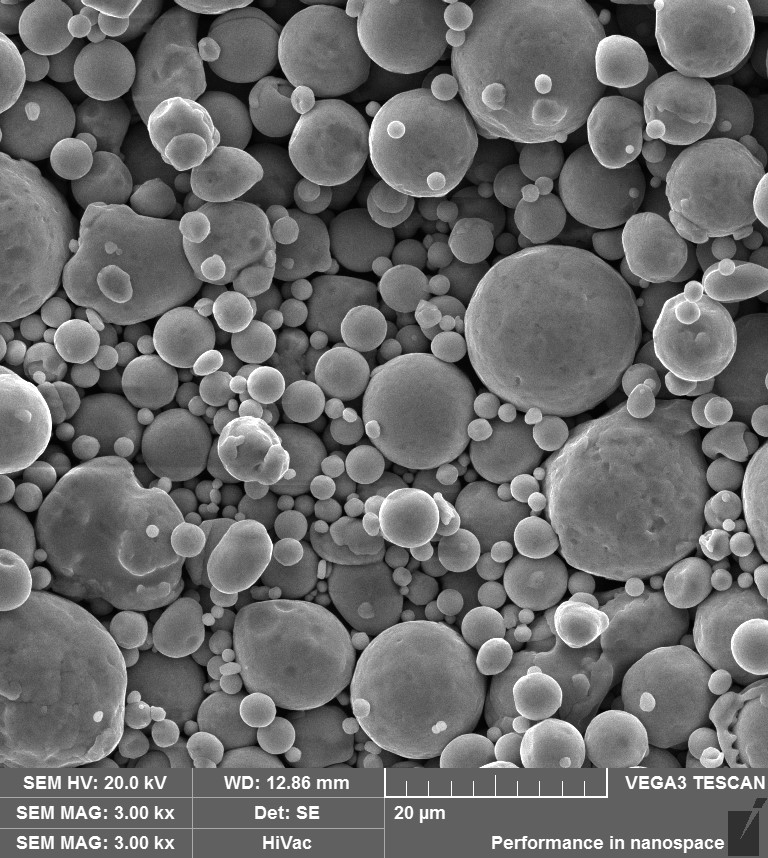
Because of this, engineers evaluate powder quality in AlSi10Mg as a combination of chemistry, morphology, particle size distribution, and oxygen control. A nominally correct alloy can still underperform if the powder is satellite-heavy, poorly classified, or contaminated during handling.
In aluminum additive manufacturing, the most usable alloy is often the one that keeps the process window wide enough for consistent builds.
Chemical Composition
The chemistry of AlSi10Mg is intentionally simple, but each element has a distinct function in printability and final part performance. Silicon governs much of the alloy’s AM behavior, magnesium supports hardening, and residual elements must be controlled because they can influence ductility, corrosion behavior, and microstructural stability.
| Element | Typical Content (wt%) | Common Range (wt%) | Primary Role | Effect in AM Parts |
|---|---|---|---|---|
| Aluminum (Al) | Balance | Remainder | Base matrix, low density, natural corrosion resistance | Enables lightweight structures and general alloy continuity |
| Silicon (Si) | 9.0–11.0 | 9.0–11.0 | Improves fluidity, reduces cracking tendency, supports eutectic formation | Enhances printability and dimensional consistency |
| Magnesium (Mg) | 0.20–0.45 | 0.20–0.45 | Provides age-hardening potential | Raises yield strength and hardness after heat treatment |
| Iron (Fe) | 0.15–0.55 | Controlled low | Residual impurity, may form intermetallic phases | Excess can reduce ductility and toughness |
| Copper (Cu) | 0.05 max typical | Very low | Minor residual element | Higher levels may reduce corrosion resistance |
| Manganese (Mn) | 0.45 max typical | Low | Secondary modifier of phase formation | Can influence intermetallic morphology |
| Zinc (Zn) | 0.10 max typical | Low | Residual impurity control | Usually limited to maintain consistency |
| Titanium (Ti) | 0.15 max typical | Low | Possible grain-refining residual | May affect nucleation during solidification |
| Oxygen (O) | Process controlled | Kept low for AM | Surface oxide indicator rather than nominal alloy element | Strongly affects fusion quality and reuse behavior |
Silicon as the main driver of AlSi10Mg printability
Silicon is the reason AlSi10Mg behaves differently from many other aluminum alloys in additive manufacturing. It improves fluidity and lowers susceptibility to hot cracking during rapid cooling. In printed microstructures, silicon-rich phases also contribute to a fine cellular or eutectic structure that supports stable dimensional results.
That does not mean silicon solves every processing challenge. Aluminum still reflects laser energy efficiently and forms tenacious surface oxides. But compared with low-silicon or high-strength wrought grades, AlSi10Mg gives process engineers a more forgiving starting point.
The role of magnesium in strength development
Magnesium is present in much smaller quantity, yet it is central to post-build performance. With suitable thermal processing, magnesium contributes to precipitation strengthening, which is why the alloy can move from acceptable as-built strength to more robust service properties after heat treatment.
This is one reason AlSi10Mg remains relevant beyond rapid prototyping. It is not only printable; it is also responsive to downstream metallurgy. That makes it useful for production parts that need a controlled balance of strength, hardness, and dimensional stability.
Residual control and powder cleanliness
Residual metallic elements are only part of the quality picture. Oxygen, absorbed moisture, and surface contamination can influence how AlSi10Mg melts and consolidates. For that reason, AM buyers normally assess chemistry together with morphology and powder handling controls rather than treating the chemistry certificate as the whole specification.
Physical and Mechanical Properties
The commercial strength of AlSi10Mg lies in its ratio of mechanical performance to density. It is far lighter than steel, cobalt alloys, and nickel superalloys, yet it still provides enough strength for a wide range of structural and functional components.
| Property | Typical Value | Unit | Test Standard / Reference Basis |
|---|---|---|---|
| Density | 2.65–2.68 | g/cm³ | Typical dense alloy value |
| Solidus Temperature | 557–570 | °C | Typical alloy reference range |
| Liquidus Temperature | 595–610 | °C | Typical alloy reference range |
| Ultimate Tensile Strength, As-Built | 320–430 | MPa | Typical AM coupon range |
| Yield Strength, As-Built | 180–260 | MPa | Typical AM coupon range |
| Ultimate Tensile Strength, Heat Treated | 380–460 | MPa | Typical stress-relieved or aged condition |
| Yield Strength, Heat Treated | 220–300 | MPa | Typical stress-relieved or aged condition |
| Elongation at Break | 3–10 | % | Process and heat treatment dependent |
| Hardness | 95–130 | HB / HV equivalent range | Typical printed condition range |
| Thermal Conductivity | 110–150 | W/m·K | Typical room-temperature range |
| Elastic Modulus | 68–76 | GPa | Typical aluminum alloy range |
Strength-to-weight performance
At approximately 2.67 g/cm³, AlSi10Mg weighs about one-third as much as most steels and substantially less than titanium, nickel, or copper alloys. That low density allows designers to produce load-bearing components with much lower inertial mass, which matters in aerospace, robotics, motorsport, and hand-held production tooling.
The practical benefit is not only lighter parts. Lower part weight can also reduce actuator demand, improve response time, and make assemblies easier to handle during installation or service. In AM, these system-level benefits often matter more than the isolated tensile number.
Mechanical properties in real production
Published strength data for AlSi10Mg vary because build orientation, layer thickness, energy density, support strategy, and heat treatment can change the final result significantly. A vertically built tensile bar may behave differently from a horizontally built one, and a stress-relieved part may differ from a T6-like condition.
That is why material datasheets should be treated as representative rather than absolute. Definitions for these process categories are commonly organized using ISO additive manufacturing terminology, while measurement practices and benchmark data are often compared against NIST materials engineering resources.
Thermal conductivity and functional design
AlSi10Mg does not match copper alloys in conductivity, but it often provides enough heat transfer for lightweight housings, heat sinks, and cooled tooling inserts. In many products, the ability to print internal channels offsets the conductivity gap by enabling a more efficient geometry.
This is why lightweight performance in AlSi10Mg should be understood broadly. The alloy supports both structural weight reduction and multifunctional design, including thermal management, cable routing, and local stiffness optimization inside one printed part.
Specifications and Available Grades
Powder specification determines whether AlSi10Mg performs well in a real machine, not just in theory. A chemistry-correct material can still create build instability if the particle size distribution is mismatched to the recoating system or if oxygen and flow properties drift between lots.
Common AlSi10Mg powder for 3D printing size ranges
For laser powder bed fusion, the most common commercial cuts are 15–45 µm and 15–53 µm. These ranges generally support thin, uniform layers and good surface quality. Coarser fractions such as 20–63 µm or 45–105 µm are more often selected for thicker layers, directed energy deposition, or cladding-type applications.
| Grade / Reference | Typical PSD (µm) | Apparent Density (g/cm³) | Tap Density (g/cm³) | Hall Flow (s/50 g) | Oxygen Content | Sphericity / Standards Note |
|---|---|---|---|---|---|---|
| Fine LPBF Grade | 15–45 | 1.30–1.55 | 1.55–1.78 | 14–22 | Low, typical controlled AM level | High sphericity for fine layers |
| Standard LPBF Grade | 15–53 | 1.28–1.52 | 1.52–1.75 | 15–23 | Low, typical controlled AM level | General-purpose powder-bed grade |
| Broad AM Grade | 20–63 | 1.32–1.58 | 1.56–1.80 | 14–21 | Low, typical controlled AM level | Balanced flowability and packing |
| DED / Cladding Grade | 45–105 | 1.40–1.70 | 1.65–1.92 | 12–19 | Controlled for route | Coarser spherical feedstock |
| Wide Engineering Grade | 53–150 | 1.45–1.75 | 1.70–1.95 | 11–18 | Route dependent | Often used outside fine LPBF |
| Cross-Reference Row | Product specific | Measured per method | Measured per method | Measured per method | Product specific | Usually specified with ASTM, ISO, AMS, GB, and DIN purchasing references |
How specifications are normally structured
A purchase specification for AM powder usually includes alloy chemistry, particle size distribution, apparent density, tap density, flow rate, oxygen content, and morphology. For many buyers, this is paired with packaging requirements, sieve or laser diffraction reporting, and lot traceability. Powder test methods are often selected from the broader ASTM standards library because reproducibility in powder measurement is essential for qualification.
Grade selection by process route
Fine grades are favored when the part has thin walls, intricate features, or demanding surface-finish requirements. Wider or coarser cuts can improve powder economy and deposition behavior in larger-format or higher-throughput systems. The correct choice depends less on a single “best” powder and more on how the powder behaves in a specific machine configuration.
Users comparing options within a wider aluminum alloy powder range often focus first on process fit, then on chemistry. That reflects real shop-floor priorities: layer consistency and build reliability are often more valuable than nominal alloy differences.
Reuse, blending, and storage
AlSi10Mg powder is reusable in many AM workflows, but reuse is not a trivial matter. Repeated thermal exposure can change fines content and oxygen levels, while poor storage can increase moisture uptake or agglomeration. A robust manufacturing plan therefore defines virgin-to-recycled blend ratios, sieving practice, exposure limits, and retest intervals before serial production begins.
Manufacturing Process
The phrase AlSi10Mg powder for 3D printing usually implies a spherical powder produced by gas atomization. That is the mainstream industrial route because it offers a practical balance of morphology, cost, throughput, and commercial availability. Still, other powder-making routes are worth understanding because they clarify why certain powders cost more and why some are better suited to niche applications.
Gas atomization as the dominant production route
In gas atomization, molten pre-alloyed AlSi10Mg is broken into droplets by high-velocity inert gas. Those droplets solidify in flight, producing near-spherical particles that can later be screened into application-specific size fractions. When well controlled, the process yields powders with good flowability, relatively low contamination, and morphology appropriate for recoating in powder-bed AM.
For aluminum alloys, inert atmosphere control is especially important because fresh particle surfaces oxidize readily. Production quality depends on more than the atomizer alone; melt cleanliness, nozzle stability, cooling conditions, classification practice, and packaging environment all affect the final powder.
PREP for premium sphericity
Plasma Rotating Electrode Process produces powder by melting the edge of a rapidly spinning electrode and throwing off droplets by centrifugal force. The resulting particles are often very spherical and exhibit low satellite content. However, PREP is usually more associated with high-value reactive alloys than with mainstream AlSi10Mg because the electrode-based route is less economical for this material family.
That does not make PREP irrelevant. It simply means that for AlSi10Mg, the technical advantages of PREP rarely outweigh the cost and throughput advantages of gas atomization in normal commercial supply.
VIGA and EIGA in specialty discussions
Vacuum Induction Melting Inert Gas Atomization, or VIGA, adds tighter melt handling and can help reduce contamination risk prior to atomization. Electrode Induction Melting Gas Atomization, or EIGA, reduces melt contact with refractory surfaces and is valuable for very sensitive alloys. Both routes are meaningful in powder metallurgy discussions, but they are less central to AlSi10Mg than to some titanium or specialty superalloy systems.
| Process | Sphericity | Oxygen Pickup Risk | PSD Control | Throughput | Relative Cost | Typical Relevance to AlSi10Mg |
|---|---|---|---|---|---|---|
| Gas Atomization (GA) | High | Low with strong inert control | Good to very good | High | Moderate | Primary industrial route |
| Plasma Rotating Electrode Process (PREP) | Very high | Low | Moderate | Low to moderate | High | Technically possible, less common commercially |
| VIGA | High | Very low to low | Good to very good | Moderate to high | Moderate to high | Cleaner-melt variant of gas atomization |
| EIGA | High to very high | Very low | Good | Moderate | High | Specialty route, limited relevance for mainstream supply |
| Water Atomization | Low to moderate | Higher | Moderate | High | Low | Usually unsuitable for demanding powder-bed AM |
Why route selection matters to buyers
From the buyer’s perspective, the important issue is not which route sounds the most advanced. The real question is which route delivers the powder morphology, cleanliness, and lot consistency needed for the target process at a viable cost. In AlSi10Mg, gas atomization usually answers that question best.
This is also why some engineering teams compare AlSi10Mg not only with other aluminum grades but with entirely different materials such as iron-based AM powders or copper-based alloy powders when process economics and functional design are both under review.
Applications by Industry
AlSi10Mg is strongest in applications where lightweighting, complex geometry, and part consolidation create tangible engineering value. It is less about replacing every conventional aluminum component and more about enabling parts that are difficult, expensive, or impossible to produce by casting or machining alone.
Aerospace and unmanned systems
Aerospace programs use AlSi10Mg for brackets, housings, ducts, antenna mounts, instrumentation supports, and non-critical structural components. In unmanned aerial vehicles, mass reduction translates directly into improved endurance or payload efficiency. The alloy is especially useful where AM can combine several machined or sheet-metal parts into one lighter integrated geometry.
Automotive, motorsport, and e-mobility
In automotive development, AlSi10Mg is used for lightweight fixtures, prototype structural parts, housings, cooling components, and motorsport hardware. For electric mobility, designers often exploit its ability to create compact enclosures and internal cooling paths while keeping total mass low. Because the alloy prints relatively reliably, it also fits rapid design iteration cycles.
Tooling and factory aids
Tooling is one of the most practical uses of AlSi10Mg in industry. Robotic end effectors, assembly jigs, ergonomic hand tools, and checking fixtures all benefit from lower weight, especially when operators or actuators move them repeatedly. Printed aluminum tooling can also include vacuum paths, cable routing, and custom mounting points that would be cumbersome to machine.
Energy, industrial machinery, and electronics
Industrial users apply AlSi10Mg to custom machine components, instrumentation housings, sensor brackets, heat-dissipating supports, and compact fluid-handling parts. The alloy’s natural corrosion resistance is generally suitable for many indoor and light industrial environments, and its thermal conductivity supports multifunctional enclosures. Where service temperatures rise sharply, other alloy classes may be more appropriate, including powders from a broader nickel superalloy portfolio.
Medical-adjacent and consumer engineering
While titanium remains dominant for load-bearing implants, AlSi10Mg is useful for non-implant medical equipment, lightweight housings, and lab-side tooling. It also appears in advanced consumer products and engineering prototypes where geometry, weight, and speed of development matter more than maximum biocompatibility or very high-temperature capability.
Comparison with Alternative Materials
Material selection in additive manufacturing is rarely about a single headline property. Engineers compare density, strength, printability, corrosion behavior, post-processing burden, and total material cost. AlSi10Mg performs well because it occupies a strong middle ground across those criteria.
| Material | Density (g/cm³) | Typical Strength Level | Printability | Corrosion Resistance | Relative Cost | Typical Best Fit |
|---|---|---|---|---|---|---|
| AlSi10Mg powder for 3D printing | 2.65–2.68 | Moderate to high for AM aluminum | Very good | Good | Moderate | Lightweight structural and thermal-functional parts |
| Ti-6Al-4V powder | 4.40–4.45 | High | Good | Excellent | High | High-specific-strength aerospace and medical components |
| 316L stainless steel powder | 7.90–8.00 | Moderate | Excellent | Very good | Moderate | General-purpose corrosion-resistant hardware |
| Inconel 718 powder | 8.10–8.20 | High, especially at elevated temperature | Good | Excellent | High | Severe-service and hot-section parts |
| CuCrZr or copper alloy powder | 8.80–8.96 | Low to moderate | Moderate | Good | Moderate to high | High-conductivity thermal and electrical components |
When AlSi10Mg is the logical choice
AlSi10Mg is often the most rational option when the part must be lightweight, geometrically complex, reasonably strong, and straightforward to print. It is well suited to supports, housings, brackets, manifolds, and integrated designs where mass matters but extreme temperatures do not. In these cases, process stability and low density often outweigh the attraction of stronger but heavier or less printable alloys.
When another powder makes more sense
Titanium usually wins when the application demands higher specific strength and stronger corrosion performance in highly critical aerospace or medical service. Stainless steel may be easier to qualify when weight is not important and a broad process window matters most. Nickel superalloys dominate high-temperature service, while copper alloys outperform AlSi10Mg wherever thermal or electrical conductivity is the core design requirement.
Our Company
Shanghai Truer Technology Co., Ltd was established in 2009 and created its additive manufacturing business in 2019. Operating am-printing.com, the company works across metal powder production and additive manufacturing equipment, including Selective Electron Beam Melting equipment, Plasma Rotating Electrode Process powder-making equipment, and gas atomization-related capabilities. Its stated powder portfolio includes TiNi, TiTa, TiAl, TiNbZr, CoCrMo, and broader nickel-based, cobalt-based, titanium-based, copper-based, aluminum-based, and stainless steel spherical metal powders for SLM, SEBM, DED, laser cladding, powder metallurgy, MIM, HIP, cold and hot spraying, welding, and coating. The company also reports a joint innovation center for metal 3D printing with laboratories and external experts and serves industries such as 3C electronics, hand tools, remote control cars, medical, aerospace, and nuclear power; further corporate background is available on the company information page and product or project discussions can be routed through the technical inquiry contact page.
FAQ
Q1. Is AlSi10Mg powder for 3D printing the standard aluminum AM powder?
In many metal powder bed fusion environments, yes. It is one of the most commonly qualified aluminum feedstocks because it combines low density, relatively forgiving process behavior, and useful post-heat-treatment properties. Many engineering teams use it as the default starting point when developing aluminum AM parts.
Q2. Why is AlSi10Mg easier to print than many other aluminum alloys?
Its silicon-rich composition reduces hot-cracking sensitivity and supports more stable solidification during rapid cooling. That does not make it simple in absolute terms, because aluminum still presents reflectivity and oxide challenges, but it generally offers a broader workable process window than many stronger wrought aluminum grades.
Q3. What particle size is typical for AlSi10Mg powder for 3D printing?
For laser powder bed fusion, 15–45 µm and 15–53 µm are the most common commercial cuts. These ranges usually balance layer quality, feature detail, and powder flow. Coarser ranges are more common in DED, cladding, and other higher-deposition-rate processes.
Q4. Can AlSi10Mg parts be heat treated after printing?
Yes, and many are. Stress relief is common to reduce residual stress, while aging or T6-like thermal routes may be used to improve strength and hardness depending on the application. The final schedule should be validated carefully because thermal treatment can also affect ductility, conductivity, and dimensional accuracy.
Q5. Is AlSi10Mg powder for 3D printing suitable for aerospace components?
Yes, especially for secondary structures, brackets, housings, ducts, and lightweight support hardware. Its main aerospace value is the combination of low mass and manufacturability, rather than the very highest strength available in titanium systems. Qualification still depends on the specific load case, inspection plan, and production controls.
Q6. What should buyers verify before ordering AlSi10Mg powder for 3D printing?
Buyers should review chemistry, particle size distribution, oxygen content, apparent density, tap density, flowability, morphology, and packaging condition rather than relying on the alloy name alone. They should also confirm whether the powder is intended for LPBF, DED, or another process and define reuse limits if recycled powder will be blended into production. In serious manufacturing, lot-to-lot consistency is usually as important as nominal composition.