Quick Answer
CM247LC powder for DED is a nickel-based superalloy powder tailored for directed energy deposition processes that build or repair high-temperature components layer by layer. It is chosen for turbine repair parts because CM247LC combines strong creep resistance, oxidation resistance, and gamma-prime strengthening with the larger melt pool and higher deposition rates typical of DED. In practice, that makes it a credible option for restoring hot-section geometry, adding wear-resistant features, or manufacturing near-net-shape superalloy parts where service temperature matters more than easy printability.
What Is CM247LC powder for DED
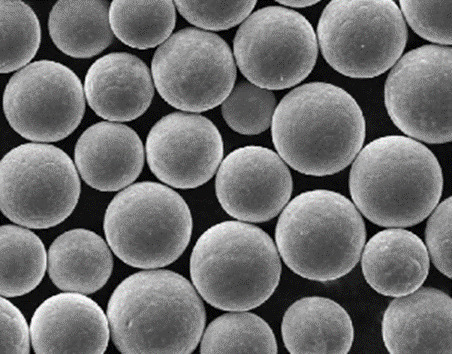
CM247LC powder for DED is the powder form of CM247LC, a cast-derived nickel superalloy developed for high-temperature structural duty, prepared in a particle size range and morphology suitable for directed energy deposition rather than fine-layer powder bed fusion. In the additive manufacturing ecosystem defined by ISO/ASTM 52900 terminology, DED feeds powder into a focused energy source so material is deposited exactly where it is needed, which changes the preferred powder specification compared with laser powder bed fusion.
CM247LC as a Nickel Superalloy Feedstock
CM247LC belongs to the precipitation-strengthened nickel superalloy family. Its chemistry is designed to generate a high volume fraction of gamma-prime precipitates, giving the alloy excellent elevated-temperature strength and creep resistance but also making it more sensitive to thermal cracking than easier AM alloys such as Inconel 718.
That balance is the reason CM247LC remains a specialist material. Engineers do not usually select it for general-purpose corrosion service or lightweight structures; they select it when a component must survive hot gas flow, long dwell times, and severe thermal exposure.
Why DED Uses a Different Powder Philosophy
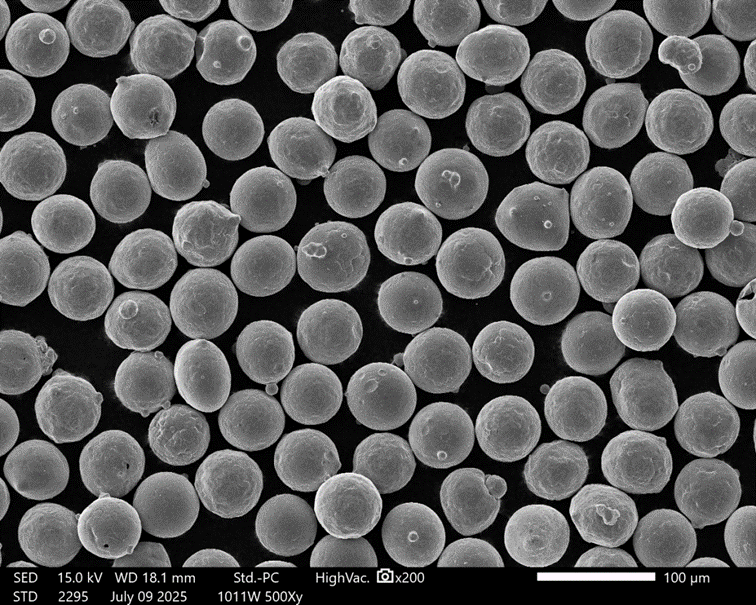
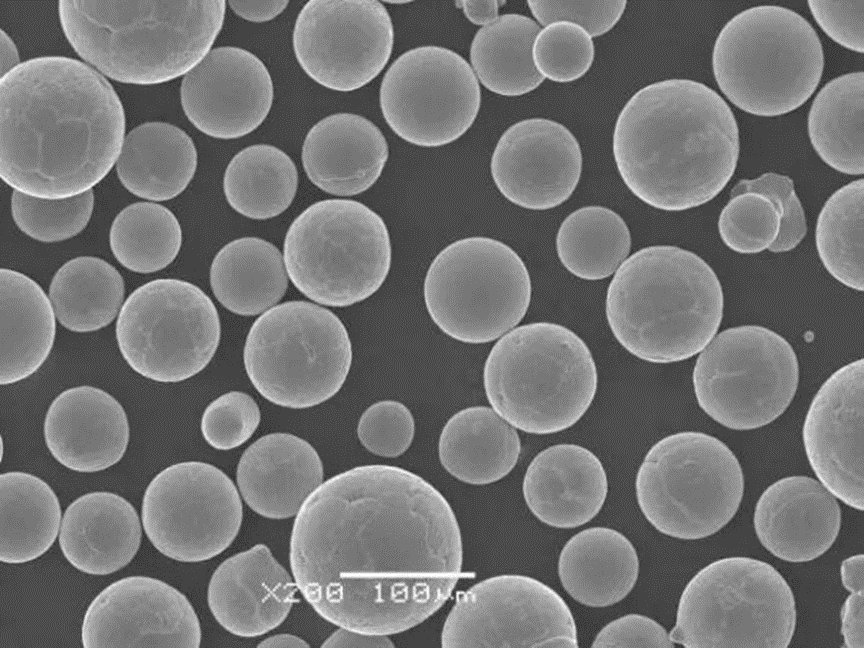
DED systems generally prefer coarser, freer-flowing powder than powder bed fusion systems. Instead of forming thin layers across a build plate, the powder is entrained in a carrier gas and delivered into a melt pool, so stable feed, predictable stream focus, and low satellite content are often more important than achieving the finest possible particle cut.
For CM247LC, this matters because the alloy is already difficult from a metallurgical standpoint. A DED-oriented powder specification aims to reduce process noise by using a controlled spherical morphology, limited fines, and a size range appropriate for nozzles, mass flow stability, and deposition efficiency.
Core Characteristics of CM247LC Powder for DED
The defining features of this material are elevated-temperature capability, oxidation resistance, and suitability for repair or feature addition on high-value components. Compared with fine LPBF powder, DED grades are normally coarser, often with PSD windows such as 45–105 µm or 53–150 µm, depending on nozzle design and laser power.
These grades are especially relevant for turbine blade restoration, shroud repair, seal surface buildup, and hybrid manufacturing workflows. Buyers comparing broader nickel superalloy powder grades often narrow to CM247LC only when the service temperature and creep demands justify the more demanding processing window.
Where CM247LC Fits Among AM Alloys
CM247LC sits above many commonly printed nickel alloys in thermal capability, but below them in ease of processing. That trade-off is well known in superalloy metallurgy and is part of the reason DED can be attractive: the process can offer larger melt pools, slower cooling than LPBF, and practical repair flexibility for parts that are too costly to replace outright.
high-temperature repair performance is therefore the real selection driver. The material exists not because it is universally convenient, but because certain hot-section applications need the service envelope it provides.
Chemical Composition
CM247LC chemistry is built around a nickel matrix strengthened by gamma-prime formers and solid-solution additions. The alloy uses cobalt, tungsten, aluminum, tantalum, titanium, hafnium, and controlled grain-boundary elements to balance creep strength, oxidation resistance, and microstructural stability at temperature.
| Element | Typical Content (wt%) | Practical Range (wt%) | Primary Metallurgical Role |
|---|---|---|---|
| Ni | Balance | Balance | Matrix phase; supports high-temperature phase stability |
| Co | 9.0–9.5 | 8.5–10.0 | Strengthens matrix and influences gamma-prime solvus |
| Cr | 7.8–8.5 | 7.5–8.5 | Improves oxidation and hot-corrosion resistance |
| W | 9.0–10.0 | 8.5–10.5 | Strong solid-solution strengthening; creep resistance |
| Al | 5.3–5.8 | 5.2–5.9 | Main gamma-prime former |
| Ta | 3.0–3.4 | 2.8–3.5 | Gamma-prime strengthening and carbide support |
| Hf | 1.2–1.5 | 1.0–1.5 | Grain-boundary strength and carbide stability |
| Ti | 0.7–1.0 | 0.6–1.1 | Additional gamma-prime formation |
| Mo | 0.4–0.7 | 0.3–0.8 | Supplemental solid-solution strengthening |
| C | 0.07–0.10 | 0.06–0.10 | Carbide formation and grain-boundary control |
| B | 0.01–0.02 | 0.005–0.02 | Grain-boundary cohesion |
| Zr | 0.005–0.02 | 0.003–0.02 | Boundary strengthening and castability support |
Why the Chemistry Suits DED
The DED case for CM247LC starts with service exposure, not convenience. Aluminum, titanium, and tantalum create the gamma-prime network that gives the alloy its hot strength, while tungsten and cobalt reinforce the matrix under long thermal dwell conditions.
That chemistry makes CM247LC valuable in turbine environments, but it also narrows process latitude. Because DED involves repeated reheating of previously deposited material, the alloy’s response to thermal cycling, dilution, and residual stress must be managed carefully.
Role of Grain-Boundary Elements
Carbon, boron, zirconium, and hafnium play a disproportionate role relative to their low weight percentages. They influence carbide distribution, grain-boundary cohesion, and high-temperature structural integrity, especially in service conditions where creep and boundary sliding matter.
For repair applications, those elements are part of why CM247LC can remain attractive even when it is harder to process than more forgiving nickel grades. The alloy was built for demanding thermal service, and the chemistry reflects that design logic.
CM247LC Versus Simpler Nickel Alloys
Compared with Inconel 625 or 718, CM247LC contains a more aggressive strengthening package aimed at hotter service. That usually means stronger performance at temperature, but lower tolerance for process variation, cracking, and thermal stress.
For DED users, chemistry control is therefore as important as PSD and flow. A powder that nominally matches the alloy on paper but drifts in oxygen, carbon, or segregation behavior can create disproportionate downstream risk.
Physical and Mechanical Properties
Published values for CM247LC depend heavily on manufacturing route, heat treatment, cracking level, dilution in repair work, and final microstructure. For DED users, the most realistic approach is to treat consolidated properties as process-dependent typical values rather than universal guaranteed numbers.
| Property | Typical Value | Unit | Test Standard / Basis |
|---|---|---|---|
| Density | 8.5–8.6 | g/cm³ | Nominal alloy value |
| Solidus | 1310–1330 | °C | Typical literature range |
| Liquidus | 1360–1375 | °C | Typical literature range |
| Ultimate Tensile Strength | 900–1250 | MPa | Typical consolidated and heat-treated range |
| Yield Strength | 650–1050 | MPa | Typical room-temperature range |
| Elongation | 3–8 | % | Typical route-dependent range |
| Hardness | 380–450 | HV | Aged or consolidated condition |
| Thermal Conductivity | 10–14 | W/m·K | Approximate room-temperature range |
Property Interpretation for DED Builds
DED parts often differ from cast, wrought, or LPBF microstructures. Cooling rates are lower than LPBF, layer heights are larger, and reheating is more substantial, so grain morphology and segregation patterns can shift significantly depending on toolpath and interpass temperature.
That means property data should be read as a qualified outcome, not an automatic result of buying the powder. The feedstock provides the chemistry platform, but the final tensile strength and ductility depend on how the deposit is built and treated.
CM247LC Powder for DED in Repair Conditions
Repair work introduces another variable: dilution from the substrate. When CM247LC is deposited onto a similar superalloy, the final chemistry in the repaired zone may remain close to target; when the substrate differs, dilution can change cracking behavior, hardness, and local heat-treatment response.
This is one reason process development for repairs is often more application-specific than new-build DED. The same powder can behave differently depending on base metal composition, damage geometry, and the number of remelt cycles in the part.
In DED, alloy selection and repair strategy must be qualified together, because the deposit is inseparable from the substrate.
Why Thermal Capability Matters More Than Peak Ductility
CM247LC is rarely chosen for its room-temperature elongation. It is chosen because it retains strength in hot-section service where easier alloys may lose creep margin or oxidize too quickly over long exposure times.
creep resistance at temperature is therefore the material’s most important performance theme. If the component never sees that level of thermal load, a more printable and less expensive alloy is often the better engineering answer.
Specifications and Available Grades
DED powder specifications are usually written around flow through the feeder, stream stability at the nozzle, chemistry control, and acceptable oxygen content. Because DED systems vary by laser power, nozzle geometry, and carrier gas setup, the most useful commercial approach is to define several supply grades rather than pretend one PSD works for every machine.
| Grade / Reference Type | PSD Range (µm) | Apparent Density (g/cm³) | Tap Density (g/cm³) | Hall Flow (s/50 g) | Oxygen (wt%) | Sphericity / Cross-Reference Note |
|---|---|---|---|---|---|---|
| Fine DED Grade | 45–90 | 4.8–5.3 | 5.4–5.9 | 12–18 | 0.02–0.08 | High sphericity; useful for smaller nozzles and finer beads |
| Standard DED Grade | 45–105 | 4.9–5.4 | 5.5–6.0 | 11–17 | 0.02–0.07 | Common general-purpose DED range for repair and build-up |
| Coarse DED Grade | 53–150 | 5.0–5.5 | 5.6–6.2 | 10–16 | 0.02–0.06 | Higher deposition efficiency in larger nozzle systems |
| Laser Cladding Grade | 75–150 | 5.1–5.6 | 5.7–6.3 | 10–15 | 0.02–0.06 | Optimized for robust feed and broad repair beads |
| Standards Cross-Reference Grade | By purchase spec | By lot | By lot | By lot | By lot | Typically documented with ASTM, ISO, AMS, GB, or DIN reporting practice rather than a single dedicated CM247LC DED standard |
PSD Selection for CM247LC Powder for DED
DED generally needs a coarser particle range than LPBF because the powder must flow through feeders and nozzles without excessive clogging or unstable stream dispersion. The 45–105 µm band is often a practical middle ground for many laser DED systems, while 53–150 µm is more common where higher deposition rates and larger melt pools are preferred.
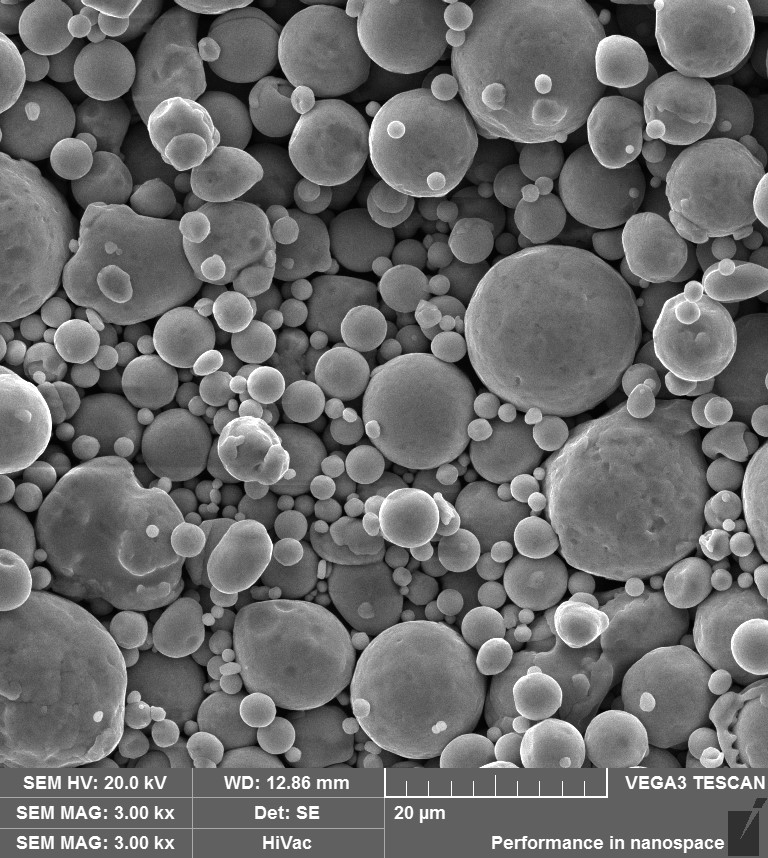
Finer cuts can work in some setups, but excessive fines may raise oxidation sensitivity, worsen flow irregularity, and make powder delivery less predictable. That is especially undesirable in a superalloy already prone to thermal stress issues.
Tolerance Standards and Powder Reporting
There is no single globally dominant CM247LC DED powder specification used across all end markets. In practice, buyers combine internal material requirements with general powder test methods and AM terminology, often referencing the ASTM F42 additive manufacturing committee for standards context and project-specific acceptance plans.
Lot documentation commonly includes chemistry, PSD, apparent density, tap density, Hall flow, oxygen, and morphology review. For high-value repairs, additional checks such as sieve retention, moisture control, and metallographic review of representative deposits may also be used.
Available Grades in a Real Supply Chain
A supplier serving DED, cladding, HIP, and PM should not treat all CM247LC powder as interchangeable. Coarser DED grades may be unsuitable for fine PBF work, while very fine PBF powder may not deliver the same feeder stability or deposition economics in DED.
That is why AM programs often map material grade to process route from the start. Readers comparing adjacent material families can also place CM247LC against broader industrial AM application sectors to decide whether DED repair, net-shape build, or a non-AM route is the better fit.
Manufacturing Process
The way CM247LC powder is produced has a direct effect on morphology, internal porosity, satellite content, and oxygen pickup. Those variables matter in DED because inconsistent powder feed translates quickly into unstable bead geometry and variable metallurgical outcomes.
| Process | Typical Sphericity | Oxygen Pickup Risk | PSD Control | Throughput | Relative Cost | Typical Use Case |
|---|---|---|---|---|---|---|
| Gas Atomization (GA) | High | Low to moderate | Good | High | Medium | Mainstream AM and cladding powder production |
| PREP | Very high | Very low | Good | Low to medium | High | Premium spherical feedstock for critical applications |
| VIGA | High to very high | Low | Good to very good | Medium | Medium-high | Controlled chemistry and cleaner atomized powder |
| EIGA | Very high | Very low | Very good | Medium | High | High-purity powder with minimal contamination risk |
| Plasma Atomization / Specialty Routes | High to very high | Low | Good | Low | High | Niche premium powders where purity and morphology dominate |
Gas Atomization for DED Feedstock
Gas atomization remains the most practical industrial route for many DED powders. It offers the combination of scalable output, reasonable cost, and sufficiently spherical morphology needed for stable feeding in repair and cladding operations.
For CM247LC, GA powder can perform well when particle shape, satellites, and oxygen are controlled tightly. However, high-end repair programs may still specify narrower morphology requirements if nozzle stability and lot-to-lot consistency are critical.
PREP and Other Premium Routes
PREP is widely associated with very round particles and low contamination, qualities that matter when the goal is smooth powder feeding and clean deposition behavior. VIGA and EIGA also support high-purity spherical feedstock, with the added advantage of stronger control over chemistry and contamination pathways.
The trade-off is cost and throughput. Premium routes rarely win on volume economics, but they can make sense when a rejected turbine repair costs far more than the powder premium.
Why Morphology Matters in DED
DED is more forgiving than LPBF in some respects, but it is not indifferent to powder quality. Poor morphology can destabilize mass flow, shift the powder focus, and make bead dimensions less repeatable, especially in long repair passes or complex five-axis motion.
stable powder feeding is therefore one of the most practical reasons to buy a higher-quality CM247LC powder. In DED, flow behavior is not a secondary lab metric; it is part of the deposition system itself.
Process Route Versus Final Deposition Quality
Even premium powder does not guarantee sound deposits. DED results still depend on laser power, stand-off distance, powder feed rate, shielding gas, traverse speed, substrate preheat, and post-deposition heat treatment.
That wider process window is one reason DED remains attractive for repair. It offers flexibility, but it also demands application-specific qualification, especially for a crack-sensitive superalloy such as CM247LC.
Applications by Industry
CM247LC powder for DED is not a universal industrial material. It is most valuable in sectors where component replacement is expensive, thermal exposure is severe, and localized repair or buildup creates a meaningful economic advantage over machining a new part from billet or recasting an entire assembly.
Aerospace Turbine Repair
Aerospace remains the strongest fit. DED can rebuild worn tips, restore seal surfaces, add material to damaged edges, or create localized hot-section repairs on components that would otherwise be scrapped.
In those cases, CM247LC is selected because the repaired region must continue to perform in a very hot environment. The process must be validated carefully, but the potential savings on high-value turbine hardware are significant.
Industrial Gas Turbines and Energy Hardware
Land-based turbines, combustion equipment, and power-generation hot-path components are also relevant. Operators in these sectors often prioritize uptime, refurbishment cycles, and part life extension, making DED a practical route when the deposit can restore geometry without compromising high-temperature performance.
CM247LC fits these jobs better than simpler corrosion-resistant nickel alloys when creep strength and oxidation resistance dominate the failure mode. The powder specification becomes part of the maintenance strategy, not just a purchasing line item.
Oil and Gas and Heavy Industrial Repair
Some oil and gas equipment experiences localized thermal and corrosive loading severe enough to justify a superalloy repair alloy, especially in high-value rotating hardware or burner-adjacent systems. While cobalt or corrosion-driven nickel grades may be more common in many wear applications, CM247LC remains relevant when hot strength is the main design constraint.
Users comparing classes of repair alloys sometimes evaluate cobalt alloy powder families against nickel superalloys to separate wear-dominant problems from heat-dominant ones. That distinction matters more than the AM process label alone.
Tooling, Hybrid Manufacturing, and Feature Addition
DED is also used to add high-temperature features to pre-machined substrates or to build near-net-shape preforms for later machining. In such workflows, CM247LC may be used selectively rather than for an entire component, which improves material efficiency while placing the superalloy only where it delivers value.
This hybrid logic is common in expensive hardware. Instead of using premium alloy everywhere, engineers localize it to the zones that actually see extreme service conditions.
Where Other Materials Make More Sense
CM247LC is not normally the default choice for lightweight automotive parts, standard medical implants, or general structural fabrication. Titanium, aluminum, stainless steel, or easier nickel grades will often offer a better balance of cost, printability, and qualification speed.
For weight-sensitive systems, a broader titanium AM powder portfolio usually aligns better with the engineering target than a dense turbine-class superalloy. The material should be selected for the service environment, not for its prestige.
Comparison with Alternative Materials
DED material selection is always comparative. CM247LC competes not only with other nickel superalloys but also with cobalt-based repair alloys and, in some cases, lower-cost iron-based systems where temperature demand is moderate rather than extreme.
| Material | Density (g/cm³) | Strength Profile | DED Printability | High-Temperature Capability | Corrosion / Oxidation Behavior | Relative Cost |
|---|---|---|---|---|---|---|
| CM247LC powder for DED | 8.5–8.6 | Very high at elevated temperature | Challenging to moderate | Excellent | Strong oxidation and hot-corrosion resistance | High |
| Inconel 718 powder | 8.1–8.2 | High overall structural strength | Good to very good | Good to very good | Good corrosion and oxidation resistance | Medium-high |
| Inconel 625 powder | 8.4–8.5 | Moderate to high | Good | Moderate to good | Excellent corrosion resistance | Medium-high |
| CoCr-based DED powder | 8.3–8.8 | High hardness and wear strength | Good | Moderate to good | Very good wear and corrosion resistance | High |
| Martensitic stainless / Fe-based repair powder | 7.7–7.9 | Moderate | Very good | Moderate | Moderate | Lower |
CM247LC Versus Inconel 718 for DED
Inconel 718 is generally easier to process and qualifies faster in many AM programs. It is a strong choice for structural parts and moderate high-temperature service, but it does not occupy the same hot-section niche as CM247LC when creep resistance at more severe temperatures becomes central.
CM247LC earns its place when service conditions are harsh enough to justify the added processing complexity. If they are not, 718 is often the more rational choice.
CM247LC Versus Inconel 625
Inconel 625 is valued for corrosion performance and manufacturing tolerance. It is often preferred in chemically aggressive environments where ultimate hot-strength requirements are lower than in turbine hardware.
For DED repair, 625 can be easier to deploy. But where the repaired zone must survive sustained thermal exposure, CM247LC remains in a different performance class.
CM247LC Versus Cobalt and Iron-Based Alternatives
Cobalt alloys can outperform nickel superalloys in some wear-dominant, galling, or hot-corrosion niches. Iron-based materials, meanwhile, may offer compelling economics for moderate-temperature repair jobs where extreme thermal capability is unnecessary.
This means material selection should begin with failure mode analysis. Engineers looking across multiple feedstock families, including advanced iron-based powders, usually find that CM247LC wins only when the thermal duty cycle is severe enough to justify it.
When CM247LC Is the Best Fit
CM247LC becomes the right DED powder when the deposit must retain strength and oxidation resistance at temperatures that push more forgiving alloys toward their limits. It is not the cheapest, easiest, or most versatile option, but it can be the most appropriate one for hot-section restoration and high-value superalloy feature addition.
DED repair economics often decide the issue. If extending the life of a critical component offsets the alloy and qualification cost, CM247LC is often worth the complexity.
Our Company
Shanghai Truer Technology Co., Ltd., the company operating am-printing.com, was established in 2009 and created its additive manufacturing business in 2019. Based on the company information provided, Truer integrates 3D printing powder-making equipment and powder supply, with stated capabilities in SEBM equipment, PREP powder-making equipment, and gas atomization, and it supplies spherical metal powders including TiNi, TiTa, TiAl, TiNbZr, CoCrMo, and broader nickel-, cobalt-, titanium-, copper-, aluminum-, and stainless-based categories for SLM, SEBM, DED, laser cladding, powder metallurgy, MIM, HIP, cold and hot spraying, welding, and coating across medical, aerospace, nuclear power, 3C electronics, hand tools, and remote-control vehicle applications. Additional factual company background appears on the corporate information page.
FAQ
Q1. What particle size is best for CM247LC powder for DED?
For many DED systems, 45–105 µm is a practical starting range because it balances feeder stability, nozzle flow, and deposition efficiency. Some setups prefer 53–150 µm for higher throughput or larger melt pools, while smaller nozzles may use narrower cuts. The right answer depends on nozzle geometry, laser power, and target bead width.
Q2. Is CM247LC powder for DED better than CM247LC powder for LPBF?
Neither is universally better; they are optimized for different processes. DED powder is usually coarser and designed for stable powder delivery into a melt pool, while LPBF powder is finer for thin-layer spreading. Using the wrong PSD can reduce process stability even if the chemistry is correct.
Q3. Why is CM247LC considered difficult to print or deposit?
Its high gamma-prime strengthening level gives the alloy outstanding hot strength, but also increases susceptibility to thermal cracking and residual-stress problems. During DED, repeated reheating and substrate dilution add further complexity. That is why qualification must address process parameters and heat treatment, not just powder purchase.
Q4. Can CM247LC powder for DED be used for new parts as well as repairs?
Yes. Although turbine repair is a major use case, the powder can also support near-net-shape builds, hybrid manufacturing, and feature addition on preforms or wrought substrates. The commercial logic is strongest where the part is high value and its service temperature justifies the alloy.
Q5. What quality metrics matter most when buying CM247LC powder for DED?
Chemistry control, PSD, oxygen content, morphology, apparent density, tap density, and flow behavior are all important. In DED, feeder stability and nozzle consistency make coarse-powder flow metrics especially relevant. Buyers should also consider lot traceability and whether the supplier can align powder grade with the intended deposition setup.
Q6. Which industries benefit most from CM247LC powder for DED?
Aerospace turbine repair and industrial gas turbine refurbishment are the strongest fits because they combine severe thermal service with very high component value. Some energy, heavy industrial, and specialized oil and gas repairs can also justify the alloy. It is usually less attractive for lightweight structures, standard implants, or moderate-temperature parts where easier materials perform well enough.