Kurzantwort
Al6061 powder for additive manufacturing is a heat-treatable aluminum-magnesium-silicon feedstock engineered for powder-based manufacturing routes such as laser powder bed fusion, directed energy deposition, and related thermal processes. It is chosen when a project needs low density, good corrosion resistance, familiar post-machining behavior, and a well-known structural aluminum grade rather than the widest possible printing window. In real production, it is best suited to lightweight brackets, housings, tooling, fixtures, and industrial components where balanced properties and established downstream processing matter more than maximum as-built printability.
What Is Al6061 powder for additive manufacturing
Al6061 powder for additive manufacturing is the particulate form of 6061 aluminum alloy, one of the most widely specified precipitation-hardening aluminum grades in engineering. In metallurgical terms, 6061 belongs to the 6xxx series, meaning that magnesium and silicon are the principal alloying elements responsible for strengthening through the formation of magnesium silicide during aging. When this familiar wrought alloy is converted into spherical powder, it becomes suitable for processes that build or coat parts layer by layer rather than shaping solid bar, plate, or extrusion.
The importance of Al6061 in powder form comes from its position in the broader aluminum family. It is not the strongest aluminum used in AM, and it is not always the easiest aluminum to print. Its value lies in its balance. Designers already know 6061 from conventional manufacturing, so when they move into additive workflows, the alloy offers a recognizable combination of low density, moderate strength, corrosion resistance, and good machinability.
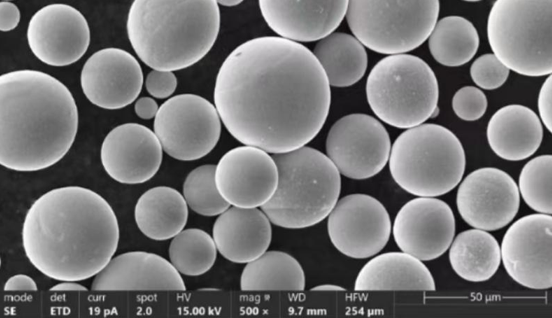
Al6061 powder in the 6xxx alloy family
The 6xxx family is defined by the aluminum-magnesium-silicon system. In conventional metallurgy, these alloys are used extensively for structural extrusions, frames, transport components, and general engineering hardware. For AM users, that history matters because it creates an existing base of design knowledge, corrosion expectations, machining practice, and heat-treatment logic.
Powder-based processing changes the manufacturing route, but not the alloy’s underlying identity. The material is still fundamentally a heat-treatable Al-Mg-Si alloy. What changes is the feedstock format: instead of billets or extrusions, engineers qualify particle size distribution, sphericity, oxygen level, apparent density, tap density, and flow consistency.
Why Al6061 is relevant as an AM powder
Powder form allows 6061 to be used in build processes that require controlled particle delivery and predictable melting. Fine, spherical material is required for recoating in powder bed systems, while somewhat coarser fractions are typically preferred in blown-powder deposition systems. That is why the same alloy may appear in multiple commercial grades depending on the intended process window.
For many users, Al6061 sits between easy-to-process aluminum powders and high-performance specialty alloys. It often appeals when the design target is a lightweight structural part that may need machining, tapping, boring, or surface finishing after printing. Product families such as an aluminum alloy powder catalog help buyers compare whether 6061 is the best fit or whether another aluminum chemistry would offer a more forgiving build envelope.
How Al6061 differs from common AM aluminum alternatives
The most common comparison is with AlSi10Mg. Silicon-rich aluminum powders are typically preferred when the main goal is print robustness in laser powder bed fusion, because they tend to crack less readily and support more forgiving processing. Al6061, by contrast, is often selected because it maps more naturally onto conventional structural aluminum thinking.
This difference is important. In additive manufacturing, the “best” alloy is rarely the one with the single best headline property. It is usually the one that fits the entire manufacturing chain: powder handling, printing, thermal treatment, machining, inspection, and end use.
In metal additive manufacturing, feedstock selection is a process decision as much as a materials decision.
Naming conventions and search terminology
In industry documents, the alloy may be described as 6061 aluminum powder, Al6061 powder, AA6061 powder, or 6061 spherical powder. These labels generally point to the same base chemistry, but procurement documents often add process-specific information such as “LPBF grade,” “DED grade,” or “gas-atomized spherical powder.” Clear naming matters because a nominal alloy designation alone does not define particle shape, cleanliness, or usability in a specific AM machine.
Chemische Zusammensetzung
The chemistry of Al6061 powder for additive manufacturing generally follows the composition window associated with standard 6061 aluminum alloy. However, powder production introduces additional variables that do not exist in bulk wrought product to the same degree, especially surface oxidation, fine-particle segregation, and volatility-related shifts during melting and atomization. For that reason, chemistry must be verified on the final powder lot rather than assumed from the starting melt alone.
| Element | Typical Content (wt%) | Main Metallurgical Role | Functional Effect in AM Powder and Built Parts |
|---|---|---|---|
| Aluminium (Al) | Bilanz | Base matrix | Provides low density, corrosion-resistant oxide film, and good thermal conductivity |
| Magnesium (Mg) | 0.80-1.20 | Primary hardening element with Si | Drives age-hardening response and strongly affects final strength after heat treatment |
| Silizium (Si) | 0.40-0.80 | Forms Mg2Si with Mg | Supports precipitation strengthening and influences melt behavior |
| Kupfer (Cu) | 0.15-0.40 | Secondary strengthening addition | Contributes to strength, though higher levels may slightly reduce corrosion tolerance |
| Chrom (Cr) | 0.04-0.35 | Microstructure control | Helps stabilize grain structure and supports corrosion performance |
| Eisen (Fe) | 0.00-0.70 max | Verbleibende Verunreinigung | Excess may form brittle intermetallics and reduce ductility |
| Mangan (Mn) | 0.00-0.15 max | Minor microstructural modifier | Usually limited, but contributes to overall alloy balance |
| Zink (Zn) | 0.00-0.25 max | Residual element | Kept low to avoid shifting corrosion and hardening behavior |
| Titan (Ti) | 0.00-0.15 max | Grain refinement aid | Can assist solidification control at low levels |
The magnesium-silicon pair in Al6061 powder
Magnesium and silicon are the defining alloying pair in 6061. Their controlled relationship determines how effectively the alloy can be precipitation hardened during aging. In additive manufacturing, this is especially significant because build thermal cycles do not necessarily produce the same precipitation state as conventional wrought tempers.
For that reason, printed parts are often evaluated in a post-processed condition rather than only as-built. A powder batch that drifts high or low in magnesium can shift strength response, so chemistry control is not just about meeting a nominal composition range; it is about maintaining predictable heat-treatment behavior.
Impurities and why they matter in additive manufacturing powder
Residual elements such as iron and zinc are normally tightly controlled. Iron is especially important because excessive Fe can promote intermetallic phases that are harder and more brittle than the surrounding aluminum matrix. In AM, rapid solidification can refine microstructure, but it does not eliminate the need to control unwanted phases.
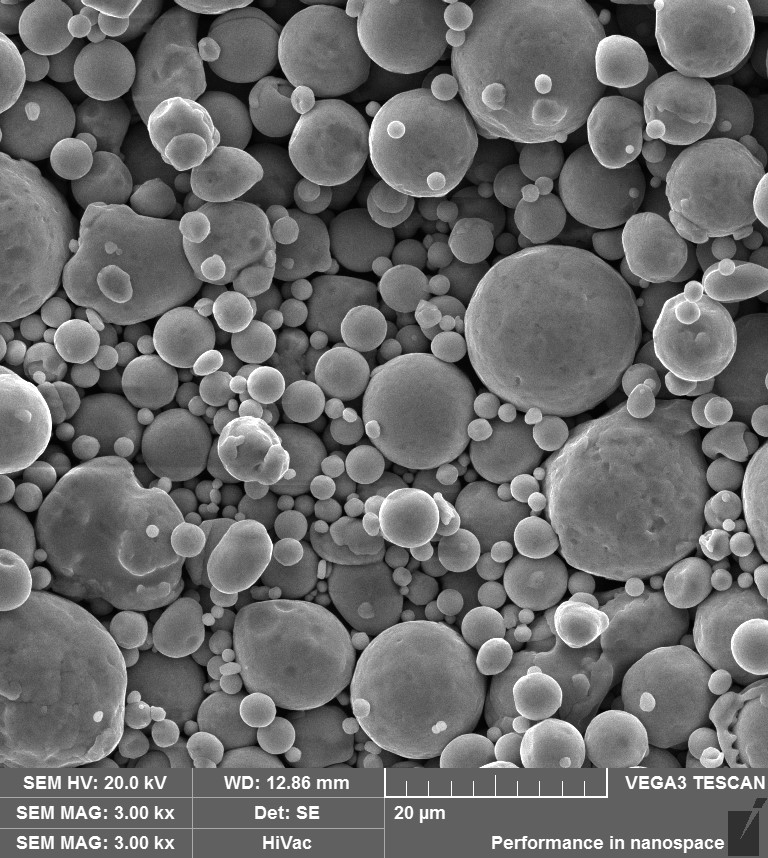
Surface oxygen is another critical variable even though it is not part of the nominal alloy composition table. Every aluminum particle carries an oxide film, and that film becomes more influential as particle size decreases because surface area rises sharply. In powder qualification, oxygen is often treated as a critical cleanliness parameter alongside the base alloy chemistry.
Chemistry versus printability
Meeting the 6061 chemistry window does not guarantee easy printing. A powder can be chemically compliant yet still perform poorly if it contains too many satellites, too broad a PSD, or too much surface oxidation. That is one reason engineers increasingly use terminology consistent with ISO/ASTM 52900 additive manufacturing definitions, which frame feedstock characteristics as process-critical variables rather than secondary procurement details.
Physikalische und mechanische Eigenschaften
The physical and mechanical properties of Al6061 powder for additive manufacturing have to be interpreted with care because published values may refer to different material states. Powder properties govern feeding and spreading, while consolidated properties govern service performance. In practice, the final numbers achieved in a printed component depend on build orientation, porosity level, machine parameters, thermal history, and post-build heat treatment.
| Eigentum | Typischer Wert | Einheit | Test Standard or Condition |
|---|---|---|---|
| Solid density | 2.70 | g/cm³ | Typical room-temperature alloy value |
| Schmelzbereich | 582-652 | °C | Typical engineering reference range |
| Ultimate tensile strength | 260-340 | MPa | Typical heat-treated AM or wrought-comparable condition |
| Yield strength (0.2% offset) | 220-280 | MPa | Typical aged structural condition |
| Dehnung bei Bruch | 6-17 | % | Strongly process- and orientation-dependent |
| Härte | 80-100 | HB | Typical aged condition |
| Elastizitätsmodul | 68-70 | GPa | Typischer Wert bei Raumtemperatur |
| Wärmeleitfähigkeit | 150-170 | W/m-K | Condition-dependent engineering range |
| Koeffizient der thermischen Ausdehnung | 23-24 | µm/m·K | Approximate ambient-to-moderate temperature range |
Density and specific performance
One of the clearest reasons to use Al6061 powder for additive manufacturing is low mass. With a density around 2.70 g/cm³, the alloy is dramatically lighter than stainless steels, cobalt alloys, or nickel superalloys. That makes it attractive for brackets, housings, fixtures, covers, and mobile-system components where reducing inertia can be just as valuable as reducing total weight.
The density advantage becomes even more relevant in topology-optimized parts. AM often removes material from low-stress regions, and aluminum compounds that benefit by providing a light base material before optimization even begins.
Strength, heat treatment, and realistic expectations
The strength of Al6061 is highly dependent on condition. In conventional wrought product, 6061 is commonly used in T6-type tempers. In AM, the thermal path is different, so printed parts often require stress relief and, where appropriate, solution treatment and aging to approach target structural values.
That distinction matters because engineers sometimes compare as-built AM data with wrought handbook values without considering the metallurgical state. Al6061 can achieve useful strength, but it is generally not chosen for the highest-strength aluminum applications. It is chosen for a practical balance of properties combined with light weight and process familiarity.
Hardness, conductivity, and corrosion behavior
Hardness levels are sufficient for many structural and tooling-related uses, especially where wear is limited or can be addressed by design. The alloy also retains good thermal conductivity compared with titanium and most steels, which supports use in housings, fixturing, electronics-adjacent hardware, and lightweight thermal structures.
Corrosion resistance is another reason 6061 remains relevant. Its natural oxide layer provides solid performance in many industrial and atmospheric environments. However, it is still an aluminum alloy, so aggressive chloride-rich or galvanically unfavorable environments may require protective finishing or a different material selection.
Why published numbers vary in AM data sheets
Mechanical results for AM-built 6061 often show a wider spread than users expect. This does not necessarily mean the alloy is unreliable; it usually means the process window is narrower and more sensitive than for silicon-rich castable AM aluminum grades. That is why qualification programs should be based on part-specific builds, not only on generic property tables.
For comparison against reference property databases, users sometimes consult sources such as the NIST materials data gateway to align terminology and test practice, even though machine-specific validation remains essential.
Technische Daten und verfügbare Güteklassen
Specifications for Al6061 powder for additive manufacturing usually combine chemistry requirements with powder morphology and handling metrics. Most procurement documents define more than the alloy name because the end-use process dictates what “good” powder looks like. A fine, highly spherical LPBF powder and a coarser DED powder may share the same alloy chemistry while functioning very differently in production.
| Grade or Reference Type | Typischer PSD-Bereich | Scheinbare Dichte | Zapfstellendichte | Hall-Strömung | Sauerstoffgehalt | Sphericity or Morphology | Standards or Cross-Reference |
|---|---|---|---|---|---|---|---|
| Fine LPBF grade | 15-45 µm | 1.35-1.55 g/cm³ | 1.55-1.75 g/cm³ | 18-28 s/50 g* | ≤0.20 wt% typical | High sphericity, low satellites | Internal AM grade aligned to 6061 chemistry |
| Standard LPBF grade | 15-53 µm | 1.40-1.60 g/cm³ | 1.60-1.80 g/cm³ | 17-26 s/50 g* | ≤0.20 wt% typical | Spherical and screened for recoating stability | Common powder bed supply range |
| DED grade | 45-105 µm | 1.45-1.65 g/cm³ | 1.65-1.85 g/cm³ | 15-24 s/50 g* | ≤0.22 wt% typical | Free-flowing spherical powder | Directed energy deposition feedstock |
| Cladding or spray grade | 53–150 µm | 1.50-1.70 g/cm³ | 1.70-1.90 g/cm³ | 14-22 s/50 g* | ≤0.25 wt% typical | Coarser spherical distribution | Laser cladding and thermal spray routes |
| Standards reference row | - | - | - | - | Controlled by lot | Verified by microscopy | Chemistry often cross-checked to 6061 requirements and internal QA |
| Documentation row | - | - | - | - | Reported per batch | Morphology documented | Customer specs may cite ASTM, ISO, AMS, GB, or DIN frameworks |
*Very fine aluminum powders may show method-sensitive flow results; alternative flow characterization is also common in advanced powder labs.
Particle size distribution for Al6061 AM powder
Particle size distribution is one of the most consequential specifications because it affects spreadability, energy absorption, packing behavior, and final density. Fine cuts such as 15-45 µm are often preferred for thin-layer laser powder bed fusion. Coarser distributions such as 45-105 µm generally suit powder-fed deposition better because they flow well through nozzles and tolerate thicker deposition streams.
PSD is not an isolated variable. It interacts with the recoater type, layer thickness, laser spot size, and shielding-gas strategy. A distribution that works well on one platform may need adjustment on another to maintain stable layer formation.
Flowability and oxygen control in spherical powder
Flowability is commonly reported through Hall flow or related methods, but users should interpret those figures carefully for fine aluminum powders. In some cases, highly fine fractions do not behave like denser steel powders under standard flow funnels, so complementary characterization may be necessary.
Oxygen control is equally important. Aluminum powders naturally oxidize, but excessive oxygen or moisture exposure can change melting behavior and reduce process consistency. For reusable feedstock, storage discipline and sieving practice become part of the effective specification, not just post-delivery handling.
Standards logic and cross-reference practice
There is no single universal AM standard that fully defines Al6061 powder across all processes, so procurement often uses a layered approach. Chemistry may be based on 6061 alloy norms, particle testing may follow internal methods or general powder standards, and AM terminology may reference ASTM additive manufacturing standards where relevant. In practice, customers usually qualify a supplier’s lot against their own machine and part requirements rather than treating standards alone as sufficient proof of performance.
Herstellungsprozess
The powder-making route strongly influences whether Al6061 performs like premium AM feedstock or like general-purpose metal powder. For aluminum alloys, atomization quality is especially important because the material is reactive at high surface area and can be sensitive to oxygen pickup, irregular morphology, and residual satellites. The manufacturing route therefore affects not only appearance, but also layer behavior, powder reuse, and final part quality.
| Process Route | Basic Principle | Sphärizität | Oxygen Pickup Risk | PSD-Steuerung | Durchsatz | Relative Kosten | Typical Relevance to Al6061 |
|---|---|---|---|---|---|---|---|
| Gaszerstäubung (GA) | Inert gas breaks up a molten metal stream into droplets | Gut bis sehr gut | Low with proper inert control | Sehr gut | Hoch | Mäßig | Main commercial route for AM-grade Al6061 |
| VIGA | Vacuum induction melting followed by gas atomization | Sehr gut | Niedrig | Sehr gut | Mittel bis hoch | Mäßig bis hoch | Useful where melt cleanliness and atmosphere control are emphasized |
| PREP | Plasma melts a rotating electrode to eject droplets | Ausgezeichnet | Sehr niedrig | Gut | Mittel | Hoch | Technically attractive for premium spherical powder, less common for routine 6061 |
| EIGA | Electrode induction melting with gas atomization | Very good to excellent | Sehr niedrig | Gut bis sehr gut | Mittel | Hoch | Chosen where contamination control is critical |
| Wasserzerstäubung | Water jets atomize molten metal | Poor to fair for AM | Hoch | Gut | Hoch | Niedrig | Generally unsuitable for high-end spherical AM feedstock |
Gas atomization as the main commercial route
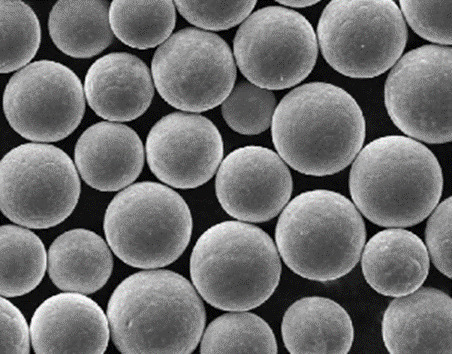
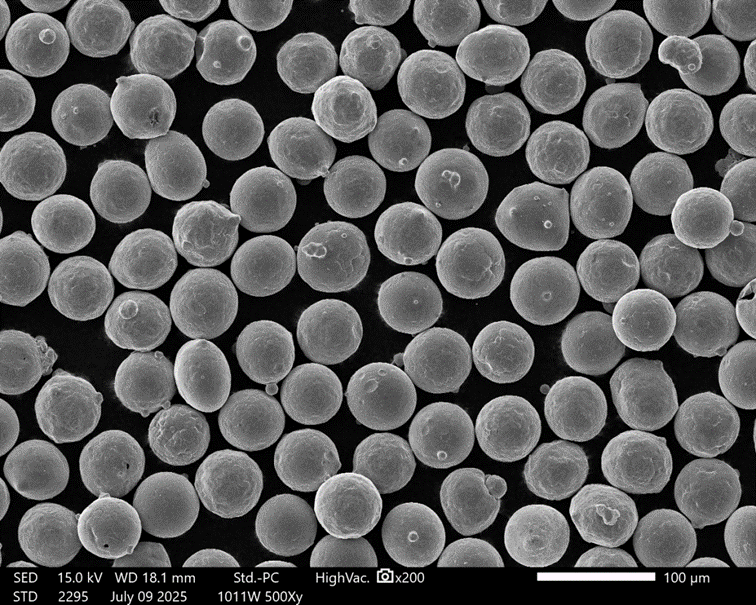
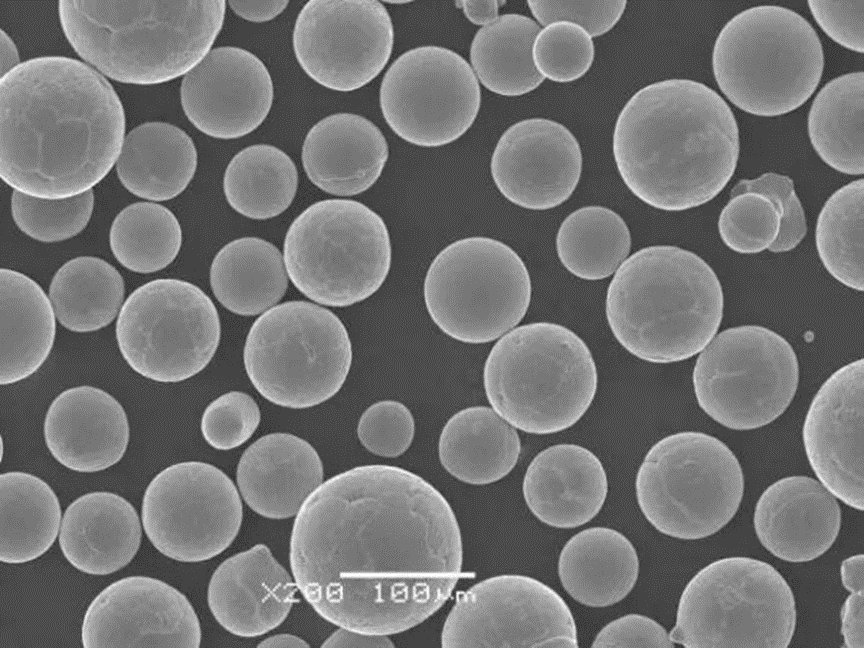
Gas atomization is the dominant manufacturing method for Al6061 powder used in AM. In this route, molten alloy is poured through a nozzle and disintegrated by high-velocity inert gas, typically under tightly controlled atmosphere conditions. The droplets cool rapidly, forming relatively spherical particles that are later screened into usable size classes.
Its main advantage is the combination of scalability, repeatability, and commercially realistic cost. For Al6061 specifically, careful control of the melt and atomization atmosphere helps preserve chemistry and limit oxidation, which is critical for fine fractions used in powder bed systems.
PREP and premium spherical powder routes
PREP, or Plasma Rotating Electrode Process, creates powder from a rotating electrode rather than a conventional molten stream. This often produces exceptionally spherical particles with low contamination risk, making it attractive for reactive and high-value alloys. For Al6061, PREP is less common than gas atomization in routine commercial supply, but it is still relevant when discussing premium morphology and cleanliness.
VIGA and EIGA sit between mainstream and premium production approaches. By controlling the melt environment more tightly, they can reduce contamination and improve lot consistency. Those benefits must be weighed against cost and throughput, especially in applications where 6061 is selected partly because it is a practical, broadly used engineering alloy.
Post-atomization classification and handling
High-quality powder production does not end when the droplets solidify. The material must be sieved to remove oversized particles and fines, classified into the target PSD, checked for satellites and internal porosity, and packaged to protect it from moisture and contamination. These downstream steps have a direct impact on how the powder behaves in the machine.
For fine aluminum powder, packaging integrity is especially important. Surface condition can change during storage and transport if the powder is not protected effectively, which is why delivery format and handling instructions are part of serious technical evaluation.
Manufacturing capability in broader AM ecosystems
Powder producers that also work across multiple materials often compare process choices according to application rather than alloy family alone. For example, users evaluating Al6061 for lightweight structures may simultaneously compare more temperature-resistant nickel superalloy powders or specialty deposition feedstocks used in harsher environments. That broader context helps clarify that the ideal powder-making route depends on the final use case, not just on alloy tradition.
Anwendungen nach Branche
Al6061 powder for additive manufacturing is best understood as a practical lightweight structural material. It is used where lower density, decent strength, corrosion resistance, and secondary machining compatibility deliver value. It is not the universal solution for every metal AM application, but it fills an important space between highly printable casting-style aluminum powders and heavier structural alloys.
Aerospace and lightweight transport structures
In aerospace and adjacent transport sectors, Al6061 is most appropriate for secondary structures, mounting hardware, housings, covers, brackets, fixture components, and custom tooling. These are the kinds of parts where low mass matters, but the most extreme high-temperature capability is not required.
The alloy can also be useful in prototyping and bridge production. When engineers need to assess fit, function, and assembly behavior in a material with credible structural relevance, Al6061 is often more informative than a generic polymer or a much denser steel alternative.
Automotive, robotics, and mobility hardware
Automotive and robotics users often value the alloy for reducing inertia in moving systems. Mounts, frames, sensor housings, custom jigs, and low-volume brackets are typical examples. Because printed parts frequently require drilling, tapping, or finish machining, the familiarity of 6061 with standard shop practice is a real operational advantage.
This is where balanced lightweight performance becomes more important than peak strength alone. A component that is easy to machine, light to handle, and sufficiently strong may outperform a theoretically stronger but heavier or more difficult alternative.
Electronics, tooling, and manufacturing support
In electronics manufacturing and industrial equipment, Al6061 powder may be used for housings, carriers, structural thermal components, and production aids. Its conductivity is not comparable to copper for highly demanding electrical or heat-transfer functions, but it is often adequate for mixed structural-thermal roles.
Where thermal or electrical performance becomes the primary design driver, engineers frequently compare it with copper-based alloy powders instead of treating all nonferrous powders as interchangeable. The right comparison depends on whether the component is fundamentally a structure, a conductor, or both.
Energy, oil and gas, and general industrial use
In energy systems and general industrial equipment, Al6061 can serve in instrumentation mounts, covers, enclosures, support hardware, and specialized tools. It is less suited to prolonged high-temperature service or the harshest corrosive environments, but it can be effective where mass reduction simplifies installation or operation.
Where Al6061 is not usually the first choice
Medical implants are not a standard target application for this alloy, and severe wear, high chloride exposure, or hot-section service generally push the material outside its strongest use case. In those situations, harder, more corrosion-resistant, or more temperature-tolerant systems become preferable. Users comparing broader application pathways often review an industrial AM application overview to understand how process routes and end industries influence powder choice across material families.
Vergleich mit alternativen Materialien
Material selection in AM is inherently comparative. Engineers do not simply ask whether Al6061 works; they ask whether it is a better choice than AlSi10Mg, 7075 aluminum, titanium, or stainless steel for a given geometry, build strategy, and service condition. The following comparison frames Al6061 in that decision context.
| Material | Dichte (g/cm³) | Typisches Leistungsniveau | Relative Printability | Korrosionsbeständigkeit | Relative Kosten | Wärmeleitfähigkeit | Optimaler Anwendungsfall |
|---|---|---|---|---|---|---|---|
| Al6061 powder for additive manufacturing | 2.70 | Moderate to high after heat treatment | Mäßig | Gut | Mäßig | Hoch | Lightweight structural parts with familiar aluminum behavior |
| AlSi10Mg-Pulver | 2.67 | Mäßig bis hoch | Sehr gut | Gut | Mäßig | Mäßig | General-purpose aluminum LPBF production |
| 7075 aluminum powder | 2.81 | Hoch | Difficult to moderate | Mäßig | Mäßig bis hoch | Mäßig | Higher-strength lightweight parts with tighter process control |
| Ti-6Al-4V-Pulver | 4.43 | Hohe spezifische Festigkeit | Gut bis sehr gut | Sehr gut | Hoch | Gering bis mäßig | Aerospace and premium structural applications |
| 316L-Edelstahlpulver | 7.90-8.00 | Mäßig | Ausgezeichnet | Sehr gut | Mäßig | Niedrig | Corrosion-resistant industrial parts where weight is secondary |
Al6061 versus AlSi10Mg
This is usually the first comparison because both are aluminum AM materials intended for lightweight parts. AlSi10Mg generally offers a wider processing window and better print robustness in laser powder bed fusion, which explains its popularity. Al6061 is more compelling when design teams want an alloy closely associated with conventional structural aluminum engineering.
Al6061 versus 7075 aluminum powder
7075 promises higher strength, but it also tends to be less forgiving in corrosion balance and process handling. Al6061 often wins when the part must combine reasonable strength with broader manufacturability and more familiar general-purpose behavior.
Al6061 versus titanium and stainless steel
Titanium offers excellent specific strength and corrosion resistance, but at significantly higher material cost and density than aluminum. Stainless steel is easy to print and broadly corrosion resistant, yet it imposes a major weight penalty. Process-friendly structural familiarity is where Al6061 maintains its niche: it gives users a lightweight metallic option that still feels close to mainstream engineering practice rather than to an exotic material system.
Unser Unternehmen
Shanghai Truer Technology Co., Ltd., which operates am-printing.com, was established in 2009 and launched its additive manufacturing business in 2019. According to the company’s published profile, its activities include integrating powder-making equipment and services with spherical metal powders for additive manufacturing and related processes, with core technologies spanning Selective Electron Beam Melting equipment, Plasma Rotating Electrode Process equipment, and Gas Atomization where relevant. Its portfolio includes TiNi, TiTa, TiAl, TiNbZr, CoCrMo, and nickel-, cobalt-, titanium-, copper-, aluminum-, and stainless steel powders for SLM, SEBM, DED, laser cladding, powder metallurgy, MIM, HIP, cold or hot spraying, welding, and coating across industries such as 3C electronics, hand tools, remote-control cars, medical, aerospace, and nuclear power; additional corporate details are provided on the company background page.
FAQ
Q1. Is Al6061 powder for additive manufacturing easy to print?
Not usually in the same way that AlSi10Mg is considered easy to print. Al6061 can be more sensitive to cracking, oxide effects, and parameter selection, so successful builds typically depend on tighter process optimization and stronger feedstock control.
Q2. What particle size is commonly used for Al6061 powder in metal 3D printing?
For laser powder bed fusion, common commercial ranges are 15-45 µm and 15-53 µm. For directed energy deposition or cladding, coarser fractions such as 45-105 µm or 53-150 µm are more typical because they feed more reliably through powder-delivery systems.
Q3. Why is spherical Al6061 powder preferred for additive manufacturing?
Spherical particles generally spread better, flow more consistently, and pack more uniformly than irregular particles. That improves recoating stability, powder feeding behavior, and the likelihood of producing dense, repeatable parts.
Q4. Can Al6061 powder for additive manufacturing be heat treated after printing?
Yes, and in many structural applications it should be. Stress relief, solution treatment where appropriate, and aging are used to tune final strength and dimensional stability, although the exact cycle depends on the printed condition and the property target.
Q5. How does Al6061 compare with AlSi10Mg for additive manufacturing projects?
AlSi10Mg is usually selected when printability and process robustness are the first priorities. Al6061 is more attractive when the user wants a recognizable structural aluminum grade with familiar machining behavior, good corrosion resistance, and a conventional engineering pedigree.
Q6. What should buyers verify before qualifying Al6061 powder for additive manufacturing?
They should verify chemistry, particle size distribution, apparent density, tap density, flow behavior, oxygen level, sphericity, and packaging integrity, not just the nominal alloy name. Machine-specific build trials, reuse strategy, and post-processing validation are also essential because final performance depends on the interaction between powder quality and the actual AM process.