Kurzantwort
7050 aluminium powder is a high-strength Al-Zn-Mg-Cu alloy powder adapted from the well-known 7050 wrought aerospace grade for additive manufacturing and other powder-based processes. It is chosen when engineers want a lightweight alloy with strong static strength, good fracture toughness, and better stress-corrosion performance than some earlier 7xxx alloys. The trade-off is that 7050 is more difficult to process than mainstream AM grades such as AlSi10Mg, so powder quality, oxygen control, and crack-management strategy are critical to achieving consistent results.
What Is 7050 aluminium powder
7050 aluminium powder is the powder form of 7050, a high-strength 7xxx-series alloy originally developed for aerospace plate, forgings, and structural components that require a demanding balance of strength, toughness, and resistance to stress-corrosion cracking. In conventional metallurgy, 7050 is best known as a heat-treatable aluminium-zinc-magnesium-copper alloy used in heavily loaded airframe sections. As a powder, it becomes relevant to additive manufacturing, laser cladding, powder metallurgy, and advanced repair workflows where the same performance logic applies.
The alloy belongs to the broader 7000-series aluminium family, where zinc is the main alloying element and magnesium works with zinc to form strengthening precipitates. Copper is also added to raise achievable strength, while zirconium helps control recrystallization and grain structure. This metallurgical architecture is why 7050 sits above many cast-oriented aluminium powders in peak mechanical performance, but it is also why it can be less forgiving in fusion-based AM than silicon-rich aluminium feedstocks.
7050 aluminium powder in the AM materials landscape
In metal AM, 7050 occupies a specialized middle ground. It is far lighter than nickel or cobalt superalloys, yet stronger than many common aluminium casting alloys after proper heat treatment. Engineers evaluating lightweight structural parts often compare it with AlSi10Mg, Scalmalloy-type alloys, and 7075, especially where aerospace-driven property targets matter more than simple printability.
Unlike AlSi10Mg, which was widely adopted because its silicon content improves fluidity and lowers crack tendency, 7050 comes from a wrought-alloy design philosophy. That means it was optimized first for service properties in wrought tempers rather than for melt-pool stability in a powder bed. The distinction matters because a strong wrought alloy does not automatically become an easy AM alloy.
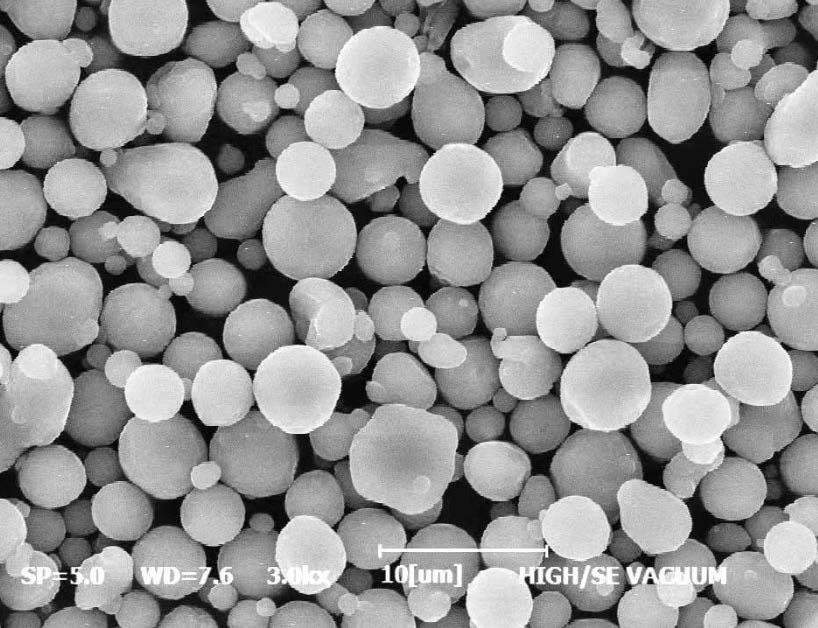
Why 7050 aluminium powder exists
The reason 7050 exists at all is the long-standing aerospace need for aluminium alloys that combine high strength with better fracture toughness and improved resistance to stress-corrosion cracking in thick sections. As aerospace manufacturing evolves, similar demands now appear in additive workflows for lightweight brackets, housings, fixtures, low-volume flight hardware, and near-net-shape preforms. Powder routes can reduce machining waste, enable geometry consolidation, and support repair or hybrid manufacturing, provided the material can be processed without excessive defects.
Distinguishing features of 7050 aluminium AM powder
From a metallurgical standpoint, 7050 is defined by precipitation hardening. Its key strengthening phases form during solution treatment, quenching, and aging, and that means final properties depend heavily on post-processing rather than on as-built condition alone. For AM users, this creates both opportunity and complexity: excellent strength is possible, but only if the powder, build parameters, and heat treatment are aligned.
In high-strength aluminium AM, the alloy choice is often a compromise between maximum mechanical performance and minimum processing difficulty.
Readers looking across related lightweight feedstocks often compare 7050 with the broader aluminium alloy powder range, where silicon-rich, copper-bearing, and high-strength wrought-derived grades serve very different use cases.
Chemische Zusammensetzung
7050 is a tightly balanced Al-Zn-Mg-Cu alloy with small zirconium additions. The nominal composition is engineered to achieve strong precipitation hardening while maintaining useful toughness and improved resistance to environmentally assisted cracking relative to older high-strength grades. In powder form, chemistry control matters not only for final properties but also for oxidation behavior, powder storage stability, and melt-pool response.
Typical composition of 7050 aluminium powder
| Element | Typical wt% | Rolle in der Metallurgie | AM Relevanz |
|---|---|---|---|
| Al | Bilanz | Matrix metal; low density and good thermal conductivity | Governs lightweight performance and thermal behavior during melting |
| Zn | 5.7–6.7 | Primary strengthening element in 7xxx alloys | Drives high age-hardening response but can increase hot-cracking tendency |
| Mg | 1.9–2.6 | Works with Zn to form strengthening precipitates | Essential for strength development after heat treatment |
| Cu | 2.0–2.6 | Raises strength and hardenability | Improves peak strength but can reduce corrosion tolerance if not properly treated |
| Zr | 0.08–0.15 | Recrystallization control and grain refinement | Helps microstructural stability in thermal cycles |
| Fe | ≤0.15 | Verbleibende Verunreinigung | Excess can form brittle intermetallics and reduce toughness |
| Si | ≤0.12 | Residual impurity in wrought-grade chemistry | Lower than cast alloys; limited help for fluidity, so AM processability is harder |
| Mn | ≤0,10 | Minor residual or supplemental control | Can influence dispersoid formation in small amounts |
| Cr | ≤0,04 | Usually restricted in 7050 | Excess may alter corrosion and microstructural response |
| Ti | ≤0.06 | Grain-refining residual or addition | Can influence solidification behavior in some melt histories |
| Others, each / total | ≤0.05 / ≤0.15 | Impurity control | Critical to supplier qualification and lot consistency |
The most important feature of the chemistry is the combination of zinc, magnesium, and copper. These three elements generate the age-hardening response that gives 7050 its reputation for structural strength. By contrast, the very low silicon content distinguishes it from cast-friendly aluminium powders and explains why 7050 generally demands more careful AM parameter development.
Role of zinc, magnesium, and copper in 7050 aluminium powder
Zinc is the dominant alloying element, but it does not work alone. Magnesium combines with zinc to support precipitate formation, while copper boosts achievable strength and shifts the precipitation behavior during aging. This three-element balance is the core reason 7050 can deliver a strong strength-to-weight ratio after heat treatment.
The downside is that a chemistry optimized for strength is not automatically optimized for weldability or crack resistance. That is why 7050 powder, like 7075 powder, is often described as more challenging than AlSi10Mg or other silicon-rich aluminium AM powders.
Impurity control and powder cleanliness
For powder feedstock, low oxygen, limited moisture exposure, and tight impurity control are essential. Aluminium powders form stable oxide films very quickly, and those oxides can affect flow, fusion quality, and final defect content. In a high-strength alloy such as 7050, even modest contamination can magnify porosity or lack-of-fusion sensitivity because the processing window is narrower than it is for easier-printing aluminium grades.
The background metallurgy of the 7xxx family is summarized in the 7000 series aluminium alloy overview, which helps explain why these alloys are valued in aircraft structures but remain comparatively demanding in additive manufacturing.
Physikalische und mechanische Eigenschaften
7050 is selected primarily for structural performance. Its density remains close to that of other aluminium alloys, but its achievable strength after full heat treatment is much higher than that of common casting-focused AM powders. Published values vary by temper, product form, orientation, and thermal history, so powder users should treat all figures as typical engineering ranges rather than as universal guarantees.
Typical properties of 7050 aluminium powder parts
| Eigentum | Typischer Wert | Einheit | Prüfnorm / Prüfbedingungen |
|---|---|---|---|
| Dichte | 2.80–2.85 | g/cm³ | Typical nominal alloy density |
| Solidustemperatur | 475–490 | °C | Typischer Legierungsbereich |
| Liquidustemperatur | 630–640 | °C | Typischer Legierungsbereich |
| Endgültige Zugfestigkeit | 510–570 | MPa | Typical heat-treated wrought-equivalent target range |
| Streckgrenze (0.2%) | 440–505 | MPa | Typical heat-treated wrought-equivalent target range |
| Dehnung | 7–13 | % | Typical, condition-dependent |
| Härte | 150–180 | HB | Typical aged condition |
| Wärmeleitfähigkeit | 125–155 | W/m-K | Typischer Raumtemperaturbereich |
| Elastischer Modul | 71–73 | GPa | Typical aluminium alloy range |
The density advantage is straightforward: 7050 delivers high structural strength at a density of only about one-third that of nickel superalloys and far below most steels. For lightweight engineering, that is a major reason the alloy remains attractive despite its processing difficulty. Where the design is weight-driven rather than temperature-driven, the alloy can offer a compelling performance envelope.
Strength and toughness profile of 7050 aluminium powder
In service, 7050 is known for high tensile and yield strength combined with good fracture toughness relative to several legacy high-strength aluminium grades. Those attributes explain its use in heavily loaded aerospace structures such as bulkheads, wing fittings, and thick plate applications in wrought form. For powder-derived components, comparable property levels are only realistic after the right consolidation and heat-treatment sequence.
A crucial point is that as-built AM strength is not the whole story. Solution treatment, quench control, and aging can shift the final result dramatically because precipitation hardening is the main strengthening mechanism. This is why material qualification for 7050 often focuses on the full process chain, not just on powder chemistry.
Thermal behavior and printing implications
Aluminium’s high thermal conductivity helps dissipate heat quickly, which can reduce some thermal accumulation issues seen in titanium and nickel alloys. However, rapid heat extraction also steepens thermal gradients in powder bed fusion, and that can contribute to residual stress, distortion, and cracking in high-strength wrought-type alloys. In addition, the reflective nature of aluminium makes laser energy coupling less forgiving than it is in darker, denser alloys.
The practical implication is that hot-cracking risk must be evaluated along with target strength. Even when density is high and surface finish looks acceptable, a 7xxx alloy can contain solidification defects or microcracks if the process window is not tightly controlled. This challenge is one reason many AM programs still default to AlSi10Mg for general use.
Why property data for 7050 AM builds vary
Property scatter in 7050 powder parts usually comes from four sources: powder morphology, build parameters, post-processing, and microstructural anisotropy. Small changes in oxygen, particle size distribution, scan strategy, or quench rate can alter porosity, residual stress, and precipitation response. As a result, the same nominal chemistry may produce very different mechanical outcomes across machines or suppliers.
Technische Daten und verfügbare Güteklassen
Commercial 7050 powder is normally specified by chemistry, particle size distribution, morphology, flow behavior, contamination limits, and intended process route. Because 7050 is not as standardized in AM commerce as AlSi10Mg or Ti-6Al-4V, procurement often relies on supplier-specific grade designations supported by conventional powder test methods and additive manufacturing terminology. In that context, the ISO/ASTM 52900 terminology standard is useful for aligning definitions across powder, machine, and part qualification documents.
Typical 7050 aluminium powder supply grades
| Supply Grade / Condition | PSD-Bereich | Scheinbare Dichte | Zapfstellendichte | Hall-Strömung | Oxygen / Sphericity / Cross-Reference |
|---|---|---|---|---|---|
| 7050-A15-45 | 15-45 µm | 1.45–1.70 g/cm³ | 1.65–1.95 g/cm³ | 20–32 s/50 g | O typically ≤0.20 wt%; high sphericity; fine PBF fraction |
| 7050-A15-53 | 15-53 µm | 1.50–1.75 g/cm³ | 1.70–2.00 g/cm³ | 19–30 s/50 g | O typically ≤0.20 wt%; common laser AM cut |
| 7050-A45-105 | 45-105 µm | 1.55–1.80 g/cm³ | 1.75–2.05 g/cm³ | 17–27 s/50 g | O typically ≤0.20 wt%; suitable for DED and cladding |
| 7050-A53-150 | 53-150 µm | 1.60–1.85 g/cm³ | 1.80–2.10 g/cm³ | 16–25 s/50 g | O typically ≤0.20 wt%; coarse fraction for spray or PM use |
| Test / Standards Context | - | ASTM B212 typical | ASTM B527 typical | ASTM B213 typical | Chemistry often aligned to UNS A97050 / EN AW-7050 / AMS family references |
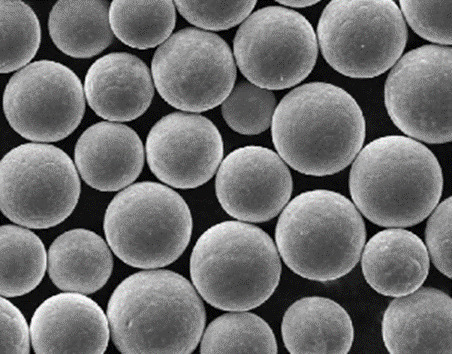
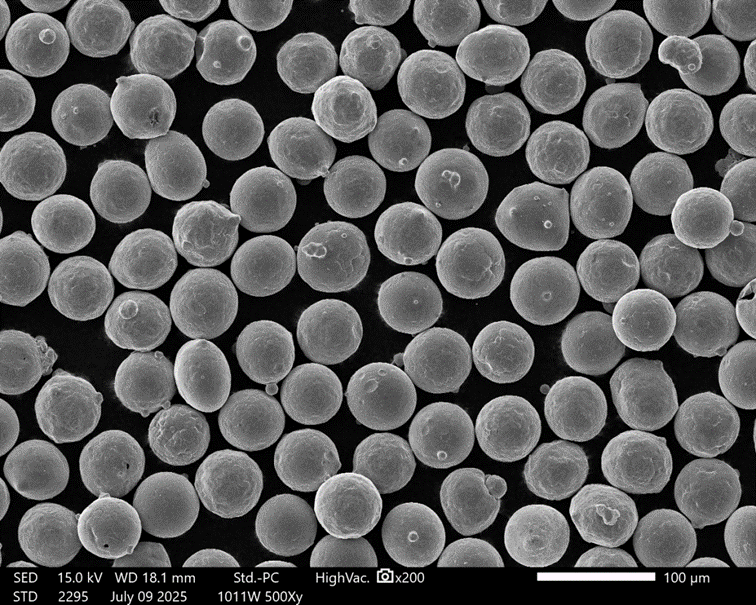
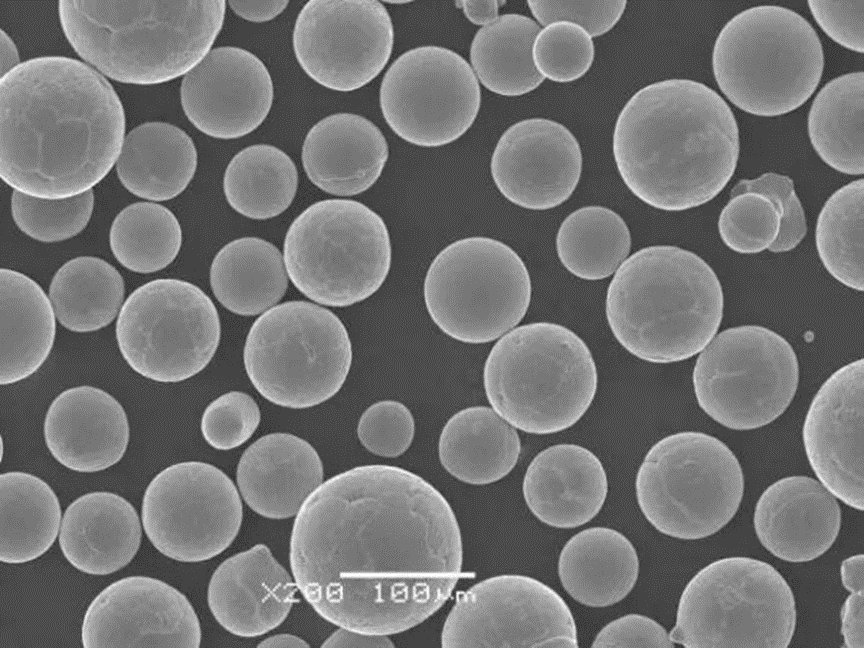
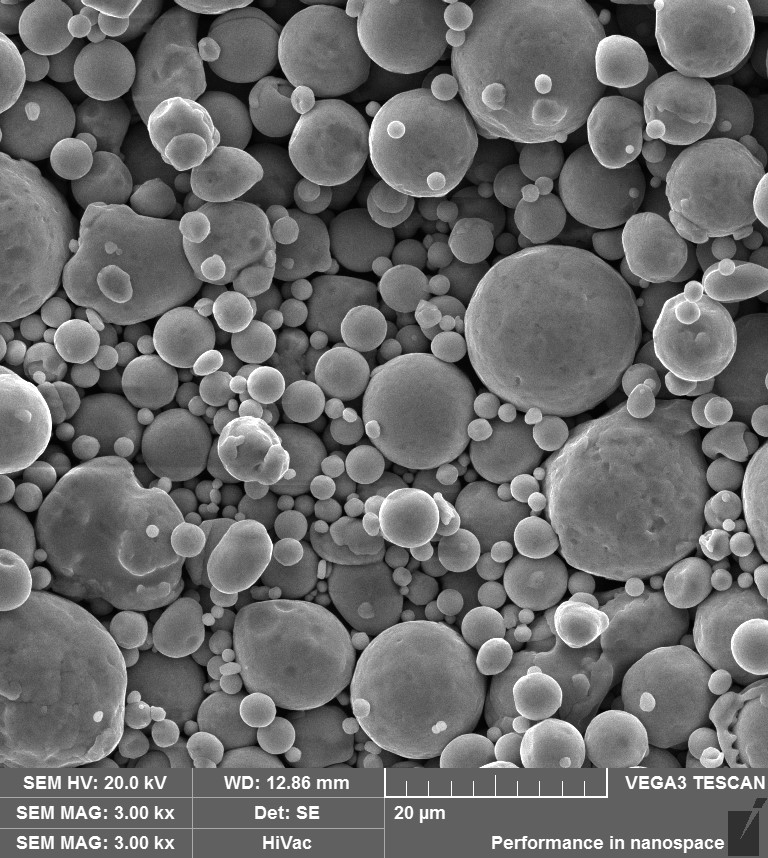
The density values above are much lower than those seen in steel or nickel powders because aluminium has lower intrinsic density and often shows different packing behavior. Apparent and tap density still matter because they influence layer uniformity, hopper feeding, and volumetric consistency in additive processes. Sphericity and satellite content are equally important for stable recoating.
7050 aluminium powder PSD selection by process
Fine cuts such as 15–45 µm and 15–53 µm are usually considered for powder bed fusion because they support thinner layers and more stable surface coverage. Coarser fractions such as 45–105 µm or 53–150 µm are more natural fits for directed energy deposition, laser cladding, thermal spraying, and some powder-metallurgy routes. A supplier may also classify lots by oxygen level, moisture history, or reuse suitability.
Standards and cross-reference logic
7050 itself is usually referenced through wrought alloy systems such as AA 7050, UNS A97050, and EN AW-7050 rather than through a single dedicated AM powder material standard. Powder users therefore combine chemistry references with generic test methods for apparent density, flow, tap density, sieve analysis, and particle morphology. Many qualification teams also align internal language with the ASTM F42 additive manufacturing committee framework because terminology consistency matters when translating wrought-alloy requirements into powder-based workflows.
What buyers should verify before qualification
For a demanding alloy such as 7050, buyers should request PSD data, oxygen content, humidity handling guidance, chemistry certificate, morphology evidence, and application fit. The most useful question is often not whether the powder is “high quality” in generic terms, but whether it is optimized for laser PBF, DED, laser cladding, PM, or HIP. A powder cut suitable for one route can be inefficient or unstable in another.
Herstellungsprozess
7050 powder can be produced by several spherical-powder routes, although gas atomization is the most common industrial choice. Route selection affects oxygen pickup, particle shape, satellite population, usable size distribution, and cost. Because 7050 is a reactive aluminium alloy with a relatively narrow process window, manufacturing route matters significantly to downstream AM performance.
Process comparison for 7050 aluminium powder
| Prozess | Sphärizität | Sauerstoffaufnahme | PSD-Steuerung | Durchsatz | Relative Kosten |
|---|---|---|---|---|---|
| Gaszerstäubung (GA) | Hoch | Low to moderate with good inert control | Gut | Hoch | Mittel |
| Vakuum-Induktions-Gaszerstäubung (VIGA) | Hoch | Lower than conventional GA | Gut bis sehr gut | Mittel | Mittel-hoch |
| Elektrodeninduktions-Gaszerstäubung (EIGA) | Sehr hoch | Sehr niedrig | Sehr gut | Mittel | Hoch |
| Plasma-Rotations-Elektroden-Verfahren (PREP) | Ausgezeichnet | Sehr niedrig | Often less efficient for fine aluminium cuts | Mittel | Hoch |
| Plasma Atomization / Related Plasma Routes | Ausgezeichnet | Sehr niedrig | Sehr gut | Lower to medium | Hoch |
Gas-atomized 7050 aluminium powder
GA is generally the reference route for 7050 aluminium powder because it offers scalable production and practical control of particle size distribution. Molten alloy is disintegrated by high-velocity inert gas, creating droplets that solidify into mostly spherical particles. With strong inert-gas control and careful melt handling, GA can provide suitable flowability and chemistry consistency for AM development programs.
The main drawbacks are oxide formation, satellite particles, and lot-to-lot variation if the process is not tightly controlled. For aluminium, even well-made gas-atomized powder will carry an oxide film, so storage and reuse procedures matter. In a high-strength 7xxx alloy, those details can materially affect print stability and defect formation.
PREP, VIGA, and EIGA for 7050 aluminium AM powder
PREP is best known for very high sphericity and low contamination, but it is more often associated with titanium and nickel alloys than with mainstream aluminium powder supply. It remains technically relevant because it can deliver clean particles, yet it is usually less economical for fine aluminium powder production and may not be the default commercial route for 7050. VIGA and EIGA can also be considered when a buyer prioritizes chemistry control and cleaner melting conditions.
This is where low oxygen and tight PSD become decisive differentiators. For 7050, the powder route is not only about flow behavior; it also influences defect probability in the build and therefore the realism of achieving wrought-like property targets. Cleaner powder helps, but it does not eliminate the intrinsic processing difficulty of the alloy.
Why 7050 remains harder to print than AlSi10Mg
The biggest challenge is not particle shape alone. It is the interaction between a high-strength, low-silicon chemistry and the thermal conditions of fusion-based AM. Silicon-rich aluminium powders wet and solidify more easily, while 7050 is closer to a high-performance wrought alloy that was never designed around laser melt-pool tolerance.
The result is that 7050 often requires more extensive parameter mapping, scan-strategy development, and post-build heat treatment than easier aluminium AM grades. In some programs, that effort is justified by superior target properties. In others, it is not.
For manufacturers comparing adjacent materials and routes, the titanium alloy powder portfolio offers a useful contrast in how lightweight alloys can differ radically in process behavior even when both are aerospace-facing.
Anwendungen nach Branche
7050 powder is not a universal aluminium AM feedstock. It is most relevant where designers need a high-strength aluminium alloy and are willing to manage a more demanding process window to avoid the mass penalty of steel or nickel alloys. That naturally makes aerospace the leading use case, with additional relevance in defense, motorsport, tooling, and selected industrial equipment.
Aerospace structures and flight-weight hardware
Aerospace is the most credible home for 7050 aluminium AM powder because the base alloy already has a strong history in structural airframe applications. Powder-derived versions are of interest for lightweight brackets, fixtures, housings, low-volume replacement parts, development hardware, and near-net-shape preforms that still need a high-strength heat-treatable aluminium chemistry. In these cases, the appeal is weight reduction without dropping too far in structural capability.
Defense, UAV, and space-adjacent hardware
Unmanned systems, defense platforms, and some space-adjacent ground hardware can benefit from 7050 where stiffness-to-weight and strength-to-weight are more important than extreme temperature resistance. Small-batch production and rapid design iteration also make powder routes attractive. However, qualification tends to be application-specific because structural reliability expectations are high.
Automotive, motorsport, and performance engineering
In mainstream automotive production, 7050 powder is less common because cost and process complexity often favor other alloys. But in motorsport, prototyping, suspension-adjacent fixtures, lightweight jigs, and performance housings, the material can make sense. High-strength aluminium is often attractive when every gram matters and production volumes are limited.
Tooling, fixtures, and industrial components
7050 powder can also be relevant for high-load fixtures, robotic end-of-arm tooling, lightweight manufacturing aids, and structural components in industrial equipment. When the part benefits from reduced weight but still sees significant mechanical loading, the alloy can outperform softer aluminium options. Its limitation is not usefulness, but the extra work needed to print and heat-treat it well.
Where 7050 aluminium powder is less suitable
Medical implants are not a mainstream target because implant-grade titanium and cobalt-chromium have stronger regulatory and biocompatibility histories. Oil and gas applications are possible in non-corrosive, weight-sensitive tools, but aluminium’s temperature and corrosion limits often shift those projects toward stainless steels, nickel alloys, or copper-based materials. Engineers comparing adjacent categories sometimes review copper alloy powder options when conductivity rather than peak structural strength becomes the main design driver.
A broader process-to-sector view appears in the company’s industry application overview, which places aluminium powder use alongside SEBM, DED, cladding, PM, and HIP workflows.
Vergleich mit alternativen Materialien
7050 rarely gets selected in isolation. It is typically screened against easier aluminium AM powders, a closely related high-strength wrought alloy, and sometimes titanium when weight-normalized performance is the true design objective. The most practical comparison is therefore between property ambition, printability, and qualification burden.
7050 aluminium powder versus alternative AM powders
| Material | Dichte (g/cm³) | Typisches Leistungsniveau | Relative Powder Cost | Druckbarkeit | Corrosion / Best-Fit Use |
|---|---|---|---|---|---|
| 7050 aluminium powder | 2.80–2.85 | Very high for aluminium after heat treatment | Mittel-hoch | Herausfordernd | Good toughness and SCC resistance; aerospace structural focus |
| AlSi10Mg | 2.65–2.70 | Mäßig | Mittel | Ausgezeichnet | Very good general-purpose AM alloy for housings and lightweight parts |
| 7075 aluminium powder | 2.80–2.81 | Very high for aluminium | Mittel-hoch | Challenging to very challenging | Similar strength class; often worse SCC reputation than 7050 |
| Scalmalloy-type Al-Mg-Sc alloy | ~2.67 | Hoch | Sehr hoch | Gut bis sehr gut | Excellent AM-specific behavior for premium lightweight structures |
| Ti-6Al-4V | 4.43 | Hoch | Hoch | Ausgezeichnet | Best when higher temperature capability and strength outweigh density penalty |
Against AlSi10Mg, 7050 offers a clear strength upside but usually loses on ease of printing. That is the central trade-off most buyers face. If production repeatability and broad machine compatibility matter more than maximum strength, AlSi10Mg often remains the easier decision.
Compared with 7075, 7050 is frequently preferred in aerospace thinking because of its stronger reputation for toughness and improved resistance to stress-corrosion cracking in heavy sections. In AM, however, both are difficult relative to silicon-rich aluminium powders, and both demand careful thermal management. Compared with Scalmalloy-type alloys, 7050 may have stronger familiarity in conventional aerospace metallurgy, but Sc-bearing alloys were developed more explicitly around additive processing.
Titanium presents a different kind of competition. It is much denser than aluminium, but it is also more mature in aerospace AM and can deliver excellent properties with a more established qualification pathway. The real decision is often about process-property balance rather than raw strength alone.
Unser Unternehmen
Shanghai Truer Technology Co., Ltd., the operator of am-printing.com, was established in 2009 and created its additive manufacturing business in 2019. The company works across metal powder making equipment and powder supply, with published capabilities in Selective Electron Beam Melting equipment, Plasma Rotating Electrode Process powder-making equipment, and Gas Atomization, alongside spherical metal powders including TiNi, TiTa, TiAl, TiNbZr, CoCrMo, and nickel-, cobalt-, titanium-, copper-, aluminium-, and stainless-steel-based materials. Its stated downstream processes include SLM, SEBM, DED, laser cladding, powder metallurgy, MIM, HIP, cold and hot spraying, welding, and coating for industries such as 3C electronics, hand tools, remote control cars, medical, aerospace, and nuclear power; additional background is provided on the Unternehmensprofilseite.
FAQ
Q1. Is 7050 aluminium powder good for metal 3D printing?
It can be good for metal 3D printing when the project demands high-strength aluminium and the team is prepared for a narrower process window than with AlSi10Mg. The alloy is more challenging because of crack sensitivity, oxide management, and its reliance on a carefully controlled heat-treatment route to reach target properties.
Q2. How does 7050 aluminium powder compare with 7075 powder?
Both are high-strength 7xxx aluminium alloys, and both are more difficult to print than silicon-rich aluminium powders. 7050 is often favored where fracture toughness and resistance to stress-corrosion cracking are especially important, while 7075 is better known commercially but not always the safer choice for demanding structural environments.
Q3. What particle size is typical for 7050 aluminium powder?
For powder bed fusion, typical commercial cuts are 15–45 µm and 15–53 µm. Coarser fractions such as 45–105 µm or 53–150 µm are more common for directed energy deposition, laser cladding, thermal spraying, or general powder-metallurgy applications.
Q4. Why is 7050 aluminium powder harder to print than AlSi10Mg?
The main reason is chemistry. AlSi10Mg contains enough silicon to improve flow and solidification behavior during melting, while 7050 is a low-silicon, high-strength wrought-derived alloy that offers less natural tolerance to thermal stress and solidification cracking in fusion-based AM.
Q5. Which industries use 7050 aluminium powder most often?
Aerospace is the strongest fit because the underlying alloy already has a long history in high-strength structural applications. Defense, UAVs, motorsport, tooling, and specialized industrial components are also plausible users when low weight and high mechanical performance matter more than simple printability.
Q6. What should buyers check before ordering 7050 aluminium powder?
Buyers should check chemistry certification, particle size distribution, apparent and tap density, oxygen level, morphology, and recommended process route. It is also important to confirm whether the powder has been characterized for laser PBF, DED, cladding, or PM, because performance expectations differ significantly across those use cases.