Kurzantwort
Inconel 690 nickel alloy powder is a high-chromium nickel-base alloy powder used when a printed or powder-processed part must resist oxidation, sulfidation, and aggressive aqueous corrosion while retaining useful strength at elevated temperature. It is chosen for additive manufacturing and related powder routes when corrosion performance matters more than peak room-temperature strength. In practice, the alloy is especially relevant for heat-handling hardware, chemical process components, and power-generation parts exposed to caustic or chloride-bearing environments.
What Is Inconel 690 nickel alloy powder
Inconel 690 nickel alloy powder is the powder form of Alloy 690, a nickel-chromium-iron corrosion-resistant superalloy best known for combining a high nickel matrix with substantially higher chromium than many mainstream nickel alloys. As part of the broader Inconel family, it belongs to the group of wrought and cast nickel-base materials developed for elevated-temperature service and severe corrosion environments. The Inconel name is generally associated with nickel-chromium alloy systems used in harsh thermal and chemical conditions, especially where stainless steels lose reliability or where chloride stress-corrosion cracking is a concern.
For powder users, the alloy matters because powder-based manufacturing makes it possible to produce geometrically complex components that still leverage Alloy 690’s well-established corrosion profile. In additive manufacturing, the goal is not simply to print “another nickel alloy,” but to preserve the metallurgy that gives 690 its reputation for long-term resistance in wet-corrosion and high-temperature service. That includes resistance to oxidizing acids, many caustic media, and steam-side degradation mechanisms that challenge lower-chromium grades.
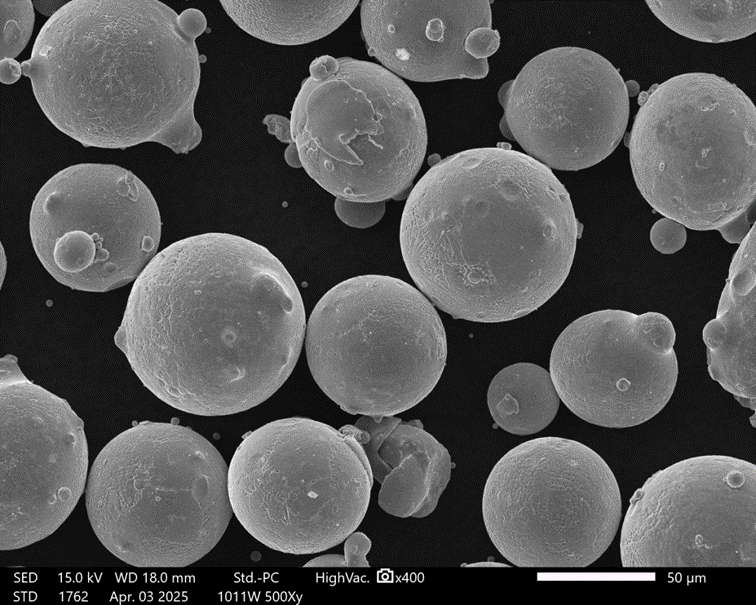
Inconel 690 Nickel Alloy Powder Within the Nickel Superalloy Family
Among nickel-based AM powders, Inconel 690 sits in a different selection niche than 718 or 625. Alloy 718 is usually chosen for precipitation-strengthened structural performance, while 625 is often selected for broad corrosion resistance and weldability. Inconel 690, by contrast, is typically chosen for exceptional resistance to chloride stress-corrosion cracking and for oxidation or hot-gas conditions where its chromium-rich surface scale is a major advantage.
That difference is important in metal AM. If the part will see high mechanical stress at elevated temperature, 718 may still be the default comparison. But if the governing failure mode is environmental attack, especially in heat exchangers, nuclear water systems, flue-gas handling, or chemical processing, Inconel 690 becomes a much more relevant candidate.
Why the Powder Form Matters
Powder supply expands the alloy’s usability beyond conventional wrought product forms such as bar, tube, plate, or weld wire. In laser powder bed fusion, directed energy deposition, and thermal spray feedstock preparation, a controlled spherical powder lets engineers build shapes that are difficult to machine from wrought stock. This is consistent with additive manufacturing’s layer-by-layer approach as defined in Begriffe gemäß ISO/ASTM 52900, and with the metrology-driven powder qualification approach emphasized by NIST metals additive manufacturing research.
Key Characteristics That Distinguish Alloy 690
The central design feature of Alloy 690 is its high chromium content relative to many other nickel alloys. That chemistry promotes formation of protective oxide scales at high temperature and improves resistance to numerous corrosive aqueous environments. Nickel provides matrix stability and helps suppress stress-corrosion issues that often limit austenitic stainless steels in chloride-bearing service.
Mild additions and controlled residuals then support the alloy’s fabricability and service stability. For AM engineers, this translates into a material that may not be the strongest nickel powder available, but often delivers a better environmental durability profile when corrosion mechanisms dominate part life. That makes it valuable in design cases where replacing damaged components is expensive, disruptive, or safety-critical.
In corrosion-driven design, the “best” AM alloy is often the one that survives the environment longest, not the one with the highest headline strength.
Chemische Zusammensetzung
Alloy 690 is generally described as a nickel-chromium-iron alloy with tightly controlled carbon and impurity levels. The chemistry is optimized less for precipitation hardening and more for corrosion control, scale formation, and structural stability during elevated-temperature service. In powder form, the same nominal chemistry must be paired with low oxygen pickup and clean atomization to ensure that the powder consolidates into a part with predictable corrosion behavior.
Typical Composition of Inconel 690 Nickel Alloy Powder
| Element | Typical wt.% Range | Rolle in der Metallurgie | Functional Effect |
|---|---|---|---|
| Ni | 58.0 min, typically 58-63 | Base matrix | Provides corrosion resistance, toughness, and high-temperature matrix stability |
| Cr | 27.0-31.0 | Oxide-forming alloy element | Improves oxidation resistance, sulfidation resistance, and resistance to many corrosive media |
| Fe | 7.0-11.0 | Matrix balance element | Controls cost, phase balance, and hot-workability while supporting strength |
| C | 0.05 max typical | Residual control | Low carbon helps reduce sensitization risk and preserves corrosion performance |
| Mn | 0.50 max typical | Deoxidation and residual control | Supports melt processing but is kept modest for chemistry control |
| Si | 0.50 max typical | Deoxidation and fluidity support | Excess silicon can affect hot workability and oxidation behavior |
| Cu | 0.50 max typical | Residual element | Usually limited to avoid unwanted corrosion or hot-working effects |
| S | 0.015 max typical | Inclusion control | Low sulfur improves cleanliness and hot-workability |
| P | 0.015 max typical | Brittleness control | Low phosphorus supports ductility and weldability |
The balance between nickel, chromium, and iron is the defining feature. Nickel is high enough to stabilize the alloy in severe service, but chromium is higher than in many common nickel-base AM powders. That composition is what gives Alloy 690 its strong reputation in chloride-bearing water, steam-generator contexts, and oxidizing thermal environments.
Role of Each Major Alloying Element
Nickel forms the corrosion-resistant base matrix and gives the alloy its superalloy identity. It also supports toughness and helps the material retain ductility after thermal exposure. In aggressive aqueous service, a nickel-rich matrix is especially valuable because it reduces the vulnerability seen in many lower-alloy steels.
Chromium is the main environmental-defense element. It promotes the formation of a persistent, adherent oxide layer that slows further attack at elevated temperature. In wet corrosion, chromium also improves passivation, which is why Alloy 690 is often considered where stainless steels approach their practical limits.
Iron is not just an inexpensive filler. In these compositions it contributes to the overall alloy balance and processability, helping keep the chemistry in the established 690 family rather than pushing the material toward more exotic, higher-cost nickel systems. Residual elements such as sulfur and phosphorus are controlled because cleanliness matters for both hot workability and service reliability.
Powder Chemistry and AM Performance
For AM-grade powder, chemistry control extends beyond the nominal alloy. Oxygen, nitrogen, moisture pickup, and trace contamination from melting or handling can affect laser absorptivity, flow behavior, and the corrosion performance of the final part. That is why powder producers often pair a standard chemistry certificate with morphology analysis, lot traceability, and process-specific recommendations.
The same principle applies to reclaimed powder. Even if the bulk Ni-Cr-Fe percentages remain in range, surface oxidation and fine-particle enrichment can alter the feedstock enough to change porosity or microsegregation behavior during printing. In corrosion-critical parts, conservative powder-reuse controls are usually more important for Alloy 690 than for purely noncritical prototypes.
Physikalische und mechanische Eigenschaften
The property profile of Inconel 690 nickel alloy powder should be interpreted in two layers: the powder properties that influence handling and printability, and the consolidated-part properties that govern service performance. Alloy 690 is not normally selected to beat precipitation-hardened alloys on tensile strength. Instead, it combines useful mechanical integrity with high-temperature corrosion resistance, good ductility, and stable service behavior under thermal exposure.
Typical Properties of Inconel 690 Nickel Alloy Powder and Consolidated Material
| Eigentum | Typischer Wert | Einheit | Test Standard |
|---|---|---|---|
| Dichte | 8.19 typical | g/cm³ | Reference alloy data |
| Solidus-Liquidus Range | 1343-1377 typical | °C | DSC / reference alloy data |
| Endgültige Zugfestigkeit | 620-760 typical, condition dependent | MPa | ASTM E8/E8M |
| Streckgrenze (0.2%) | 280-420 typical, condition dependent | MPa | ASTM E8/E8M |
| Dehnung | 30-45 typical | % | ASTM E8/E8M |
| Härte | 150-220 typical | HB or HV equivalent | ASTM E10 / ASTM E384 |
| Wärmeleitfähigkeit | 13-15 typical at room temperature | W/m-K | Reference alloy data |
| Elektrischer spezifischer Widerstand | 1.10-1.20 typical | µΩ·m | Reference alloy data |
| Elastizitätsmodul | 205-215 typical | GPa | Reference alloy data |
These ranges are representative of annealed or appropriately processed Alloy 690 and should not be read as a universal guarantee for every AM build condition. Part density, scan strategy, heat treatment, and build orientation can shift strength and ductility. NIST’s work on metal additive manufacturing repeatedly emphasizes that process-structure-property relationships are central to qualification, especially for critical metal powder systems.
Corrosion Performance as a Functional Property
For Alloy 690, the most important “property” is often not listed in a standard tensile table. Its real value lies in long-term behavior in oxidizing, caustic, and chloride-affected environments. That is why materials engineers often qualify it against service exposure data, cracking history, and oxide-scale behavior rather than room-temperature strength alone.
This is also why direct comparisons with Inconel 718 can be misleading. 718 is stronger, but that does not make it automatically better for a heat-transfer manifold or a chemical handling component that fails by corrosion rather than by overload.
Temperature Capability and Mechanical Stability
Alloy 690 maintains useful structural integrity across a wide service temperature range and is commonly discussed for elevated-temperature environments rather than cryogenic or ultra-high-strength applications. The alloy’s ductility is usually better than many engineers expect from a corrosion-focused material, which helps it tolerate fabrication, thermal cycling, and inspection without becoming excessively brittle.
In AM, that ductility can be beneficial during support removal or finish machining. However, post-build thermal treatment remains important because residual stress and local segregation can affect both corrosion resistance and distortion control.
Thermal Conductivity, Resistivity, and Fabrication Implications
Thermal conductivity is modest, as is typical for nickel-base alloys. That means heat can remain localized during powder bed fusion, increasing the importance of scan strategy and support design. Electrical resistivity is relatively high compared with copper alloys, so Alloy 690 is not a conductivity material; where heat transfer rather than corrosion is the main requirement, designers may instead review a copper-alloy powder range or another thermally optimized option.
From a fabrication standpoint, the combination of moderate conductivity and high alloy content can raise cracking sensitivity if parameters are poorly tuned. That does not make the powder unprintable, but it does mean process development should focus on density, microsegregation, and stress management rather than on speed alone.
Technische Daten und verfügbare Güteklassen
Commercial supply of Inconel 690 nickel alloy powder is usually organized around powder morphology, particle-size distribution, and intended process route. Unlike a simple billet purchase, AM and powder-metallurgy procurement must account for how the feedstock spreads, packs, melts, and reuses over time. The most useful specification therefore combines alloy chemistry with measurable powder characteristics and a process-specific size cut.
Typical Supply Conditions for Inconel 690 Nickel Alloy Powder
| Grade / Supply Condition | Typischer PSD-Bereich | Scheinbare Dichte | Zapfstellendichte | Hall-Strömung | Sauerstoffgehalt | Kugelförmigkeit / Morphologie | Cross-Reference / Typical Use |
|---|---|---|---|---|---|---|---|
| Fine LPBF grade | 15-45 µm | 4.4-5.1 g/cm³ | 5.0-5.8 g/cm³ | 14-22 s/50 g | 0.02-0.08 wt.% typical | Highly spherical, low satellites | Fine-feature laser powder bed fusion |
| Standard LPBF grade | 20-53 µm | 4.5-5.2 g/cm³ | 5.2-5.9 g/cm³ | 13-20 s/50 g | 0.02-0.06 wt.% typical | Spherical atomized powder | General AM builds and qualification coupons |
| DED / laser cladding grade | 45-105 µm | 4.6-5.3 g/cm³ | 5.3-6.1 g/cm³ | 12–18 s/50 g | 0.02-0.06 wt.% typical | Coarser spherical cut | Repair, deposition, and coating applications |
| Thermal spray / specialty coarse cut | 53–150 µm | 4.7-5.4 g/cm³ | 5.4-6.2 g/cm³ | 12–17 s/50 g | 0.02-0.07 wt.% typical | Kugelförmig bis nahezu kugelförmig | Overlay and corrosion-resistant surface engineering |
| Standards alignment row | Supplier-specific | - | - | - | - | - | Test methods often reference ASTM B213 Hall flow standard, ASTM B212, ASTM B527, and internal AM qualification protocols |
These values are typical supply ranges, not universal limits across all powder makers. Apparent density and Hall flow can shift with PSD window, satellite content, and surface condition. For that reason, buyers should compare lots within the same intended process category rather than across fundamentally different size cuts.
Inconel 690 Nickel Alloy Powder for LPBF and DED
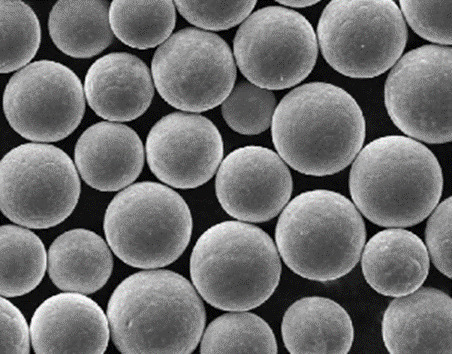
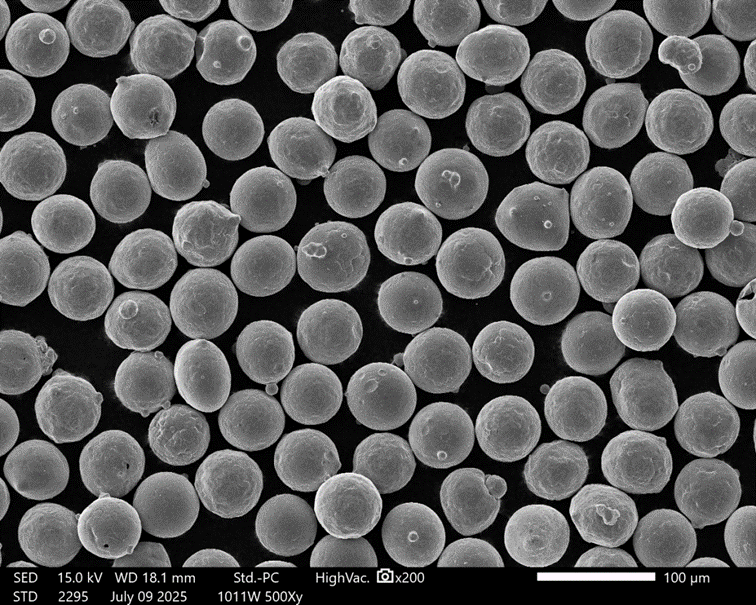
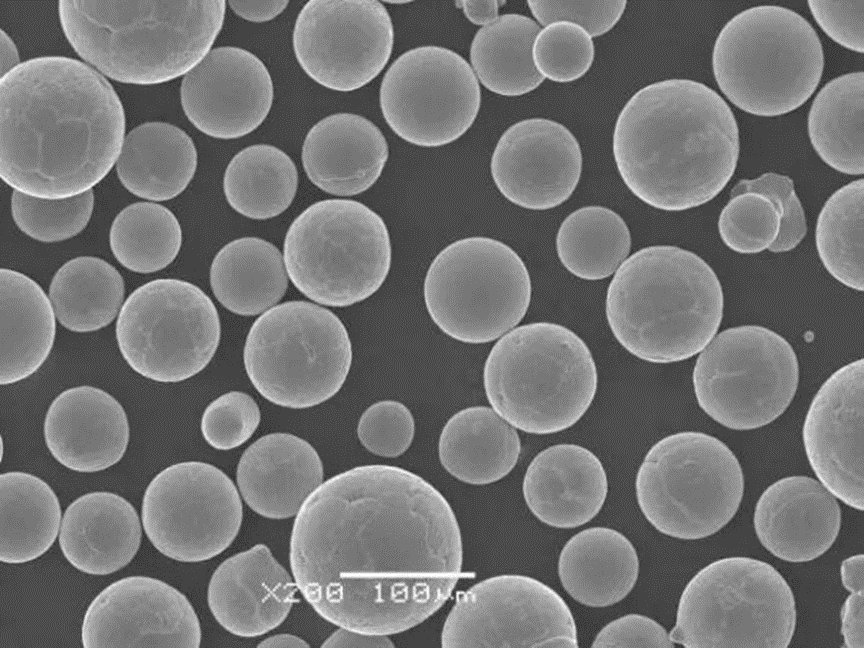
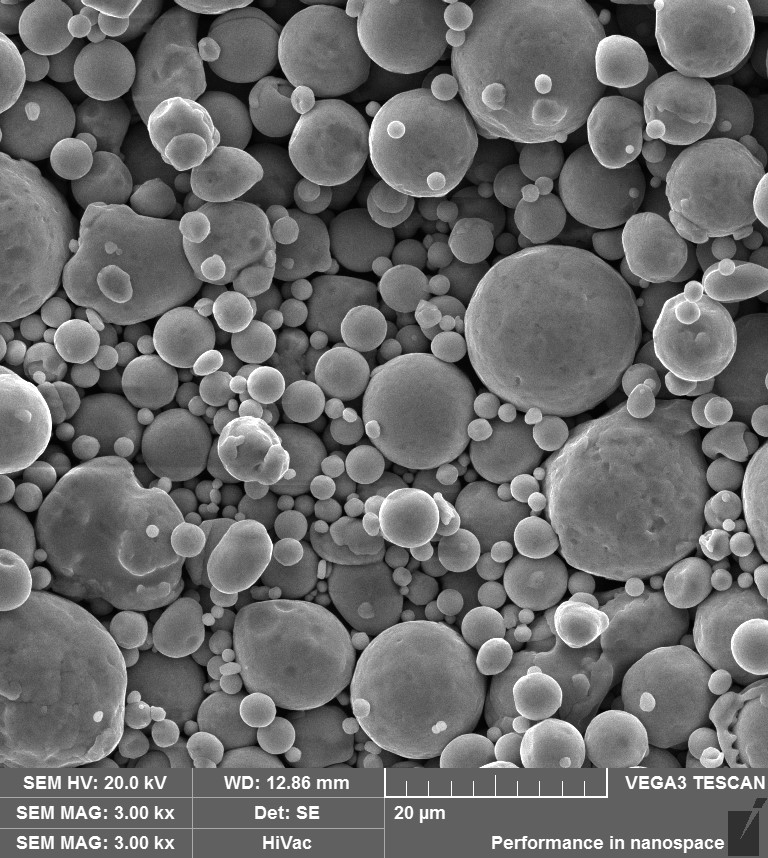
For laser powder bed fusion, a tighter fine-cut distribution is usually preferred because it improves layer uniformity and feature resolution. Directed energy deposition uses coarser powder because feeding stability matters more than thin-layer spreading. In both routes, sphärische Pulvermorphologie is a practical requirement rather than a marketing descriptor; it directly influences packing consistency, powder delivery, and repeatability.
Standards, Cross-References, and Purchasing Logic
There is no single AM-only specification that fully captures the needs of Alloy 690 powder procurement. Instead, purchasers typically combine powder test methods, internal material standards, and part-specific qualification plans. AM vocabulary and process classification follow the framework used in ISO/ASTM additive manufacturing terminology, while powder characterization often borrows from long-established PM test methods.
What a Complete Datasheet Should Include
A complete technical datasheet should report chemistry, PSD, apparent density, tap density, flowability, oxygen, and morphology. For critical environments, it should also define packing atmosphere, recommended reuse practice, and the post-build heat treatment window used to generate mechanical data. Without that context, tensile numbers alone provide an incomplete picture of service suitability.
Herstellungsprozess
The manufacturing route used to make Inconel 690 nickel alloy powder has a direct effect on cleanliness, shape, and lot consistency. For AM, the preferred powders are normally produced by inert-gas atomization under controlled melting conditions, although premium routes such as VIGA, EIGA, and PREP may be used where contamination risk or morphology demands are stricter.
Powder-Making Routes for Inconel 690 Nickel Alloy Powder
| Prozess | Sphärizität | Sauerstoffaufnahme | PSD-Steuerung | Durchsatz | Relative Kosten |
|---|---|---|---|---|---|
| Gaszerstäubung (GA) | Hoch | Gering bis mäßig | Gut | Hoch | Mäßig |
| Vakuum-Induktions-Gaszerstäubung (VIGA) | Sehr hoch | Niedrig | Sehr gut | Mittel bis hoch | Mäßig bis hoch |
| Elektrodeninduktions-Gaszerstäubung (EIGA) | Sehr hoch | Sehr niedrig | Sehr gut | Mittel | Hoch |
| Plasma-Rotations-Elektroden-Verfahren (PREP) | Extremely high | Sehr niedrig | Good, often coarser | Medium to low | Hoch |
| Wasserzerstäubung | Niedrig bis mittel | Höher | Mäßig | Hoch | Niedrig |
Gas Atomization for Mainstream AM Feedstock
Gas atomization is the most common route for nickel alloy AM powders because it offers scalable throughput and good particle sphericity. A molten stream is disintegrated by high-velocity inert gas, then the resulting droplets solidify into powder that is sieved into target fractions. For Inconel 690, this route usually provides the best cost-to-quality balance for LPBF, DED, and laser cladding feedstock.
The resulting powder typically shows good flow and acceptable oxygen control when melting and handling are managed properly. However, satellite content, fines fraction, and internal porosity still need review because even a nominally spherical powder can print inconsistently if classification is loose.
VIGA, EIGA, and PREP Trade-Offs
VIGA introduces vacuum melting before gas atomization, reducing contamination and improving chemistry control. EIGA goes further by atomizing from an electrode rather than a crucible-held melt, which can be advantageous for sensitive or premium alloy programs. PREP, meanwhile, is well known for producing extremely round particles with clean surfaces, but usually at higher cost and often with a coarser economic yield.
For Alloy 690, these methods are selected when cleanliness, traceability, or premium morphology justify the added expense. In corrosion-driven applications, that decision can be rational if the component is difficult to replace or if the qualification pathway penalizes powder inconsistency more than raw material cost.
Powder Conditioning and Reuse Control
After atomization, the powder is screened, sampled, blended if required, and sealed for transport. These are not minor downstream tasks. NIST’s AM measurement work shows that repeatable metal powder processing depends on disciplined control of feedstock condition and process history, not just nominal alloy identity.
Reuse strategy deserves separate attention. Fine-particle enrichment, oxidation, and morphology drift can all alter laser response or corrosion performance over multiple cycles. For critical Alloy 690 parts, especially in process industries and energy systems, closed-loop powder control is usually part of the qualification plan.
Anwendungen nach Branche
Inconel 690 nickel alloy powder is most relevant in industries where parts operate in corrosive high-temperature service and where conventional machining from wrought stock is costly or geometrically limiting. Its natural fit is not consumer hardware or decorative metal printing. It is an engineering alloy for harsh thermal-chemical duty.
Power Generation and Nuclear Systems
Alloy 690 has a strong reputation in power-generation environments because of its resistance to stress-corrosion cracking and its stable behavior in high-temperature water and steam-side conditions. That makes powder-based versions relevant for repair features, brackets, manifolds, shields, and specialized flow components associated with nuclear and chemical processing components.
In nuclear-adjacent use, the value of AM is often geometric rather than purely metallurgical. Designers may need compact internal channels, integrated joints, or replacement parts for legacy systems where tooling lead times are unacceptable.
Chemical Processing and Pollution Control
Chemical plants, flue-gas systems, and caustic handling equipment often expose metal parts to mixed-temperature and mixed-chemistry attack. In those settings, Alloy 690 is attractive for nozzles, burner hardware, thermowells, fittings, and corrosion-resistant internals. AM adds value when the part includes internal passages, custom interface geometry, or low-volume replacement demand.
Oil, Gas, and Petrochemical Service
Oil and gas service is more commonly associated with alloys such as 625, 718, or C-276-type materials, but Inconel 690 can still be relevant where oxidation, sulfidation, or aggressive refinery-side chemistry dominates. It is usually a specialist choice rather than the default. Engineers evaluate it when chloride stress-corrosion risk, steam exposure, or high-temperature corrosive atmospheres outweigh the need for ultra-high strength.
Aerospace and Thermal Hardware
In aerospace, Alloy 690 is not a mainstream rotating-engine structural alloy, but it can serve in combustion-adjacent fixtures, exhaust-side hardware, and thermal-management components where corrosion resistance and oxidation protection matter more than maximum specific strength. When low mass is the top priority, users more often review a titanium alloy powder portfolio; when hot corrosion dominates, nickel-base systems remain the stronger candidate.
Surface Engineering, Cladding, and Hybrid Manufacturing
Powder is also used outside full-net-shape printing. Laser cladding, DED repair, and corrosion-resistant overlays can apply Alloy 690 selectively to vulnerable surfaces. That matters in cost-sensitive parts where only the exposed face needs nickel-base performance. In those cases, the alloy competes not only with other bulk powders but also with coatings and weld overlays from the broader nickel superalloy powder lineup.
Vergleich mit alternativen Materialien
Inconel 690 is rarely chosen in isolation. Engineers usually compare it with other nickel-base alloys and, in some cases, with stainless steels or cobalt alloys. The most sensible comparison set includes Inconel 625, Inconel 718, and Hastelloy-family corrosion alloys, plus a stainless benchmark for cost perspective.
Inconel 690 Nickel Alloy Powder vs Alternative AM Materials
| Material | Dichte (g/cm³) | Strength Level | Druckbarkeit | Korrosionsbeständigkeit | Relative Kosten | Optimaler Anwendungsfall |
|---|---|---|---|---|---|---|
| Inconel 690 nickel alloy powder | 8.19 | Mäßig | Good after qualification | Excellent in many oxidizing and chloride-related environments | Hoch | Corrosion-critical high-temperature components |
| Inconel 625-Pulver | 8.44 | Mäßig bis hoch | Sehr gut | Excellent broad corrosion resistance | Hoch | General corrosion service and weldable AM parts |
| Inconel 718-Pulver | 8.19 | Hoch | Ausgezeichnet | Good, but not the main selection driver | Hoch | High-strength aerospace and energy hardware |
| Hastelloy C-276-type powder | 8.8-8.9 | Mäßig | Gut | Outstanding in many severe chemical environments | Sehr hoch | Highly aggressive wet chemical service |
| 316L-Edelstahlpulver | 7.9-8.0 | Mäßig | Ausgezeichnet | Good, but below nickel superalloys in severe service | Niedrig bis mittel | Kostengünstige, korrosionsbeständige AM-Teile |
Compared with 625, Alloy 690 usually offers stronger oxidation and stress-corrosion-cracking resistance in specific service windows, but 625 can be easier to position as a general-purpose corrosion alloy. Compared with 718, 690 gives up strength but may gain longevity when environmental attack is the limiting factor. Against 316L, the performance gap is large in severe high-temperature corrosive duty, though the cost difference is equally real.
The most important insight is that Alloy 690 is not a universal upgrade. It is a specialist material selected when long-term environmental durability outweighs the benefits of lower-cost stainless powders or stronger precipitation-hardened nickel grades. That selection logic is consistent with the broader classification of nickel superalloys and corrosion-resistant AM materials described in general Inconel alloy background.
Unser Unternehmen
Shanghai Truer Technology Co., Ltd., operating am-printing.com, was established in 2009 and created its additive manufacturing business in 2019. According to its published company information, the company integrates powder-making equipment and services with spherical metal powder supply for additive manufacturing, including TiNi, TiTa, TiAl, TiNbZr, CoCrMo, and nickel-based, cobalt-based, titanium-based, copper-based, aluminum-based, and stainless steel powders. Its stated technical scope includes Selective Electron Beam Melting equipment, Plasma Rotating Electrode Process equipment, gas atomization, and a joint innovation center for metal 3D printing, with downstream support across SLM, SEBM, DED, laser cladding, PM, MIM, HIP, cold and hot spraying, welding, and coating for sectors including aerospace, medical, nuclear power, 3C electronics, hand tools, and remote control cars, as outlined on the Seite mit Informationen zum Lieferanten.
FAQ
Q1. Is Inconel 690 nickel alloy powder better than Inconel 718 for additive manufacturing?
Not universally. Inconel 718 is usually preferred when high strength is the main design target, while Inconel 690 is preferred when corrosion resistance and oxidation resistance are the dominant failure controls. The better alloy depends on whether the part is limited by load, temperature, or environment.
Q2. What is Inconel 690 nickel alloy powder mainly used for?
It is mainly used for parts that need strong resistance to hot corrosion, oxidizing environments, and chloride-related stress-corrosion cracking. Typical uses include chemical process hardware, power-generation components, thermal handling parts, overlays, and specialized AM-built internals.
Q3. Can Inconel 690 nickel alloy powder be used in laser powder bed fusion?
Yes, provided the powder has appropriate size distribution, sphericity, and oxygen control. Parameter development is still necessary because nickel-base alloys can respond strongly to scan strategy, heat input, and post-build heat treatment. Qualification should focus on density, cracking tendency, and corrosion performance after printing.
Q4. How does Inconel 690 nickel alloy powder compare with Inconel 625 powder?
Both are corrosion-resistant nickel alloys, but they occupy different niches. Inconel 625 is often treated as a broader-purpose corrosion alloy with strong weldability, while Inconel 690 is usually selected for service windows where higher chromium and better resistance to specific cracking or oxidation mechanisms are more valuable.
Q5. What particle sizes are typical for Inconel 690 nickel alloy powder?
Typical AM supply cuts are about 15-45 µm or 20-53 µm for laser powder bed fusion, and roughly 45-105 µm for DED or cladding. Exact ranges vary by supplier, build platform, and whether the powder is optimized for fine detail, deposition rate, or overlay quality.
Q6. What should buyers request when sourcing Inconel 690 nickel alloy powder?
They should request chemistry certification, PSD data, Hall flow, apparent and tap density, oxygen content, morphology information, and the intended process route. For critical parts, it is also sensible to ask through the technischer Kontaktkanal about reuse guidance, recommended heat treatment, and lot-level traceability.