Quick Answer
FeNiMo soft magnetic powder is an iron-nickel-molybdenum alloy powder used in additive manufacturing and powder metallurgy when engineers need soft-magnetic performance, dimensional precision, and stable processing in complex parts. It is usually chosen for magnetic cores, sensor components, inductive hardware, shielding structures, and precision electromagnetic assemblies where permeability, low coercivity, and controlled losses matter more than maximum structural strength. Compared with pure iron powder, FeNiMo typically offers a better balance of magnetic softness, resistivity, and process stability, especially after proper annealing.
What Is FeNiMo soft magnetic powder
FeNiMo soft magnetic powder is the powder form of a soft-magnetic iron-nickel alloy modified with molybdenum to tune permeability, coercivity, electrical resistivity, and microstructural stability. In broad terms, it belongs to the Fe-Ni magnetic alloy family that includes permalloy-type compositions, but the molybdenum addition shifts the balance away from simple iron-nickel behavior and toward improved soft-magnetic response in demanding electromagnetic applications. As a spherical or near-spherical powder, it is suitable for additive manufacturing, metal injection molding, powder metallurgy, hot isostatic pressing, and magnetic component prototyping.
The alloy is relevant because many electromagnetic parts are no longer simple laminations or stamped geometries. Modern electrical systems increasingly rely on compact three-dimensional magnetic circuits, sensor housings, miniaturized actuator parts, and intricate flux-guiding structures that are difficult to machine or assemble from sheet products. Powder-based manufacturing allows those shapes to be built directly while preserving the possibility of post-process heat treatment for magnetic optimization.
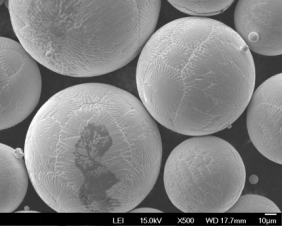
FeNiMo soft magnetic powder in the magnetic alloy family
FeNiMo sits between general-purpose iron powders and highly specialized high-nickel magnetic materials. Pure iron powders can deliver strong saturation magnetization, but they often sacrifice corrosion resistance, dimensional stability, or high-frequency loss control. High-nickel alloys can provide excellent permeability and low coercive force, but they may be more expensive or less practical when a component also needs moderate mechanical integrity and powder-process versatility.
Adding molybdenum to an Fe-Ni alloy changes the magnetic and metallurgical picture in subtle but useful ways. It can improve resistivity, help refine domain-wall behavior after annealing, and support more stable powder processing by influencing solidification and subsequent heat-treatment response. That is why FeNiMo is often considered for printed magnetic parts that must operate reliably under repeated switching, moderate thermal exposure, or tight dimensional tolerances.
Why FeNiMo exists as an additive manufacturing powder
Conventional soft-magnetic materials have historically been supplied as strip, bar, laminations, or pressed components. Those forms remain efficient for large-volume motors and transformers, but they are less ideal for customized sensors, complex magnetic paths, integrated cooling channels, compact electromagnetic housings, and low-volume development parts. Powder-based routes allow more design freedom without abandoning soft-magnetic functionality.
This matters in sectors such as robotics, aerospace electronics, industrial control, and high-precision instrumentation. A printed magnetic part can combine geometry consolidation with property tuning through annealing, infiltration, or HIP, making the alloy attractive where conventional fabrication creates too many process steps.
Core characteristics of FeNiMo soft magnetic powder
The main appeal of FeNiMo is not extreme mechanical strength. Instead, designers look to it for a package of magnetic softness, relatively high permeability, low coercivity after suitable heat treatment, and better resistivity than simple iron-rich materials. Depending on exact composition and consolidation route, the alloy can also show improved dimensional consistency and reduced eddy-current tendencies compared with some lower-alloy alternatives.
For most printed magnetic components, final heat treatment influences performance just as much as the nominal alloy chemistry.
Engineers reviewing adjacent categories often compare FeNiMo with broader iron-based alloy powder options to separate structural ferrous powders from true magnetic-alloy feedstocks.
Chemical Composition
FeNiMo alloys do not all share one universal chemistry window, but commercial soft-magnetic grades usually cluster around a high iron base with significant nickel and a modest molybdenum addition. Tight control of carbon, sulfur, phosphorus, oxygen, and silicon is essential because these residuals can degrade permeability, raise coercive force, or increase brittleness after consolidation. In soft-magnetic materials, impurity management is often as important as the headline alloy percentages.
Typical composition of FeNiMo soft magnetic powder
| Element | Typical wt% | Metallurgical Role | AM / PM Relevance |
|---|---|---|---|
| Fe | Balance | Primary ferromagnetic matrix and structural backbone | Governs saturation behavior and densification response |
| Ni | 45.0–52.0 | Raises permeability, lowers coercivity, improves ductility and corrosion behavior | Central to soft-magnetic response and heat-treatment sensitivity |
| Mo | 1.5–5.0 | Increases resistivity, refines magnetic behavior, supports microstructural stability | Helps reduce magnetic losses and tune final performance |
| Si | ≤0.50 | Minor deoxidation aid in controlled amounts | Excess silicon can impair ductility or alter magnetic softness |
| Mn | ≤0.80 | Deoxidation support and residual control | Useful in melting, but must remain limited for magnetic cleanliness |
| C | ≤0.03 | Residual impurity kept very low | High carbon reduces permeability and can increase brittleness |
| P | ≤0.02 | Residual impurity | Elevated phosphorus can embrittle grain boundaries |
| S | ≤0.02 | Residual impurity | High sulfur worsens hot workability and magnetic performance |
| O | Controlled, typically low | Surface oxide and contamination indicator | Critical for powder flow, laser behavior, and annealed magnetic quality |
The exact nickel and molybdenum levels vary with the intended magnetic target. Some grades lean closer to classic high-permeability Fe-Ni alloys, while others are tuned for higher resistivity or a better compromise between magnetic softness and manufacturing practicality. Buyers should therefore focus on the full chemistry certificate, not just the alloy family label.
Role of nickel in FeNiMo soft magnetic powder
Nickel is the dominant alloying element after iron. It reshapes the magnetic domain behavior of the iron matrix, enabling lower coercivity and higher permeability than many ordinary ferrous powders can provide. Nickel also improves ductility, which helps the alloy tolerate pressing, sintering, HIP, or additive thermal cycles better than some brittle specialty magnetic systems.
Why molybdenum is added
Molybdenum is the differentiator that turns a simple Fe-Ni alloy into FeNiMo. Its presence tends to raise electrical resistivity and can support more favorable magnetic behavior after stress-relief or magnetic annealing. In practical terms, that means the alloy can offer lower core losses and more stable performance in components that experience alternating magnetic fields.
Contamination control in soft magnetic powder
Soft-magnetic alloys are especially sensitive to unwanted residuals. Carbon, oxygen, sulfur, and phosphorus can all act as obstacles to domain-wall motion or as microstructural defect sources that increase coercivity. That is why powder manufacturing, handling, and storage procedures matter so much for FeNiMo.
Readers wanting broader context on high-permeability nickel-iron systems often start with the permalloy background article, which explains how nickel content reshapes magnetic behavior across the Fe-Ni family.
Physical and Mechanical Properties
FeNiMo is usually specified through a blend of physical, magnetic, and mechanical properties rather than through tensile strength alone. In many applications, the decisive values are relative permeability, coercive force, saturation behavior, resistivity, and dimensional stability after heat treatment. Mechanical data still matter, but mostly to ensure the part survives assembly, service handling, and post-processing without distortion or fracture.
Typical properties of FeNiMo soft magnetic powder parts
| Property | Typical Value | Unit | Test Standard / Condition |
|---|---|---|---|
| Density | 8.10–8.35 | g/cm³ | Typical nominal alloy density |
| Melting Range | 1420–1470 | °C | Typical alloy range |
| Tensile Strength | 420–700 | MPa | Typical consolidated, condition-dependent range |
| Yield Strength (0.2%) | 180–420 | MPa | Typical after sintering or AM plus heat treatment |
| Elongation | 10–30 | % | Typical density- and condition-dependent range |
| Hardness | 120–220 | HV | Typical annealed to moderately worked condition |
| Thermal Conductivity | 15–22 | W/m·K | Typical room-temperature range |
| Electrical Resistivity | 0.50–0.75 | µΩ·m | Typical, composition-dependent |
| Relative Permeability | 3,000–20,000 | — | Typical after magnetic annealing, highly process-dependent |
| Coercive Force | 0.2–1.5 | A/m | Typical annealed condition |
These values should be treated as typical engineering ranges, not universal guarantees. Magnetic properties in particular depend heavily on density, grain size, residual stress, texture, porosity, and post-build annealing schedule. A nominally identical alloy can show very different permeability or coercive force if one part is left as-built while another is fully stress-relieved and magnetically annealed.
Magnetic performance of FeNiMo AM powder
The magnetic value proposition of FeNiMo is based on soft-magnetic behavior rather than permanent magnetism. The alloy is designed to magnetize and demagnetize efficiently, making it useful in inductive systems, magnetic shielding, and electromagnetic circuits that cycle repeatedly. If the goal is a hard magnetic part that retains strong remanence, FeNiMo is the wrong class of material.
For printed parts, magnetic performance improves markedly when porosity is minimized and residual stress is relieved. Domain walls move more easily through a clean, low-stress microstructure than through a defect-heavy one. That is why densification and annealing strategy are inseparable from alloy selection.
Mechanical behavior and structural limits
Mechanically, FeNiMo is adequate for many housings, shields, sensor frames, and magnetic support components, but it is not a high-strength structural superalloy. Designers normally choose it because the part needs magnetic function first and moderate mechanical reliability second. If a project is dominated by load-bearing requirements, structural steels, maraging grades, or nickel superalloys are more likely candidates.
Thermal and electrical considerations
Electrical resistivity matters because it influences eddy-current losses in alternating-field applications. Molybdenum additions can help on this front compared with some simpler Fe-Ni alloys, although the actual benefit depends on density and operating frequency. Thermal conductivity is modest rather than exceptional, so thermal design still requires attention in tightly packed electromagnetic assemblies.
This is where high permeability after annealing becomes the practical selection criterion. Catalog chemistry alone does not make a soft-magnetic part perform well; the full process route has to preserve low stress and good domain mobility. The vocabulary used in the ISO standards overview for additive manufacturing is often helpful when documenting those process-property relationships in qualification plans.
Specifications and Available Grades
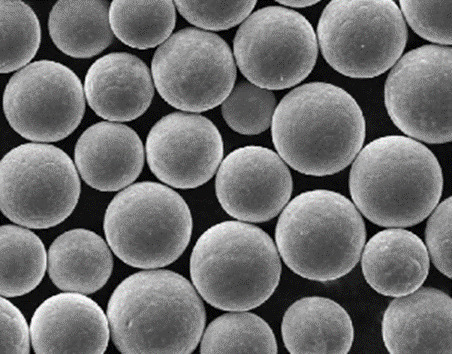
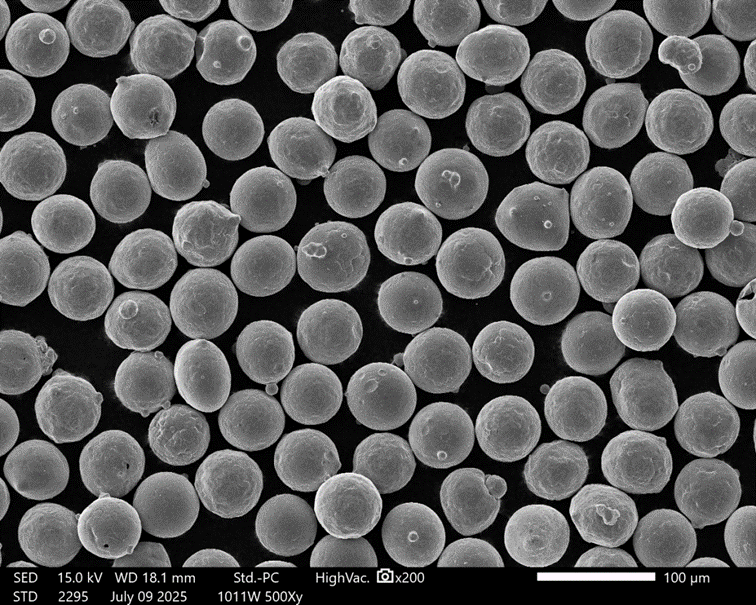
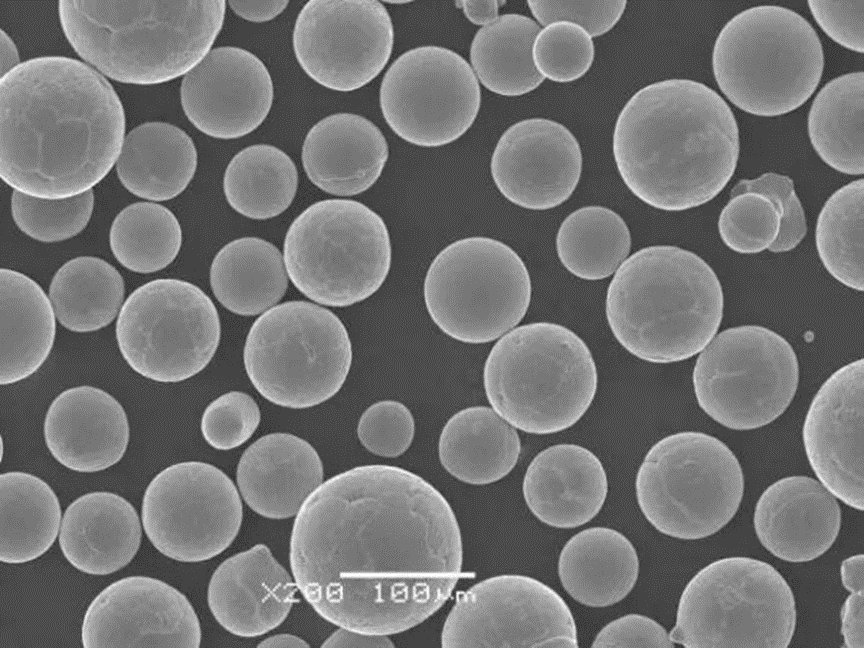
Commercial FeNiMo powder is generally supplied by particle size distribution, powder morphology, oxygen level, apparent density, tap density, Hall flow, and intended manufacturing route. Unlike 316L or Ti-6Al-4V, FeNiMo is less likely to have a universally familiar off-the-shelf AM designation, so suppliers often define internal grade codes around PSD and process suitability. The most important question is whether the powder is optimized for laser powder bed fusion, binder jetting, directed energy deposition, or conventional press-and-sinter work.
Typical FeNiMo soft magnetic powder grades
| Supply Grade / Condition | PSD Range | Apparent Density | Tap Density | Hall Flow | Oxygen / Sphericity / Cross-Reference |
|---|---|---|---|---|---|
| FeNiMo-PBF15-45 | 15–45 µm | 4.0–4.8 g/cm³ | 4.8–5.6 g/cm³ | 15–24 s/50 g | O typically ≤0.10 wt%; high sphericity; laser PBF fraction |
| FeNiMo-PBF15-53 | 15–53 µm | 4.1–4.9 g/cm³ | 4.9–5.7 g/cm³ | 15–23 s/50 g | O typically ≤0.10 wt%; common AM cut |
| FeNiMo-DED45-105 | 45–105 µm | 4.2–5.0 g/cm³ | 5.0–5.8 g/cm³ | 13–21 s/50 g | O typically ≤0.08 wt%; suitable for DED and cladding |
| FeNiMo-PM53-150 | 53–150 µm | 4.3–5.1 g/cm³ | 5.1–5.9 g/cm³ | 12–20 s/50 g | O typically ≤0.08 wt%; PM, spray, and coarse feed use |
| Test / Standards Context | — | ASTM B212 typical | ASTM B527 typical | ASTM B213 typical | Chemistry supplier-qualified to FeNiMo soft-magnetic family references |
The density figures are lower than the intrinsic alloy density because apparent and tap density describe packing behavior, not solid metal density. For magnetic AM powders, good recoating and uniform layer formation often matter more than maximizing bulk packing alone. Very fine powder may improve detail resolution, but it can also raise oxidation sensitivity and make flow behavior more difficult to control.
FeNiMo soft magnetic powder PSD by process
Fine cuts such as 15–45 µm and 15–53 µm are normally used for laser powder bed fusion because they spread more evenly in thin layers. Coarser fractions such as 45–105 µm and 53–150 µm suit DED, laser cladding, thermal spray, or conventional powder metallurgy more naturally. Binder jetting may use its own optimized size window depending on binder saturation and debinding strategy.
Standards and test methods
FeNiMo procurement typically combines supplier chemistry standards with generic powder test methods for flow, apparent density, tap density, and particle size analysis. Many technical teams also document AM routes using the terminology described in the powder bed fusion process reference, particularly when moving from prototype builds to process qualification. Because magnetic properties depend so strongly on post-processing, final acceptance criteria often include annealed property windows rather than just powder data.
What buyers should verify
For FeNiMo, buyers should request chemistry certificate, oxygen level, PSD curve, morphology evidence, Hall flow, apparent density, and tap density. If the powder will be used for a performance-critical magnetic part, they should also ask for indicative annealed permeability and coercive-force data from the intended process route. That step helps avoid the common mistake of qualifying a powder only on printability while overlooking its final magnetic function.
Manufacturing Process
FeNiMo powder can be manufactured by several routes, but gas atomization is usually the most practical for scalable spherical powder production. Vacuum-assisted methods and plasma-based routes can improve cleanliness and morphology, while lower-cost methods may sacrifice some flowability or oxidation control. For soft-magnetic materials, the production route has a direct effect on downstream magnetic quality because inclusions, oxide films, and internal defects all interfere with domain-wall motion.
Process comparison for FeNiMo soft magnetic powder
| Process | Sphericity | Oxygen Pickup | PSD Control | Throughput | Relative Cost |
|---|---|---|---|---|---|
| Gas Atomization (GA) | High | Low to moderate | Good | High | Medium |
| Vacuum Induction Gas Atomization (VIGA) | High to very high | Low | Good to very good | Medium | Medium-high |
| Electrode Induction Gas Atomization (EIGA) | Very high | Very low | Very good | Medium | High |
| Plasma Rotating Electrode Process (PREP) | Excellent | Very low | Good, often with coarser bias | Medium | High |
| Water Atomization | Moderate to low | Higher | Broad | Very high | Low |
Gas-atomized FeNiMo soft magnetic powder
GA remains the industrial baseline because it produces largely spherical particles with acceptable flowability and scalable economics. For laser and DED processes, this balance is hard to beat. When inert atmosphere control is strong, gas-atomized FeNiMo can achieve suitable oxygen levels and a stable PSD for consistent powder feeding.
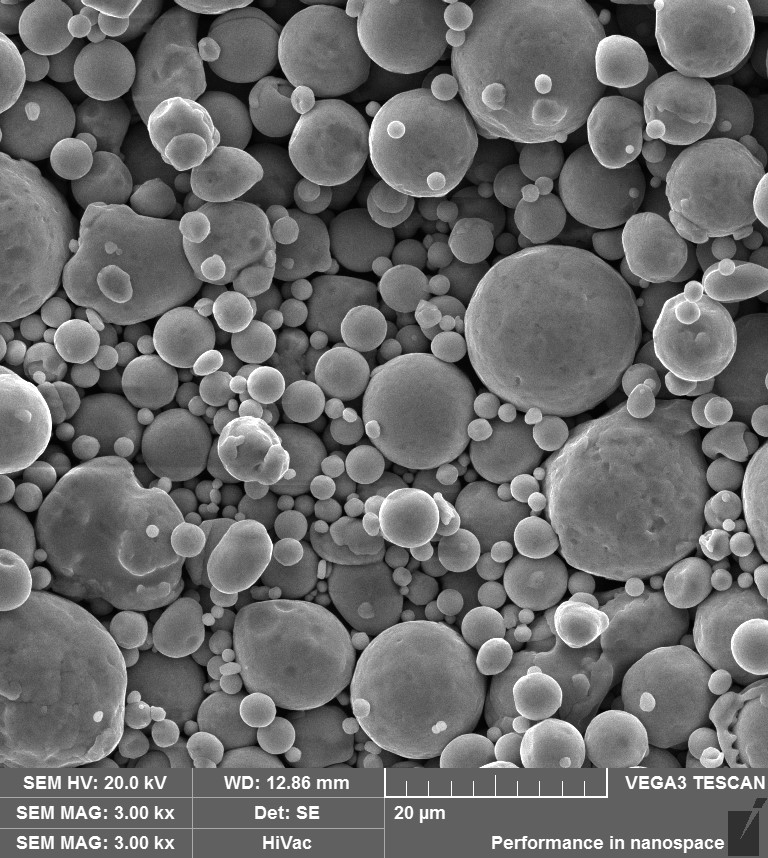
The trade-off is that GA powders may contain some satellites, rougher surface features than premium vacuum routes, and modest oxide pickup relative to cleaner methods. For structural parts that may be acceptable; for high-performance magnetic parts it deserves closer scrutiny because powder-surface condition can influence final coercivity and loss behavior.
VIGA, EIGA, and PREP trade-offs
VIGA and EIGA improve control over melting atmosphere and contamination, often yielding cleaner particles with more stable composition. PREP is associated with very high sphericity and low inclusion risk, though it can be less economical for certain fine-powder targets. These premium routes become more attractive when the application values low-loss magnetic performance enough to justify higher feedstock cost.
Water atomization and PM use cases
Water atomization is cheaper and can be suitable for some press-and-sinter routes, but its angular particles and higher oxidation levels make it less attractive for demanding AM processes. In soft-magnetic applications, the surface oxidation penalty can be particularly important because it affects both compaction behavior and final magnetic softness. As a result, water-atomized FeNiMo is usually a value choice rather than a top-performance choice.
Process route versus final properties
Powder-making method influences spreadability, packing, densification, oxygen content, and defect population. All of those variables feed into the annealing response that ultimately determines magnetic quality. In other words, low oxygen spherical powder is not just a nice specification line; it is a practical prerequisite for repeatable soft-magnetic performance.
Teams comparing magnetic alloys with broader performance families may also review nickel-based alloy powder selections when corrosion resistance or elevated-temperature strength starts to matter as much as magnetics.
Applications by Industry
FeNiMo is a specialized material, but its use cases are expanding as electromagnetic devices become more compact and geometrically complex. The alloy is most attractive where a part needs soft-magnetic behavior, moderate mechanical robustness, and a shape that benefits from powder processing. That combination appears in electronics, automation, aerospace subsystems, industrial sensors, and selected energy hardware.
Electronics and precision electromagnetic assemblies
Miniaturized inductive components, shielding structures, magnetic yokes, stator prototypes, relay parts, and sensor housings are natural applications. In these parts, the value of FeNiMo comes from the ability to print or mold three-dimensional magnetic pathways that would be awkward to stamp or machine conventionally. Post-build annealing then restores the soft-magnetic behavior required for efficient operation.
Sensors, actuators, and robotics
Modern robots and smart manufacturing systems use increasing numbers of compact sensors and actuators. FeNiMo can support magnetic flux control in housings, pole pieces, and precision flux-guiding parts where dimensional consistency is important. Powder routes also shorten iteration cycles when designers are testing multiple magnetic path geometries.
Aerospace, defense, and instrumentation
Although FeNiMo is not an airframe alloy, it can be valuable in aerospace electronics, control systems, and instrumentation. Magnetic shielding, compact actuators, and specialty sensing hardware are good examples. In these sectors, low-volume production and high design complexity often make AM a better fit than traditional stamping tooling.
Automotive and e-mobility prototyping
Automotive mass production still relies heavily on laminated electrical steels and cost-driven powder metallurgy. However, FeNiMo becomes interesting in prototypes, advanced sensors, compact motor accessories, and specialty electromagnetic modules where the geometry advantage of AM outweighs powder cost. It is especially useful during pre-production development, when design flexibility matters most.
Energy and industrial control hardware
Switchgear, inductive test components, current-sensing structures, and compact magnetic cores for research systems also fall within FeNiMo’s application window. The alloy is less likely to replace mainstream transformer steel in commodity power equipment, but it can fill niche roles where geometry complexity or size reduction matters. Broader sector usage of AM materials can be seen across the company’s industrial application coverage, where powders support printing, PM, HIP, and cladding routes.
Comparison with Alternative Materials
Material selection for magnetic parts is never based on one variable alone. FeNiMo competes with pure iron powder, silicon steels, FeNi42, and high-nickel permalloy-type materials, each of which solves a different magnetic design problem. The right choice depends on whether the priority is saturation, permeability, cost, frequency response, thermal expansion, or manufacturability.
FeNiMo soft magnetic powder versus alternative materials
| Material | Density (g/cm³) | Magnetic Behavior | Relative Cost | Printability / PM Suitability | Best-Fit Use |
|---|---|---|---|---|---|
| FeNiMo soft magnetic powder | 8.10–8.35 | High permeability, low coercivity, improved resistivity | Medium-high | Good with quality spherical powder | Precision magnetic parts, sensors, inductive hardware |
| Pure iron soft magnetic powder | 7.8–7.9 | High saturation, lower permeability than FeNiMo in many applications | Low | Very good | Cost-driven magnetic cores and structural magnetic parts |
| FeNi42 alloy powder | 8.05–8.15 | Moderate soft magnetics with controlled expansion benefit | Medium-high | Good | Thermal-match magnetic housings and sealed components |
| 3% Si electrical steel powder | 7.6–7.8 | Good magnetic response, useful for eddy-current control | Medium | Moderate to good | Motor and electromagnetic components where silicon-steel logic fits |
| 80Ni permalloy-type powder | 8.6–8.8 | Very high permeability, very low coercivity | High to very high | More specialized | Sensitive shields, high-performance magnetic circuits |
Against pure iron powder, FeNiMo usually offers better soft-magnetic finesse, particularly after annealing, but at a higher material cost. Against FeNi42, FeNiMo is more magnetically focused, while FeNi42 often wins when controlled thermal expansion is also needed. Against 80Ni permalloy-type powders, FeNiMo may give up some top-end permeability but can provide a more practical cost-performance balance for many engineering components.
Silicon-steel powders form another useful comparison. They remain strong candidates where frequency response and established motor-material logic dominate, but they do not always offer the same combination of permeability and three-dimensional component flexibility. FeNiMo is strongest where magnetic efficiency and complex geometry must coexist.
Our Company
Shanghai Truer Technology Co., Ltd., the operator of am-printing.com, was established in 2009 and created its additive manufacturing business in 2019. According to its published company information, the company works across 3D printing powder-making equipment and powder supply, including Selective Electron Beam Melting equipment, Plasma Rotating Electrode Process powder-making equipment, and Gas Atomization, while listing spherical powders such as TiNi, TiTa, TiAl, TiNbZr, CoCrMo, and nickel-, cobalt-, titanium-, copper-, aluminum-, and stainless-steel-based materials. It also states that its downstream processes include SLM, SEBM, DED, laser cladding, powder metallurgy, MIM, HIP, cold and hot spraying, welding, and coating for industries including 3C electronics, hand tools, remote control cars, medical, aerospace, and nuclear power; company background is summarized on the Truer company profile.
FAQ
Q1. Is FeNiMo soft magnetic powder suitable for metal 3D printing?
Yes, provided the powder has suitable sphericity, PSD control, and low contamination for the intended AM process. Laser powder bed fusion and DED can both use FeNiMo, but final magnetic performance depends heavily on density and post-build annealing rather than on printing alone.
Q2. How does FeNiMo soft magnetic powder compare with pure iron powder?
Pure iron powder is usually cheaper and can offer strong saturation magnetization, but it often gives a less refined soft-magnetic response in complex applications. FeNiMo is commonly preferred when designers need better permeability, lower coercivity, and improved resistivity after a controlled heat-treatment cycle.
Q3. What particle sizes are typical for FeNiMo soft magnetic powder?
For powder bed fusion, common commercial ranges are 15–45 µm and 15–53 µm. Coarser distributions such as 45–105 µm and 53–150 µm are more typical for DED, cladding, thermal spray, and conventional PM routes.
Q4. Why is annealing important for FeNiMo soft magnetic powder parts?
Annealing relieves residual stress, promotes favorable microstructure, and improves domain-wall mobility. Without that step, even a well-printed part may show lower permeability and higher coercive force than the application requires.
Q5. Which industries use FeNiMo soft magnetic powder most often?
Electronics, industrial automation, robotics, aerospace instrumentation, sensor manufacturing, and specialty energy hardware are among the most relevant sectors. These applications value the combination of soft-magnetic behavior and design freedom for three-dimensional magnetic geometries.
Q6. What should buyers verify before ordering FeNiMo soft magnetic powder?
Buyers should verify chemistry, oxygen content, particle size distribution, apparent density, tap density, Hall flow, and particle morphology. If the end use is magnetically critical, they should also request recommended heat-treatment parameters and indicative post-anneal magnetic property data for the target process route.