Quick Answer
C18150 copper chromium zirconium powder is a precipitation-hardenable CuCrZr alloy powder used in additive manufacturing when a part needs both high thermal or electrical conductivity and meaningfully higher strength than pure copper can typically provide. It is especially well suited to heat-transfer hardware, resistance-welding components, rocket and plasma-facing thermal parts, and industrial tooling with complex internal channels. In metal 3D printing, its value comes from the balance of conductivity, aging response, and print-enabled geometry rather than from maximum strength alone.
What Is C18150 copper chromium zirconium powder
C18150 is a wrought high-copper alloy grade in the Cu-Cr-Zr family, commonly referred to as CuCrZr or CuCr1Zr in closely related international naming conventions. In powder form, it is supplied as a spherical feedstock for additive manufacturing, thermal spray, powder metallurgy, and related processes where flowability, purity, and consistent particle size matter as much as nominal chemistry. The Copper Development Association alloy listing identifies C18150 as a high-copper alloy containing chromium and zirconium, with copper making up the remainder of the composition.
The reason this alloy exists is straightforward: pure copper offers excellent conductivity, but it is relatively soft and difficult to use when higher mechanical strength, hot hardness, or wear resistance are required. By adding controlled amounts of chromium and zirconium and then applying solution-and-aging heat treatment, engineers can obtain a much stronger alloy while retaining a substantial share of copper’s conductivity. That property combination is why C18150 has long been used for resistance welding electrodes, soldering gun tips, and thermally loaded industrial parts, and why it has become relevant to metal AM.
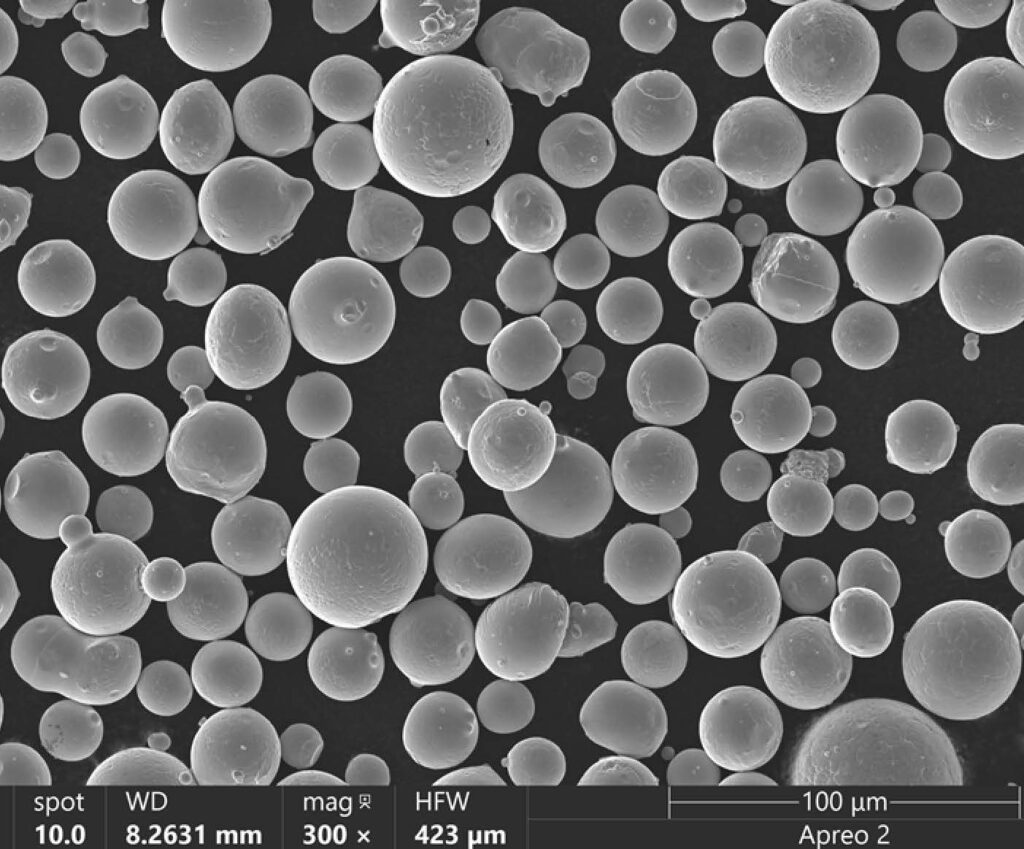
C18150 Copper Chromium Zirconium Powder in the AM Context
For additive manufacturing, the material matters because copper is notoriously challenging to print with infrared lasers. Its high reflectivity and rapid heat dissipation narrow the process window, but CuCrZr alloys are still more practical than ultra-pure copper in many industrial builds because they combine better process robustness with higher post-build strength after heat treatment. Reviews of additively manufactured CuCrZr consistently frame the alloy as one of the leading conductive copper grades for LPBF and related routes.
How C18150 Differs from Pure Copper and Other Copper Alloys
Compared with commercially pure copper, C18150 gives up some conductivity in exchange for much better mechanical performance and thermal stability after precipitation hardening. Compared with bronzes or higher-alloyed copper systems, it remains closer to a high-copper material, which is why it stays attractive in heat sinks, nozzles, electrodes, inductors, and cooling-intensive components. In other words, strength-conductivity balance is the core selling point of the grade.
Why the Powder Form Is Important
A spherical powder version enables geometries that bar stock and forgings cannot easily produce, especially lattice-supported heat exchangers, internal cooling passages, low-mass thermal heads, and near-net-shape inserts. The terminology and process families for these AM routes are defined in the ISO/ASTM 52900 additive manufacturing vocabulary, which covers powder bed fusion and directed energy deposition under a common framework. For C18150, the feedstock is not just a raw material; it is the enabler of geometry-driven thermal design.
CuCrZr becomes interesting in AM when conductivity is necessary, but geometry and post-aged strength matter too.
Chemical Composition
C18150 copper chromium zirconium powder is typically controlled as a high-copper alloy with chromium and zirconium as the principal additions. The Copper Development Association listing gives chromium at 0.50–1.50 wt.%, zirconium at 0.02–0.20 wt.%, and copper plus silver as the remainder, with copper plus the sum of named elements at 99.7% minimum. Those are the baseline chemistry expectations around which powder specifications are usually built.
| Element | Typical Content (wt.%) | Specification Range | Metallurgical Role |
|---|---|---|---|
| Cu | balance, typically 98.3–99.4 | remainder | Primary matrix; provides high thermal and electrical conductivity |
| Cr | typically 0.6–1.0 | 0.50–1.50 | Forms strengthening precipitates after aging; improves strength and softening resistance |
| Zr | typically 0.05–0.15 | 0.02–0.20 | Refines microstructure, supports precipitation response, and improves thermal stability |
| Ag | trace, if present | included with Cu value | Usually incidental within copper balance; limited effect at trace level |
| O, C, Fe, Si and other residuals | low, supplier-controlled | by internal powder spec | Influence oxide content, ductility, flow behavior, and defect sensitivity in AM |
Role of Chromium in C18150 Copper Chromium Zirconium Powder
Chromium is the main strength-forming addition. After solution treatment and aging, chromium-rich precipitates contribute significantly to hardness, tensile strength, and resistance to softening at elevated service temperatures. That is why C18150 is often chosen over pure copper when the component must survive thermal cycling or mechanical loading rather than merely conduct heat.
Role of Zirconium in CuCrZr AM Powder
Zirconium is added in a much smaller amount, but it has an outsized effect on precipitation behavior and microstructural stability. In practice, zirconium helps the alloy retain strength and refine the response to heat treatment, which is particularly valuable in AM where rapid solidification creates a supersaturated microstructure that must often be aged to reach useful performance.
Why Chemistry Control Matters for Additive Manufacturing Powder
Powder buyers should pay close attention not only to nominal Cu-Cr-Zr content but also to oxygen and residual contamination. Copper alloys are sensitive to surface oxide conditions, and in laser processes those surface conditions can influence absorptivity, wetting, and defect formation. For this reason, powder cleanliness is often as important as alloy chemistry when qualifying C18150 for serial use.
Physical and Mechanical Properties
The published baseline physical properties of wrought C18150 are well established, while AM-built properties depend strongly on relative density, build orientation, thermal history, and post-build aging. Copper.org lists specific gravity at 8.89, solidus and liquidus near 1958°F and 1976°F, electrical conductivity around 80% IACS, thermal conductivity around 187 Btu/sq ft/ft hr/°F, and elastic modulus of about 17,000 ksi. NASA and recent CuCrZr AM reviews show that additively manufactured C-18150 can achieve useful thermal performance after appropriate processing and heat treatment.
| Property | Typical Value | Unit | Test Standard / Condition |
|---|---|---|---|
| Density | 8.89 | g/cm³ | Typical room-temperature physical property |
| Solidus Temperature | 1070 | °C | Converted typical value from published alloy data |
| Liquidus Temperature | 1080 | °C | Converted typical value from published alloy data |
| Ultimate Tensile Strength | 450–560 | MPa | Typical aged condition; process dependent |
| Yield Strength | 350–520 | MPa | Typical aged condition; process dependent |
| Elongation | 8–20 | % | Typical range for dense, heat-treated material |
| Hardness | 75–90 | HRB | Typical precipitation-hardened condition |
| Thermal Conductivity | about 320–330 | W/m·K | Typical converted value from published alloy data |
| Electrical Conductivity | about 80 | % IACS | Typical room-temperature value |
Mechanical Behavior After Aging
In conventional product forms, C18150 is known as a precipitation-hardened high-copper alloy rather than a soft conductive copper. The Copper Development Association listing reports typical room-temperature tensile strengths around the high-60s to low-80s ksi range depending on form and temper, with Rockwell B hardness often in the 70s to low-80s. AM studies on CuCrZr show that post-build heat treatment is central to translating the as-built supersaturated structure into a stronger and more conductive service condition.
Thermal and Electrical Performance of C18150 Copper Chromium Zirconium Powder Builds
The main reason engineers tolerate the printing difficulty of copper alloys is that the payoff can be large in cooling-intensive parts. With C18150, the design goal is usually not to maximize conductivity at all costs, but to retain a high enough conductivity while raising strength far above pure copper. That makes the alloy particularly effective for conformal-cooled tools, heat exchangers, plasma hardware, and thermal management parts that also see vibration or contact stress.
Why Reported Properties Vary
The spread in published AM properties is wide because copper’s reflectivity, porosity sensitivity, and heat-treatment dependence amplify process differences. Laser wavelength, energy density, scan strategy, powder absorptivity, and aging schedule all influence the final balance of density, conductivity, and strength. The result is that post-build aging is not a secondary step for C18150; it is part of the materials-design logic.
Specifications and Available Grades
Commercial specifications for C18150 copper chromium zirconium powder are generally structured around chemistry, particle size distribution, morphology, oxygen content, and powder test results rather than around a single aerospace-style AM part standard. The AM vocabulary and powder testing framework are typically cross-referenced through standards such as ASTM B212 apparent density testing for metal powders and the ISO/ASTM terminology structure already noted. In day-to-day procurement, buyers usually qualify a powder against both published test methods and machine-specific build results.
| Grade / Supply Form | Typical PSD | Apparent Density | Tap Density | Hall Flow | Oxygen Content | Sphericity / Morphology | Typical Standards Cross-Reference |
|---|---|---|---|---|---|---|---|
| LPBF Fine Grade | 15–53 µm | 4.5–5.4 g/cm³ | 5.2–6.2 g/cm³ | 18–30 s/50 g | typically 200–1000 ppm | highly spherical, low satellites preferred | ISO/ASTM 52900 terminology + ASTM B212 style testing |
| LPBF Narrow Cut | 20–63 µm | 4.6–5.5 g/cm³ | 5.3–6.3 g/cm³ | 18–30 s/50 g | typically low oxygen by supplier spec | spherical gas-atomized powder | ASTM / ISO / internal AM qualification |
| DED / Cladding Grade | 45–105 µm | 4.8–5.7 g/cm³ | 5.5–6.5 g/cm³ | 16–28 s/50 g | typically 200–1200 ppm | spherical to near-spherical | machine and feeder-specific qualification |
| Coarse Thermal Grade | 53–150 µm | 4.9–5.8 g/cm³ | 5.6–6.6 g/cm³ | 15–27 s/50 g | contract-specific | spherical, classification-controlled | DED, spray, and PM route specifications |
| Cross-Reference Row | customer-defined | measured by recognized method | measured by recognized method | if free-flowing | customer limit | image analysis / SEM reviewed | ASTM / ISO / AMS / GB / DIN mapping is usually test-based, not alloy-identity based |
C18150 Copper Chromium Zirconium Powder PSD Selection
For laser powder bed fusion, the most common commercial choice is a fine spherical cut that spreads uniformly and melts consistently at thin layer thicknesses. For directed energy deposition and laser cladding, a coarser powder is typically preferred because it feeds more reliably and better matches the melt pool size. This is also why copper alloy buyers often compare C18150 against broader offerings in a copper alloy powder portfolio rather than purchasing solely by UNS number.
Powder Quality Metrics That Matter Most
Apparent density, tap density, and Hall flow are screening metrics, not final performance guarantees, but they remain useful because they reveal how consistently the powder will spread or feed. ASTM states that B212 is the preferred method for determining the apparent density of free-flowing metal powders using the Hall flowmeter funnel. For copper alloys, low oxide content and a tight satellite profile are especially important because any inconsistency in the powder can compound an already narrow process window.
International Naming and Grade Interpretation
Buyers often encounter related labels such as CuCr1Zr or CW106C alongside C18150. These are not always perfectly interchangeable in every certification context, but they point to the same general copper-chromium-zirconium alloy family. In technical sourcing, the safest approach is to match composition, test method, and intended process route rather than assuming name equivalence alone is enough.
Manufacturing Process
Most C18150 copper chromium zirconium powder for AM is made by gas atomization or a closely related inert-gas atomization route. Copper alloys demand good chemistry control and spherical morphology, so the chosen powder-making process must minimize oxidation while still delivering commercially useful throughput. In comparison with many refractory or reactive alloys, CuCrZr powder production is more about oxidation control and particle morphology than about extremely high melting temperatures.
| Process | Sphericity | Oxygen Pickup | PSD Control | Throughput | Relative Cost | Typical C18150 Use Case |
|---|---|---|---|---|---|---|
| Gas Atomization (GA) | High | Low to moderate | Good | High | Moderate | Mainstream spherical AM powder for LPBF and DED |
| Vacuum Induction Gas Atomization (VIGA) | Very high | Low | Very good | Medium to high | Moderate to high | Cleaner premium powder with tighter atmosphere control |
| Electrode Induction Gas Atomization (EIGA) | Very high | Very low | Good to very good | Medium | High | Specialty high-purity feedstock and advanced AM trials |
| Plasma Rotating Electrode Process (PREP) | Excellent | Very low | Moderate after classification | Medium | High | Ultra-spherical premium powder where morphology is critical |
| Water Atomization | Lower, more irregular | higher oxidation risk | Broad | High | Lower | PM-oriented feedstock, generally not preferred for premium LPBF |
Gas Atomization for C18150 Copper Chromium Zirconium Powder
Gas atomization is usually the baseline industrial route because it balances cost, volume, and morphology. Molten alloy is disintegrated by high-pressure inert gas into droplets that solidify rapidly, producing particles that are generally spherical enough for modern powder recoating and powder-feeding systems. For C18150, this route is widely associated with printable powder development in CuCrZr AM studies.
PREP, VIGA, and EIGA Trade-Offs
PREP can deliver excellent roundness and low satellite content, but it is usually not the first choice for large-volume copper powder because cost tends to be higher and size distribution can require additional classification. VIGA and EIGA are attractive when low contamination and tighter chemistry control are prioritized, especially for research or high-consequence thermal hardware. That trade-off resembles what buyers also see in premium refractory metal powder options and other high-performance feedstocks where purity is part of the value proposition.
Process Challenges Unique to CuCrZr Additive Manufacturing Powder
The difficulty begins after atomization as much as during it. Copper alloys reflect near-infrared laser energy strongly and conduct heat away from the melt pool quickly, so even a good powder still requires careful parameter development. Studies of LPBF CuCrZr repeatedly note that porosity reduction, cracking control, and conductivity optimization depend on the full chain of powder quality, laser strategy, and post-processing rather than on chemistry alone.
Feedstock Handling and Reuse
Because copper powders can pick up oxide and morphology changes during repeated use, reuse strategies must be managed carefully. Sieving, lot blending, storage atmosphere, and humidity control matter for C18150 just as they do for titanium or nickel alloys, but the consequences on absorptivity and melt behavior can be even more pronounced in conductive copper systems. Engineers comparing material classes often benchmark these issues against a more mature nickel powder product range to judge whether CuCrZr’s thermal upside offsets its processing complexity.
Applications by Industry
C18150 copper chromium zirconium powder is most compelling where heat must be moved quickly without surrendering all structural integrity. That profile makes it relevant across energy, aerospace, tooling, electronics, and industrial joining. In practice, the alloy’s AM adoption is driven less by generic “printability” and more by applications that reward internal channels, weight reduction, or localized thermal management.
Aerospace and Space Thermal Hardware
This is one of the strongest use cases. Additively manufactured C-18150 has been investigated by NASA specifically because copper alloys are attractive for high-heat-flux hardware, including propulsion-adjacent components where efficient heat removal is critical. Complex chamber liners, heat sinks, cooling manifolds, and thermal test articles are all plausible candidates when design freedom matters.
Resistance Welding and Industrial Joining
Long before AM, CuCrZr alloys were established in resistance welding electrodes, wheels, and related hardware because they combine conductivity with higher softening resistance than pure copper. Additive manufacturing extends that logic by allowing internal cooling paths and part-specific geometries that conventional machining would struggle to produce economically. In this sector, geometry can improve cycle time and service life as much as the alloy itself.
Tooling, Molds, and Conformal Cooling
Mold inserts and thermal tools are among the most practical industrial uses for conductive copper alloys in AM. C18150 can transfer heat rapidly while tolerating more contact pressure and thermal cycling than pure copper, making it useful for localized high-cooling zones in plastic injection or die-support tooling. This use case often sits alongside broader manufacturing case studies found in an additive manufacturing applications overview.
Energy, Fusion, and Plasma-Facing Systems
CuCrZr is already well known in extreme heat-sink discussions, including fusion-related thermal management, because it offers a strong combination of conductivity and precipitate-strengthened copper behavior. While not every fusion or plasma component is made by AM, the alloy’s role in high-heat-flux environments explains why powder-based routes are so attractive for future compact cooling architectures. The business case improves when printed complexity replaces multi-piece assemblies.
Electronics and Advanced Thermal Management
Where components must dissipate heat but cannot be made from very soft copper, C18150 becomes a sensible candidate. This includes inductors, current-carrying thermal mounts, heat spreaders, and custom electronics fixtures. The most credible applications are those where thermal management performance and shape complexity create measurable system-level value.
Comparison with Alternative Materials
C18150 copper chromium zirconium powder should always be selected against alternatives, not in isolation. The most common comparisons are with pure copper, CuCrNb-type copper alloys, bronze-like copper alloys, and nickel-based materials used when conductivity is secondary to strength or oxidation resistance. In most cases, C18150 occupies the middle ground between high conductivity and high structural capability.
| Material | Density (g/cm³) | Conductivity | Strength Potential | Printability | Relative Cost | Best-Fit Use Case |
|---|---|---|---|---|---|---|
| C18150 copper chromium zirconium powder | 8.89 | high, though below pure Cu | medium to high after aging | moderate; process-sensitive | medium to high | conformal-cooled parts, electrodes, thermal hardware |
| Pure Copper Powder | 8.96 | very high | low to moderate | difficult with standard IR lasers | medium | maximum conductivity where strength is secondary |
| CuCrNb Alloy Powder | ~8.8–8.9 | moderate to high | high at elevated temperature | moderate | high | rocket, combustion, and severe thermal service |
| CuSn10 / Tin Bronze Powder | ~8.7–8.9 | moderate | moderate | generally easier than pure copper | medium | wear-oriented or general copper-alloy AM parts |
| Inconel 625 Powder | 8.44 | low | high | well established | medium to high | high-temperature corrosion parts where conductivity is not the goal |
C18150 vs. Pure Copper
Pure copper wins on raw conductivity, but it loses when hardness, wear resistance, or structural strength become important. C18150 is often the better engineering compromise when the design needs conductive performance plus durability, especially after aging. That trade-off is central to why CuCrZr has gained traction in AM rather than remaining a niche wrought alloy.
C18150 vs. CuCrNb and Other Rocket-Grade Copper Alloys
CuCrNb-type materials are often preferred when high-temperature strength retention and combustion-chamber service dominate the requirement set. C18150 is usually more attractive where slightly higher conductivity and more established industrial copper-alloy use patterns matter, but it may not match every copper-niobium alloy in the most severe propulsion environments. The choice depends on duty cycle, cooling strategy, and allowable post-processing route.
C18150 vs. Bronze and Nickel Alloys
Bronze powders can be easier to print for some applications, but they do not occupy the same conductivity-strength niche. Nickel alloys are mechanically and chemically robust, yet they conduct heat far less efficiently. If the part’s mission is to move heat fast through a complex geometry, C18150 often makes more sense than a superalloy despite the tighter process window.
Our Company
Shanghai Truer Technology Co., Ltd., which operates am-printing.com, was established in 2009 and created its additive manufacturing business in 2019. Based on the company context provided here, Truer integrates 3D printing powder-making equipment and powder supply, with core technologies that include SEBM equipment, PREP powder-making equipment, and gas atomization-related capability; its stated portfolio includes TiNi, TiTa, TiAl, TiNbZr, CoCrMo, and spherical nickel-based, cobalt-based, titanium-based, copper-based, aluminum-based, and stainless steel powders for SLM, SEBM, DED, laser cladding, powder metallurgy, MIM, HIP, spraying, welding, and coating, with company background outlined on the company profile page and technical communication handled through the manufacturing inquiry contact page.
FAQ
Q1. Is C18150 copper chromium zirconium powder good for laser powder bed fusion?
Yes, but it is not a beginner-friendly copper powder. It is generally more practical than pure copper for many industrial parts because it can be aged to a stronger condition, yet it still requires careful control of laser parameters, powder quality, and heat treatment.
Q2. What is the main advantage of C18150 copper chromium zirconium powder over pure copper?
The main advantage is the ability to keep high conductivity while gaining much higher strength and softening resistance. That makes it useful for parts that must conduct heat or current efficiently but also survive contact loads, pressure, thermal cycling, or wear.
Q3. What particle size is typical for C18150 copper chromium zirconium powder?
For LPBF, fine spherical cuts such as 15–53 µm or 20–63 µm are common. For DED and cladding, coarser ranges such as 45–105 µm or 53–150 µm are more typical because they feed better through nozzles and align with larger melt pools.
Q4. Does C18150 copper chromium zirconium powder need heat treatment after printing?
Usually, yes. The alloy’s full value comes from precipitation hardening, so solution treatment and aging, or at minimum a carefully designed aging cycle, are often necessary to achieve the intended balance of conductivity and strength.
Q5. Where is C18150 copper chromium zirconium powder most commonly used?
Its most credible uses are in heat-transfer and current-carrying components such as conformal-cooled tooling, welding electrodes, thermal management hardware, and aerospace or energy parts exposed to high heat flux. These applications benefit from both the alloy’s conductivity and the geometric freedom of additive manufacturing.
Q6. How does C18150 copper chromium zirconium powder compare with other AM copper alloys?
It generally offers a well-balanced middle position: stronger and more thermally stable than pure copper, often more conductive than many bronze-type alternatives, and easier to justify when complex internal cooling is the real design driver. It is usually chosen when part performance depends on both conductivity and strength, not just on maximum electrical or thermal conductivity alone.