Kurzantwort
FeSiBC HVOF powder is an iron-based alloy powder, usually designed as an amorphous or amorphous-prone Fe-Si-B-C composition for high-velocity oxy-fuel thermal spraying. It is chosen when users want a lower-cost alternative to many nickel- or tungsten-based spray powders while still achieving high hardness, dense coatings, and strong wear and corrosion resistance. For industrial parts, its best value usually appears in shafts, sleeves, rollers, pump components, and repair coatings where surface protection matters more than bulk-part toughness.
What Is FeSiBC HVOF powder
FeSiBC HVOF powder is a ferrous spray feedstock built around iron with silicon, boron, and carbon additions that promote glass-forming ability, hard-phase formation, and rapid-solidification response. In most technical discussions, it sits inside the broader family of iron-based amorphous or metallic-glass coating powders rather than inside conventional stainless, tool-steel, or self-fluxing NiCrBSi categories. That family position is important because its performance comes less from equilibrium metallurgy and more from how the powder is atomized, heated in flight, and solidified on impact.
In process terms, HVOF is a thermal spray route rather than a powder-bed 3D-printing route. ISO describes thermal spraying through its own terminology and classification framework, and HVOF belongs to the high-velocity family that propels heated particles toward the substrate to build a coating layer by layer. For FeSiBC, that high-particle-velocity environment is useful because it helps produce dense deposits with lower oxidation and lower porosity than many lower-velocity spray methods.
The reason FeSiBC exists as a coating powder is straightforward: engineers often need iron-based amorphous thermal spray alloy behavior without paying for cobalt-rich or tungsten-carbide-heavy systems in every application. Silicon and boron improve glass formation and hardenability; carbon helps strengthen the deposit and support wear resistance; iron keeps the chemistry commercially practical. In service, that typically translates into good sliding-wear performance, useful corrosion resistance in many industrial environments, and a favorable cost-to-coverage ratio for large components.

FeSiBC HVOF powder as a Surface-Engineering Feedstock
FeSiBC HVOF powder should be understood first as a coating material, not as a structural wrought alloy. The end user buys it to create a functional surface with a controlled thickness, usually from tens of microns to several hundred microns, while leaving the bulk substrate to carry most of the section load. ASM’s thermal spray handbook sample notes that thermal spray coatings commonly range from about 25 µm to 6.5 mm depending on process and design intent, which fits the way Fe-based HVOF coatings are actually specified in industry.
Why This Powder Is Different from Common AM Powders
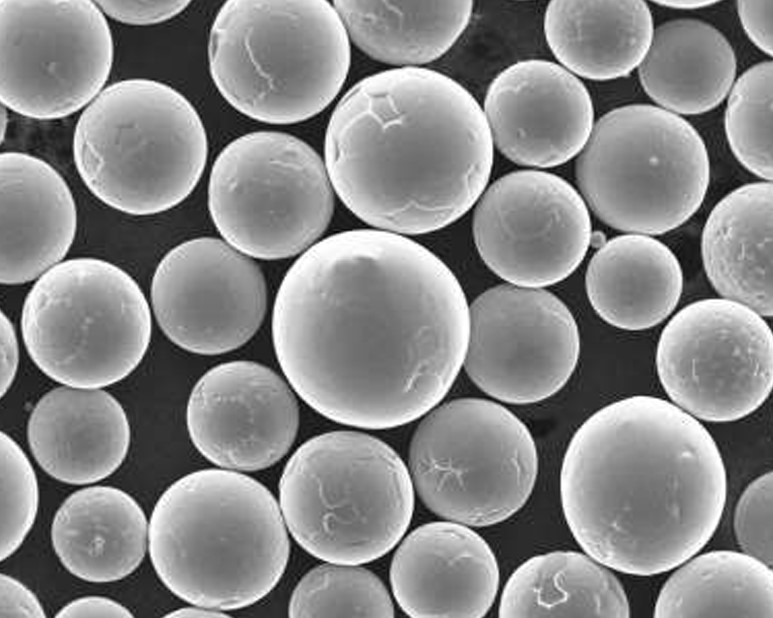
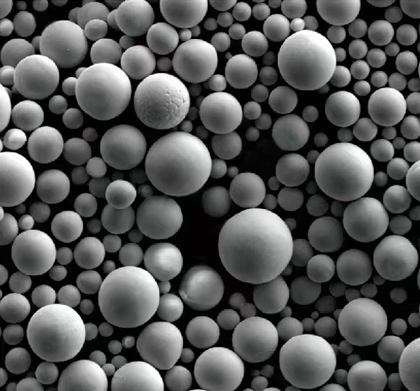
Unlike LPBF powders, FeSiBC HVOF powder is optimized for torch feeding, in-flight heating, impact flattening, and coating cohesion. That means particle morphology, flow through the feeder, and oxidation response during spraying matter more than laser absorptivity or powder-bed spreadability. Even so, many of the same powder-quality principles still apply, which is why producers often prefer spherical gas-atomized feedstock and tight size cuts.
ISO 14917 defines processes and general terms for thermal spraying.
Chemische Zusammensetzung
Publicly available FeSiBC data are more common in amorphous-powder and soft-magnetic literature than in open commercial HVOF datasheets, so most published nominal chemistries are expressed in atomic percent rather than weight percent. A widely cited FeSiBC amorphous composition is Fe(_{78})Si(_{10})B(_{10})C(_2) in at.%, which converts to roughly 91.34 wt% Fe, 5.89 wt% Si, 2.27 wt% B, and 0.50 wt% C. In HVOF practice, suppliers may tune those ratios slightly to improve atomization, flowability, or coating response, but the Fe-Si-B-C framework remains the defining feature.
| Element | Typical Content (wt%) | Typical Tolerance Style | Primary Metallurgical Role |
|---|---|---|---|
| Fe | balance, typically 89.0–93.5 | lot-specific | Matrix element, cost control, base hardness, ferrous compatibility with steel substrates |
| Si | 4.5–7.0 | nominal target | Promotes amorphous formation, improves oxidation behavior, contributes to hardness and fluidity during atomization |
| B | 1.5–3.5 | nominal target | Strong glass-forming addition, lowers melting range, supports hard boride-bearing structure after deposition or devitrification |
| C | 0.2–1.2 | nominal target | Increases hardness and wear resistance, may contribute to carbide formation depending on spray history |
| O | ≤0.20 typical for powder | controlled residual | Surface oxide indicator; excessive oxygen can reduce flow and coating quality |
| N / S / P | controlled residuals | low impurity | Kept low to reduce embrittlement, contamination, and inconsistent coating behavior |
Silicon and boron are the two most influential minor elements in the system. Boron is particularly important because Fe-based amorphous coating literature repeatedly links B additions to glass-forming ability and reduced crystallization tendency during rapid solidification. Silicon plays a similar supporting role while also helping the melt process cleanly and atomize into spherical particles.
Carbon is usually present at a lower level than silicon or boron, but it still matters. In Fe-based amorphous spray systems, carbon contributes to hardening and can shift the balance between amorphous matrix retention and secondary carbide development after spraying or heat exposure. That is one reason FeSiBC powder can be tuned either toward high as-sprayed hardness or toward a more stable mixed amorphous-plus-fine-crystalline coating structure, depending on application needs.
For users comparing families, FeSiBC is compositionally much simpler than chromium-molybdenum-rich iron-based amorphous corrosion alloys, but that simplicity is part of its appeal. It favors cost efficiency and broad wear-protection utility over the maximum chloride-corrosion performance of more alloyed Fe-Cr-Mo-B-C systems. In other words, FeSiBC is often selected for balanced industrial durability rather than for the most aggressive chemical-service environments.
Physikalische und mechanische Eigenschaften
The most important caution with FeSiBC HVOF powder is that end-use properties belong primarily to the coating, not the loose powder. Powder suppliers can certify chemistry, PSD, and morphology, but hardness, porosity, bond strength, and corrosion performance emerge only after deposition and depend strongly on torch parameters, substrate preparation, standoff distance, and coating thickness. The values below should therefore be read as typical engineering ranges for FeSiBC-class or closely related Fe-based amorphous HVOF coatings and feedstocks, not as one universal standard datasheet.
| Eigentum | Typischer Wert | Einheit | Test Standard / Basis |
|---|---|---|---|
| Powder density | 7.1–7.5 | g/cm³ | Typical calculated / measured range for Fe-rich Fe-Si-B-C feedstock |
| Coating density | 6.9–7.3 | g/cm³ | Typical HVOF coating range depending on porosity and amorphous fraction |
| Powder melting / softening range | 1050–1250 | °C | Typical engineering range; B and Si lower the effective melting interval |
| Coating hardness | 700–950 | HV0.1–HV0.3 | Typical HVOF Fe-based amorphous coating range |
| Haftfestigkeit | 40–65 | MPa | Typically evaluated under thermal-spray bond testing practice |
| Porosität | 0.5–5.0 | % | Typical optimized-to-general HVOF range |
| Wärmeleitfähigkeit | 2–8 | W/m-K | Typical reported low-to-moderate range for amorphous-rich Fe-based coatings |
| Service temperature ceiling | 350–550 | °C | Application-dependent; above this range crystallization or oxidation risk rises |
Hardness is one of the main reasons engineers choose this powder family. Published HVOF studies on related Fe-based amorphous coatings report hardness values above 800 HV, with one optimization study reporting 801 HV(_{0.1}) at low porosity and another study reporting median hardness near 752 HV in the as-sprayed condition. Other reported Fe-based amorphous coatings can exceed 1000 HV, although that usually reflects different chemistries rather than a simple baseline FeSiBC spray grade.
Bond strength and coating integrity are equally important. ASTM identifies C633 as the common tensile method for measuring adhesion or cohesion of thermal spray coatings, and published Fe-based amorphous HVOF work shows bond strength improving as porosity is reduced and spray parameters are optimized. For plant engineers, that means surface preparation and spray setup can matter as much as alloy chemistry.
Thermal conductivity is usually lower than that of bulk steel because the coating microstructure is lamellar and often contains an amorphous fraction, splat boundaries, and some residual porosity. That lower conductivity can be useful where surface heat shielding is desired, but it is not the primary selection driver for FeSiBC. The stronger commercial case is usually high hardness with lower cost than many carbide-heavy coatings.
Technische Daten und verfügbare Güteklassen
Because FeSiBC HVOF powder is not governed by one dominant global alloy standard, procurement normally relies on a supply specification rather than a named AMS-grade style designation. Buyers typically define nominal chemistry, particle size distribution, Hall flow, apparent density, oxygen limit, particle morphology, and acceptable satellite level. Particle-size acceptance is often verified using the ASTM B214 sieve analysis method, while apparent density for free-flowing powder is often checked using the ASTM B212 – Verfahren zur Bestimmung der scheinbaren Dichte.
| Supply Grade | Typischer PSD-Bereich | Scheinbare Dichte | Zapfstellendichte | Hall-Strömung | Sauerstoffgehalt | Sphärizität | Cross-Reference / Use Note |
|---|---|---|---|---|---|---|---|
| FSBC-H15/45 | 15-45 µm | 3.7–4.4 g/cm³ | 4.3–5.0 g/cm³ | 16–24 s/50 g | ≤0.15 wt% typical | hoch | Fine cut for small-nozzle HVOF or research spraying |
| FSBC-H20/53 | 20–53 µm | 3.8–4.5 g/cm³ | 4.4–5.1 g/cm³ | 15–23 s/50 g | ≤0.15 wt% typical | hoch | Common all-purpose HVOF feedstock size window |
| FSBC-H45/75 | 45–75 µm | 3.9–4.6 g/cm³ | 4.5–5.2 g/cm³ | 14–21 s/50 g | ≤0.18 wt% typical | hoch | Higher throughput on larger guns; moderate finish demand |
| FSBC-H53/106 | 53–106 µm | 4.0–4.7 g/cm³ | 4,6–5,3 g/cm³ | 13–20 s/50 g | ≤0.18 wt% typical | hoch | Coarser thermal spray, laser cladding, or repair-overlay trials |
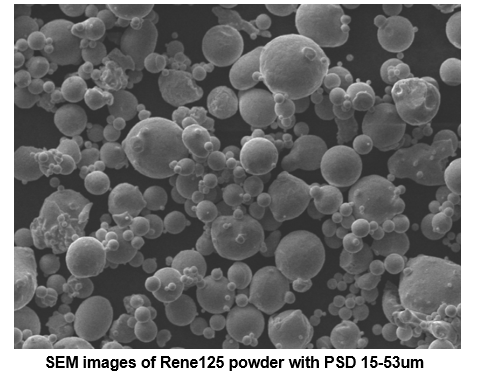
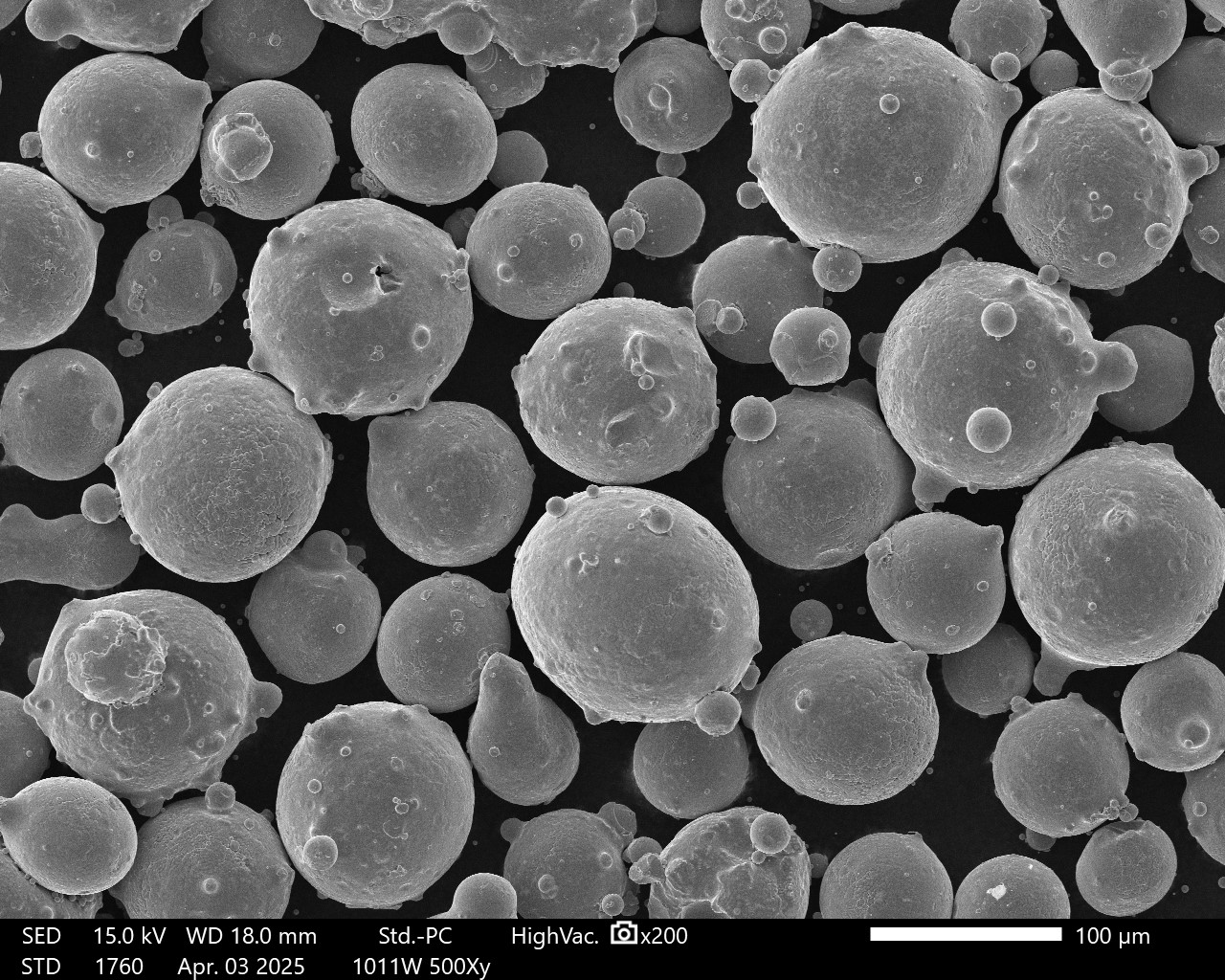
The most common HVOF size window in published Fe-based amorphous work is roughly 15–53 µm, and one numerical-experimental HVOF study describes powder particles “normally” in that range for the process. Other work used 15–45 µm gas-atomized spherical feedstock, which aligns well with standard industrial practice for dense coatings and stable feeding. That is why 20–53 µm remains the most practical starting point for FeSiBC qualification.
In commercial terms, users should ask whether the powder is fully gas atomized, gas-water atomized, or mechanically produced and then classified. FeSiBC powders in magnetic applications are often made by gas-water combined atomization, but HVOF users generally prefer more spherical material for feeding consistency and lower nozzle disruption. For coating work, spherical HVOF powder is usually the safer specification than an irregular soft-magnetic powder cut.
If a buyer is surveying adjacent materials, the broader iron-based spherical powder catalog is the natural reference point because FeSiBC competes inside the iron-alloy family rather than against every AM powder class. In specification reviews, users should also distinguish powder standards from coating standards: powder acceptance may rely on ASTM B212 and B214, while coating qualification typically adds bond strength, porosity, hardness, and thickness testing after spraying.
Herstellungsprozess
For FeSiBC HVOF powder, atomization route strongly influences particle shape, oxygen level, and final coating behavior. Gas atomization is the most natural production method for high-quality thermal spray feedstock because it produces largely spherical particles and supports tighter control of free-flowing fractions. NIST notes that atomization research has focused on process understanding and control of metal-powder production, which is exactly the kind of control HVOF users need when feeder stability and coating reproducibility are critical.
| Prozess | Feedstock Form | Typical Sphericity | Oxygen Pickup Risk | PSD-Steuerung | Durchsatz | Relative Kosten | Typischer Anwendungsfall |
|---|---|---|---|---|---|---|---|
| GA | melt stream atomized by inert gas | hoch | low to medium | very good | hoch | gemäßigt | Standard choice for HVOF powder with good flowability |
| VIGA | vacuum induction melted, inert-gas atomized | sehr hoch | niedrig | very good | mittel | mäßig bis hoch | Cleaner ferrous powder for tighter chemistry control |
| EIGA | electrode induction gas atomized | sehr hoch | niedrig | excellent | mittel | hoch | Premium spherical feedstock, lower contamination risk |
| PREP | rotating electrode atomization | sehr hoch | very low | good | niedrig | hoch | Highest sphericity, but rarely needed for cost-sensitive HVOF iron alloys |
Gas-Atomized FeSiBC HVOF powder
Gas atomization is usually the preferred route because it balances cost, particle roundness, and industrial throughput. Fe-based HVOF literature repeatedly uses gas-atomized or Ar-gas-atomized spherical feedstock, and the resulting coatings benefit from better flow, lower feeder pulsing, and more consistent particle heating. For many industrial users, GA is the point where cost and performance intersect most efficiently.
Can PREP Be Used for This Iron-Based Powder?
Technically yes, but PREP is rarely the default for FeSiBC HVOF powder. PREP excels when users need ultra-clean, very spherical powder for premium AM applications, yet FeSiBC’s commercial niche is usually surface protection rather than the most contamination-sensitive aerospace build routes. That makes PREP possible but often economically unnecessary for this alloy family.
Process Trade-Offs for HVOF Feedstock
The HVOF process itself heats and accelerates particles at high speed, commonly using fine-to-medium powder fractions that are fully or partially melted before impact. A well-known HVOF study describes typical particle sizes around 15–53 µm, high gas velocity, and strong dependence of coating structure on gas flow, fuel-to-oxygen ratio, and standoff distance. Those process variables explain why two powders with the same chemistry can produce very different coating porosity, amorphous content, and hardness.
For readers comparing adjacent technologies, FeSiBC also fits into a broader industrial powder ecosystem that includes thermal spraying, laser cladding, DED, and repair overlays. That context is visible on the site’s industrial powder application sectors, where coating and deposition routes share many of the same powder-engineering priorities even when the heat sources differ.
Anwendungen nach Branche
FeSiBC HVOF powder is not usually selected for medical implants or high-temperature turbine hot sections. Its strongest applications are wear, erosion, sliding contact, light corrosion exposure, and cost-sensitive refurbishment. That profile places it squarely in the industrial coatings segment rather than the biomedical or premium superalloy segment.
Oil and Gas Pump Components
Pump sleeves, shafts, plungers, valve parts, and seal-adjacent surfaces are logical candidates because they need abrasion resistance and tolerable corrosion behavior without always justifying WC-CoCr cost. Dense HVOF Fe-based amorphous coatings have been studied specifically for corrosion and wear-corrosion resistance, showing that coating defects and porosity reduction are central to service improvement. Where media are not extremely chloride-aggressive or erosion-intensive, FeSiBC can be a pragmatic surface option.
Automotive and Engine Hardware
Thermal spray is already well established for engine bore and tribological surface applications, and Fe-based amorphous HVOF coatings have been evaluated for protecting lightweight alloys in engine-related environments. FeSiBC is relevant wherever designers want a hard ferrous coating on steel or aluminum components with controlled coating thickness and relatively economical feedstock. Typical candidates include rollers, piston-adjacent hardware, wear rings, and sliding-contact surfaces.
Steel Processing, Paper, and General Machinery
Rollers, guide surfaces, and wear sleeves in general machinery are among the most credible commercial uses. These applications reward hardness, friction stability, and repairability more than they reward absolute corrosion resistance. That is where an amorphous-rich coating from FeSiBC can outperform plain stainless overlays or low-alloy steel hardfacings at a more accessible cost than carbide systems.
Power, Mining, and Repair Coatings
In repair work, FeSiBC HVOF powder is useful because thermal spray minimizes substrate heating compared with bulk weld build-up and can restore dimension while improving surface properties. ASM notes that thermal spray is comparatively “cold” with limited substrate thermal degradation when controlled properly, which is a practical advantage on shafts, housings, and thin-wall components. Mining and power applications benefit when downtime, not just raw material price, is the main economic driver.
For users evaluating powder portfolios across surface-engineering routes, FeSiBC sits next to cobalt, nickel, and refractory options rather than replacing them all. That is why comparison against cobalt-based coating powders or other wear-protection feedstocks is common during application screening.
Vergleich mit alternativen Materialien
Material selection for FeSiBC HVOF powder is usually a question of trade-offs: hardness versus toughness, corrosion resistance versus cost, and coating density versus deposition complexity. In that competitive set, FeSiBC does not dominate every metric, but it often wins on balanced industrial economics. It is best understood as a mid-cost ferrous protective coating rather than a universal replacement for WC-CoCr, NiCrBSi, or highly alloyed Fe-Cr-Mo amorphous powders.
| Material | Dichte (g/cm³) | Typical Hardness | Relative Kosten | HVOF Printability / Sprayability | Korrosionsbeständigkeit | Optimaler Anwendungsfall |
|---|---|---|---|---|---|---|
| FeSiBC HVOF powder | 7.1–7.5 | 700–950 HV | mittel | good | moderate to good | Cost-effective wear and light-corrosion coatings |
| WC-CoCr | 12.5-14.5 | 900–1400 HV | sehr hoch | excellent | good | Extreme abrasion and erosion resistance |
| NiCrBSi | 7.6–8.4 | 500–800 HV | mittel bis hoch | good | good | Corrosion-plus-wear service, often remelt-friendly |
| 316L / stainless spray powder | 7.8–8.0 | 200–350 HV | low to medium | very good | good | Corrosion-focused coatings with modest wear loads |
| FeCrMoCB amorphous powder | 7.2–7.8 | 800–1100 HV | hoch | good | very good | Higher-end amorphous wear-corrosion protection |
Against WC-CoCr, FeSiBC usually loses in extreme abrasion resistance and top-end hardness, but it is lighter and typically cheaper. Against NiCrBSi, it often offers higher hardness in the as-sprayed condition, though Ni-based powders can retain an advantage in broader corrosion acceptance and legacy process familiarity. Against plain stainless thermal spray powders, FeSiBC is the more serious wear solution by a wide margin.
The closest technical rival is often not tungsten carbide but a more highly alloyed Fe-based amorphous powder containing chromium and molybdenum. Those powders can provide better corrosion resistance, especially in aggressive aqueous service, but they also add alloy cost and can complicate powder sourcing. FeSiBC therefore fits best where iron-based wear and corrosion control is needed without moving all the way into premium corrosion-alloy feedstock.
In procurement terms, users who are still comparing across classes often review adjacent material families such as the nickel alloy powder range before finalizing a coating system. That is a sensible step because the substrate environment, not the alloy name alone, determines whether Fe-, Ni-, or carbide-based HVOF powder offers the best lifecycle value.
Unser Unternehmen
Shanghai Truer Technology Co., Ltd., which operates am-printing.com, was established in 2009 and launched its additive manufacturing business in 2019. According to the company’s published corporate background page, its activities include integrating powder-making equipment and powder services with spherical metal powders for processes such as SLM, SEBM, DED, laser cladding, PM, MIM, HIP, spraying, welding, and coating. The stated technology base includes SEBM equipment, PREP powder-making equipment, and gas atomization, while the broader powder portfolio covers TiNi, TiTa, TiAl, TiNbZr, CoCrMo, and nickel-, cobalt-, titanium-, copper-, aluminum-, and stainless-based materials for sectors including medical, aerospace, nuclear power, 3C electronics, hand tools, and remote-control vehicles.
FAQ
Q1. Is FeSiBC HVOF powder mainly for coating or for 3D printing?
It is mainly a coating feedstock for HVOF thermal spraying, not a mainstream LPBF or EBM structural-build powder. Its commercial value comes from surface engineering, especially where wear resistance and moderate corrosion resistance are more important than printing a full bulk part.
Q2. Is FeSiBC HVOF powder an amorphous powder?
Usually it is described as amorphous, amorphous-prone, or metallic-glass-forming, depending on exact chemistry and processing route. The powder itself may be largely amorphous after rapid atomization, and the deposited coating often aims to preserve as much amorphous fraction as practical during HVOF spraying.
Q3. What particle size is typical for FeSiBC HVOF powder?
A common industrial starting point is roughly 15–53 µm or 20–53 µm for HVOF, with finer or coarser cuts selected for specific gun designs and deposition rates. Published HVOF work on Fe-based amorphous powders repeatedly points to the 15–53 µm class as a normal operating range.
Q4. How hard are FeSiBC HVOF coatings?
Typical HVOF coatings in this family commonly fall around 700–950 HV, with many published Fe-based amorphous coatings reported above 800 HV when spray conditions are optimized. Final hardness depends on porosity, amorphous content, and whether the chemistry is a simple FeSiBC alloy or a more heavily alloyed Fe-based amorphous variant.
Q5. How is bond strength usually tested for FeSiBC HVOF coatings?
The standard reference method is often ASTM C633, which measures adhesion or cohesion strength in tension normal to the coated surface. In practice, the measured value reflects not only the alloy but also grit blasting, roughness, coating thickness, adhesive choice in the test setup, and spray-parameter discipline.
Q6. When should FeSiBC HVOF powder be chosen instead of WC-CoCr or NiCrBSi?
It is usually the better choice when the user wants a hard, dense, ferrous coating at lower cost than WC-CoCr and with stronger as-sprayed wear resistance than many stainless options. It makes less sense in ultra-severe abrasion, where WC-based systems dominate, or in highly aggressive corrosion environments, where Ni- or Cr/Mo-rich amorphous powders often hold the edge.