Kurzantwort
FeCoNiCrMo High Entropy Alloys are multi-principal-element materials, usually supplied as spherical powder for additive manufacturing, that combine high strength, good corrosion resistance, and useful thermal stability in a single alloy family. They are a strong choice for AM parts when the design needs better wear and oxidation performance than common stainless steels, while avoiding some of the extreme cost and density penalties of refractory systems. In powder form, they are especially attractive for laser powder bed fusion, directed energy deposition, and advanced coating workflows defined within ISO/ASTM 52900 – Terminologie der additiven Fertigung.
What Is FeCoNiCrMo High Entropy Alloys
FeCoNiCrMo High Entropy Alloys belong to the broader family of high-entropy alloys, also called multi-principal-element alloys or compositionally complex alloys. Instead of using one dominant base metal with minor additions, this family distributes several principal elements in relatively large proportions, often near-equiatomic ratios. That design philosophy promotes unusual phase stability, strong solid-solution effects, and a property balance that conventional iron-, nickel-, or cobalt-based alloys do not always reach.
Within that family, FeCoNiCrMo is best understood as a Mo-bearing derivative of the classic Fe-Co-Ni-Cr matrix. Molybdenum pushes the alloy toward higher strength, better pitting resistance, and improved high-temperature capability, but it can also increase segregation risk and promote intermetallic formation if the chemistry or thermal history is poorly controlled. That trade-off is exactly why this composition is interesting in additive manufacturing: powder production and rapid solidification offer tools to refine microstructure more aggressively than many cast routes.
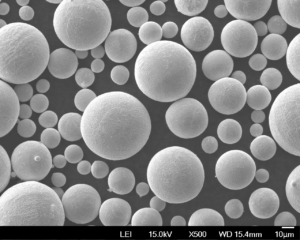
FeCoNiCrMo HEA powder in the materials landscape
Compared with the well-known Cantor-type CoCrFeMnNi system, FeCoNiCrMo generally targets a more performance-driven regime. The addition of Mo usually raises hardness, wear resistance, and hot-corrosion tolerance, making the alloy more relevant for functional engineering parts and less focused on cryogenic ductility or academic benchmark behavior. In AM powder procurement, this places the material closer to premium corrosion- and wear-resistant feedstocks than to simple stainless steels.
Why additive manufacturing suits this alloy family
AM favors alloys that benefit from rapid solidification, fine microstructure, and geometries that justify high material value. FeCoNiCrMo satisfies that logic because its complex chemistry can produce a refined cellular or dendritic structure during laser or electron-beam processing, while powder-based manufacturing reduces buy-to-fly waste for expensive elemental blends. The alloy is therefore especially relevant where performance per unit volume matters more than raw feedstock cost.
Core characteristics of FeCoNiCrMo High Entropy Alloys
The most important traits are Hochtemperaturstabilität, good corrosion behavior, strong work-hardening capacity, and elevated hardness relative to common austenitic stainless grades. Depending on exact chemistry and post-heat-treatment condition, FeCoNiCrMo can be engineered for a balance of strength and ductility or pushed toward wear-focused service with higher hardness. That tunability is one reason this alloy appears in both bulk AM and advanced coating discussions.
High-entropy alloy performance depends as much on phase control and processing history as on nominal composition.
How FeCoNiCrMo differs from conventional superalloys and stainless steels
FeCoNiCrMo is not simply a stainless steel with extra cobalt, and it is not a direct substitute for every nickel superalloy. Stainless steels usually rely on iron as the dominant matrix, while nickel superalloys are heavily centered on Ni with precipitation-hardened architectures. By contrast, FeCoNiCrMo distributes strengthening across multiple major elements and often leans on lattice distortion, mixed phases, and rapid-solidification microstructure instead of one classic precipitation mechanism.
Chemische Zusammensetzung
There is no single globally codified composition for FeCoNiCrMo High Entropy Alloys, so suppliers normally define the product as equiatomic or near-equiatomic, sometimes with a specified Mo window to tune hardness and corrosion behavior. In AM powder practice, chemistry is reported in either atomic percent or weight percent, but purchase specifications for powder certificates usually convert to weight percent because that is easier to verify by routine analytical methods.
The table below shows a representative equiatomic-to-near-equiatomic chemistry expressed in weight percent. Actual commercial targets may shift slightly to manage printability, crack resistance, or phase balance.
| Element | Typical Content (wt%) | Typical Range (wt%) | Rolle in der Metallurgie |
|---|---|---|---|
| Fe | 17.0–18.5 | 16.5–19.0 | Provides matrix support, contributes toughness, and moderates cost |
| Co | 18.0–19.5 | 17.5–20.0 | Improves high-temperature strength, phase stability, and hot hardness |
| Ni | 18.0–19.5 | 17.5–20.0 | Supports ductility, corrosion resistance, and solid-solution stability |
| Cr | 15.5–17.5 | 15.0–18.0 | Forms protective oxide films and improves oxidation and corrosion resistance |
| Mo | 28.0–31.0 | 27.0–32.0 | Raises hardness, pitting resistance, and elevated-temperature strength |
| C | ≤0.03 | 0.00–0.03 | Usually limited to avoid uncontrolled carbide networks unless intentionally modified |
| O | ≤0,10 | by powder grade | Controlled impurity affecting surface oxide, flow, and print quality |
| N | ≤0.05 | by powder grade | Controlled impurity; excessive levels may affect porosity and phase response |
The dominant strengthening logic comes from the combination of Fe, Co, Ni, Cr, and Mo rather than from one minor additive. Chromium and molybdenum are especially important because they raise corrosion resistance and harden the alloy, while cobalt and nickel help preserve matrix stability under thermal cycling. This is why FeCoNiCrMo is often evaluated for aggressive environments where both wear and chemical attack matter.
Element-by-element role in FeCoNiCrMo High Entropy Alloys
Iron provides a comparatively economical structural backbone and supports compatibility with broader engineering alloy design practice. Cobalt adds hot hardness and can help maintain strength at temperatures where simpler iron-based alloys soften. Nickel improves toughness and assists corrosion performance, while chromium develops the passive film behavior expected in aggressive oxidizing media.
Molybdenum is the pivot element. It increases strength and localized corrosion resistance, especially in chloride-bearing or reducing environments, but also raises segregation sensitivity during solidification. In powder-bed AM, that means the exact thermal strategy can decide whether Mo acts as a net advantage or becomes a source of brittle phase formation.
Composition control in spherical AM powder
For FeCoNiCrMo powder, chemistry control is inseparable from oxygen control and powder cleanliness. Fine satellites, oxide films, and composition drift between heat lots can alter laser absorptivity, melt-pool viscosity, and crack susceptibility. As a result, buyers typically qualify the powder as a system: chemistry, PSD, morphology, flow, and surface condition all matter together.
Physikalische und mechanische Eigenschaften
Because FeCoNiCrMo is a family rather than a single universally standardized alloy, published properties vary with Mo level, process route, porosity, and heat treatment. The values below represent practical engineering ranges for dense AM or HIP-consolidated FeCoNiCrMo material rather than a single guaranteed specification. They are useful for screening the alloy against stainless steels, cobalt alloys, and nickel alloys during early material selection.
| Eigentum | Typischer Wert | Einheit | Prüfnorm / Prüfbedingungen |
|---|---|---|---|
| Dichte | 8.2–8.6 | g/cm³ | Typical consolidated value at room temperature |
| Solidus temperature | 1320–1380 | °C | Calculated/typical alloy range |
| Liquidus temperature | 1380–1450 | °C | Calculated/typical alloy range |
| Ultimate tensile strength | 900–1350 | MPa | Typical dense AM or HIP condition |
| Yield strength (0.2%) | 650–1050 | MPa | Typical dense AM or heat-treated condition |
| Dehnung bei Bruch | 5–20 | % | Strongly process- and heat-treatment-dependent |
| Härte | 280–420 | HV | Typical as-built to heat-treated range |
| Elastizitätsmodul | 180–220 | GPa | Typischer Raumtemperaturbereich |
| Wärmeleitfähigkeit | 10–16 | W/m-K | Typical room-temperature estimate |
| Oxidationsbeständigkeit | good | qualitative | Service behavior depends on thermal exposure and phase balance |
These property bands explain why the alloy is attractive in difficult environments. Tensile strength is generally well above common corrosion-resistant stainless grades, while hardness is often high enough to make the material interesting for wear-loaded surfaces, valve trim concepts, and energy hardware. Thermal conductivity is relatively low, which is typical for compositionally complex alloys and can influence scanning strategy during printing.
Mechanical profile of FeCoNiCrMo HEA powder after AM consolidation
In the as-built state, FeCoNiCrMo often exhibits fine microstructural features and high strength, but elongation may be limited if there is significant elemental segregation or brittle secondary-phase formation. Hot isostatic pressing and stress relief can improve density and homogenization, though the final outcome depends heavily on alloy exactness and cooling schedule. Designers should therefore request condition-specific data rather than assuming one universal property set.
Wear, corrosion, and oxidation behavior
A major reason to select this alloy is corrosion and wear resistance under mixed mechanical and chemical loading. Chromium and molybdenum help resist aggressive media, while the hard multi-element matrix can outperform many austenitic stainless steels in sliding or erosive environments. In oxidation-limited thermal service, the alloy can also retain useful strength above the comfort zone of many standard corrosion-resistant grades.
Property variability and qualification
The property spread is wider than in mature alloys such as 316L or Inconel 718. That does not make FeCoNiCrMo unreliable; it means qualification discipline matters more. Powder chemistry, build orientation, volumetric energy density, and post-processing all influence whether the alloy delivers a tough solid solution, a strengthened multiphase structure, or an overly brittle microstructure.
Technische Daten und verfügbare Güteklassen
FeCoNiCrMo powders are typically sold as custom or semi-custom HEA grades rather than as legacy ASTM alloy names. In commercial practice, the specification package combines chemistry, particle size distribution, flow behavior, density data, oxygen limits, and morphology assessment. The absence of a single alloy-specific AM standard means powder acceptance is usually built around generic metal-powder test methods and project-level drawing or process requirements.
| Supply Grade / Reference | Typischer PSD-Bereich | Scheinbare Dichte | Zapfstellendichte | Hall-Strömung | Sauerstoffgehalt | Sphärizität | Cross-Reference / Notes |
|---|---|---|---|---|---|---|---|
| HEA-F15 | 15-53 µm | 4.4–4.9 g/cm³ | 4,9–5,5 g/cm³ | 14–20 s/50 g | ≤0.08 wt% typical | hoch | Fine LPBF-grade spherical powder |
| HEA-M45 | 45-105 µm | 4.6–5.1 g/cm³ | 5,1–5,8 g/cm³ | 12–18 s/50 g | ≤0.06 wt% typical | hoch | DED, laser cladding, coarser feed systems |
| HEA-B53 | 53-150 µm | 4.7–5.2 g/cm³ | 5.2–5.9 g/cm³ | 11–17 s/50 g | ≤0.06 wt% typical | hoch | Thermal spray or broad-cut deposition use |
| HEA-Custom | 20–63 µm or by agreement | 4,4–5,0 g/cm³ | 5,0–5,7 g/cm³ | by PSD | nach Vereinbarung | hoch | Tailored for machine-specific powder handling |
| Chemistry control row | n/a | n/a | n/a | n/a | n/a | n/a | Near-equiatomic FeCoNiCrMo with certificate of analysis |
| Powder test methods row | n/a | ASTM B212 | ASTM B527 | ASTM B213 | supplier or inert-gas fusion | image analysis | ASTM B213 – Hall-Flow-Verfahren is commonly used for free-flowing metal powders |
| PSD test methods row | n/a | n/a | n/a | n/a | n/a | n/a | Sieve practice often follows ASTM B214 sieve analysis method for coarse fractions; laser diffraction may supplement it |
| AM terminology row | n/a | n/a | n/a | n/a | n/a | n/a | Naming and process language often follows ISO/ASTM vocabulary |
For laser powder bed fusion, the 15–53 µm or 20–63 µm window is common because it balances spreadability with sufficient packing density. Directed energy deposition and cladding systems typically prefer coarser cuts to improve feeding stability and reduce the fraction of ultrafines. Broader PSDs can increase tap density, but too many fines may hurt flow and raise oxidation sensitivity.
FeCoNiCrMo High Entropy Alloys powder size selection
Powder size should match the machine, not just the alloy. A fine LPBF grade can produce better layer definition, but it may also demand tighter humidity control and a more conservative recycling strategy. Coarser powder usually handles better in feeder-based systems and is often more forgiving during production-scale operations.
Tolerance standards and documentation
There is still no universal AMS-style grade sheet for every FeCoNiCrMo HEA composition. Buyers therefore rely on a bundle of standards: generic powder tests, internal chemistry limits, oxygen thresholds, and agreed PSD tolerances. That is normal for emerging alloys and should be treated as part of the qualification plan rather than as a red flag.
Why powder consistency matters
For HEAs, Pulverkonsistenz is especially critical because even small deviations in oxygen, fine fraction, or Mo segregation can change the printed microstructure. The best procurement practice is to qualify lot-to-lot repeatability, not just one successful batch.
Herstellungsprozess
Spherical FeCoNiCrMo powder is usually produced by gas atomization or vacuum-assisted atomization routes rather than by water atomization. The alloy contains elements with high melting points and significant sensitivity to contamination, so inert atmosphere control is important. PREP can be used for premium sphericality, but it is less common than gas atomization for multi-component HEA powders because feedstock preparation is more demanding and throughput is lower.
| Prozess | Feedstock Form | Typical Sphericity | Sauerstoffaufnahme | PSD-Steuerung | Durchsatz | Relative Kosten | Practical Trade-Off |
|---|---|---|---|---|---|---|---|
| Gaszerstäubung (GA) | pre-alloyed melt | hoch | low to medium | good | hoch | gemäßigt | Most common industrial route for spherical HEA powder |
| Vakuum-Induktions-Gaszerstäubung (VIGA) | vacuum-melted pre-alloyed melt | sehr hoch | niedrig | very good | mittel | mäßig bis hoch | Better cleanliness and chemistry control |
| Elektrodeninduktions-Gaszerstäubung (EIGA) | alloy electrode | sehr hoch | very low | very good | mittel | hoch | Reduced crucible contact and lower contamination risk |
| Plasma-Rotations-Elektroden-Verfahren (PREP) | rotating alloy electrode | extremely high | very low | good | niedrig | sehr hoch | Excellent morphology, but higher cost and lower yield |
| Mechanical alloying + spheroidization | blended elemental powders | mittel bis hoch | mittel | gemäßigt | low to medium | hoch | Useful for experimental HEAs, but chemistry homogeneity must be checked |
Gas-atomized FeCoNiCrMo High Entropy Alloys
GA remains the workhorse route because it can produce spherical particles at industrial scale with acceptable oxygen levels and good size control. For FeCoNiCrMo, the pre-alloyed melt must be well homogenized before atomization, otherwise Mo-rich segregation can be frozen into the powder. When process control is strong, GA delivers a good balance of cost, output, and printability.
VIGA and EIGA for cleaner HEA powder
VIGA and EIGA are attractive when cleanliness requirements are stricter or when the buyer wants lower contamination from refractory contact. This matters for HEAs because small changes in chemistry can shift phase balance more visibly than in simpler alloys. Cleaner powder can translate into more predictable laser absorption, more stable melting, and less scatter in mechanical data.
PREP and premium spherical powder
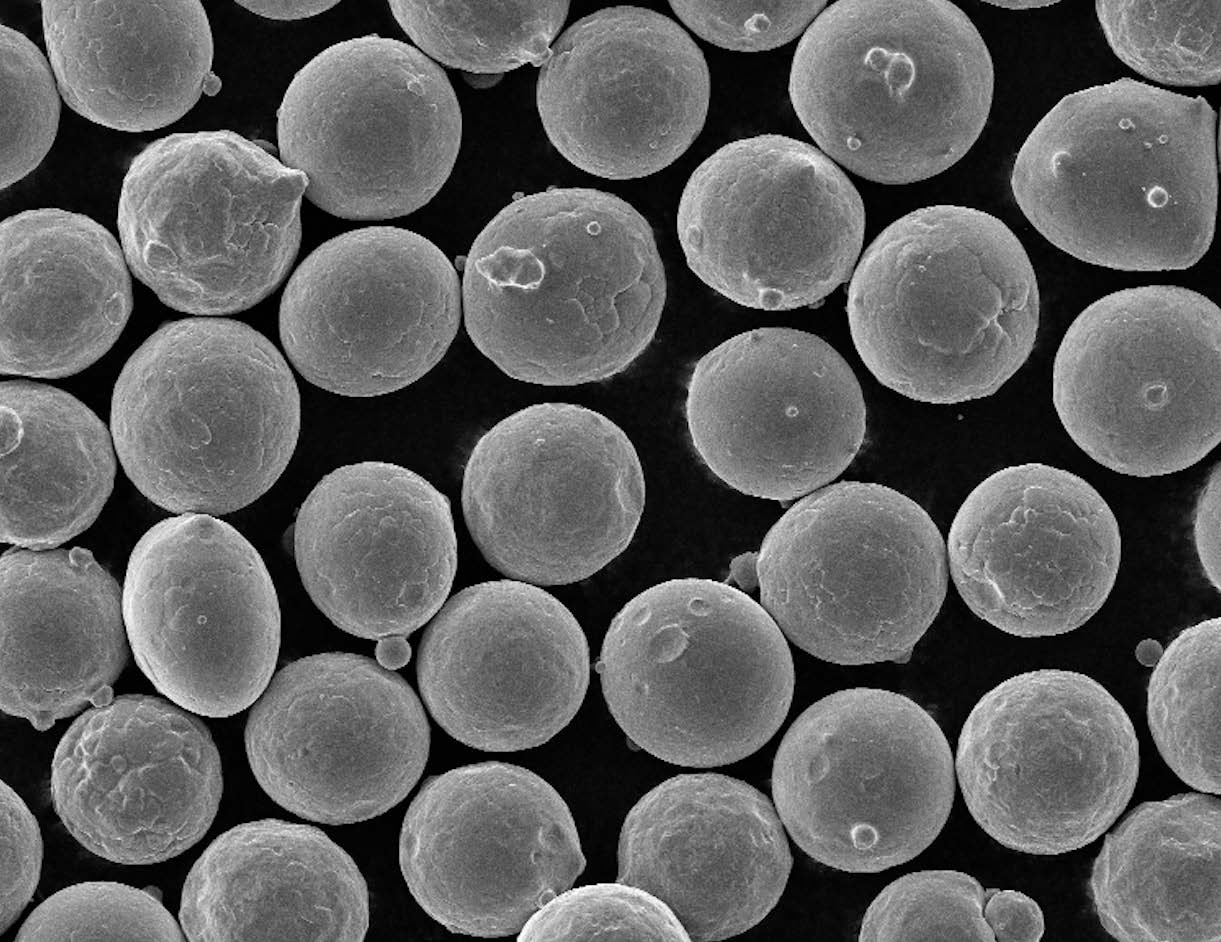
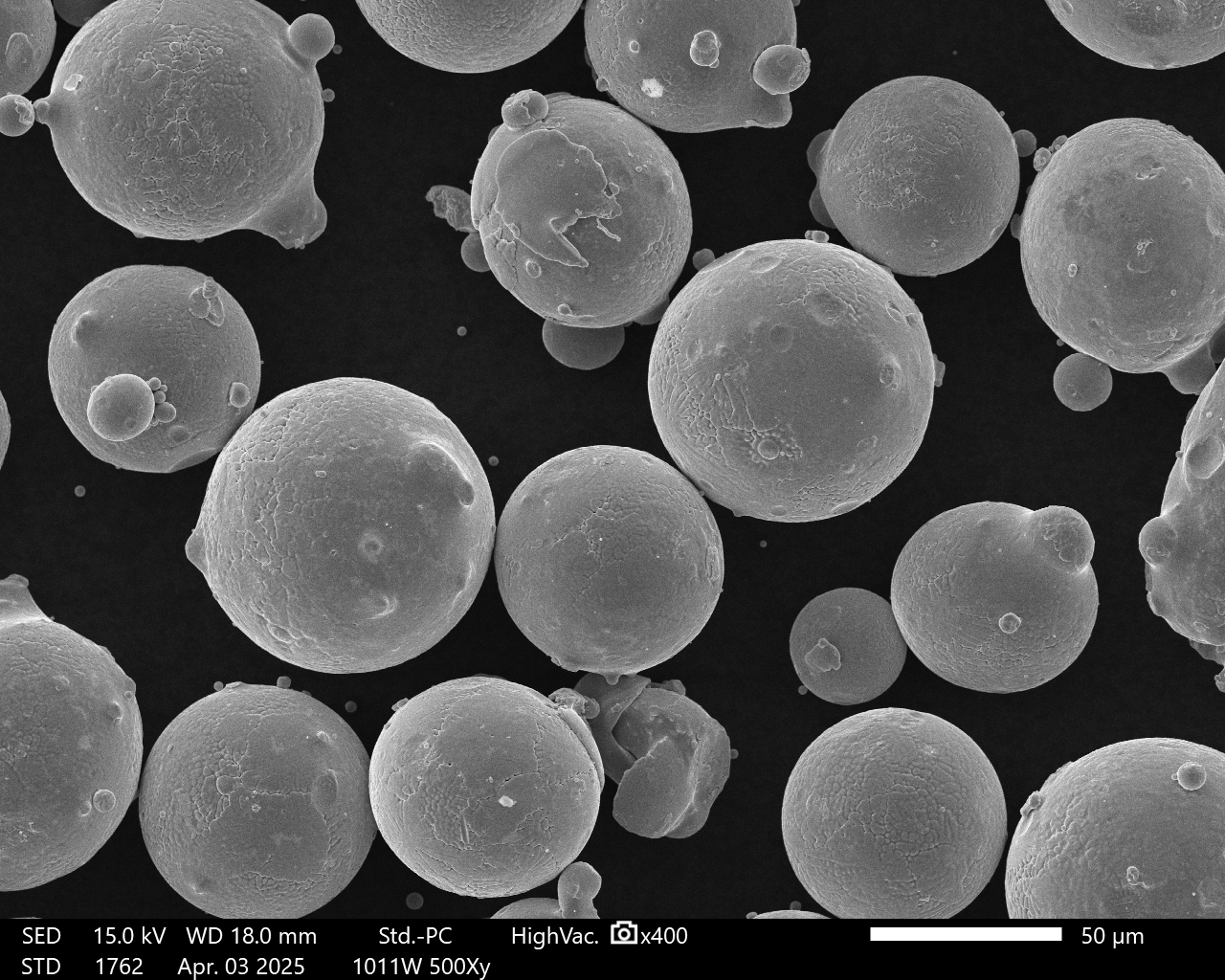
PREP is prized for near-perfect particle shape, low satellite content, and excellent flow. However, its economics usually reserve it for highly demanding applications or for alloy systems where premium morphology clearly justifies the cost. In FeCoNiCrMo, PREP can be compelling for benchmark-quality research powder or mission-critical parts, but it is not always the default commercial route.
Downstream processing routes
Once produced, FeCoNiCrMo powder can be used in LPBF, DED, laser cladding, and some thermal spray workflows. The general additive-manufacturing framework described by NIST-Forschung im Bereich der additiven Fertigung highlights why powder properties, machine parameters, and process monitoring are tightly linked in metal AM.
This alloy family also sits naturally beside other advanced feedstocks such as multi-principal element powder grades and premium nickel alloy powder systems when engineers compare heat resistance, corrosion behavior, and qualification burden.
Anwendungen nach Branche
FeCoNiCrMo High Entropy Alloys are not commodity powders. They are chosen when corrosion, wear, strength, and thermal exposure combine in ways that strain conventional stainless steels but do not necessarily require the full expense of the most exotic refractory alloys. That makes the material relevant in targeted, high-value sectors rather than in general-purpose prototyping.
Aerospace and aero-engine support hardware
In aerospace, the alloy is most plausible for non-flight-critical development parts, combustor-adjacent hardware, wear-prone fixtures, and hot-gas-path support geometries that benefit from corrosion and oxidation resistance. It is less established than titanium or nickel superalloys in flight-certified structural roles, but it is technically interesting where thermal stability and geometric complexity matter together.
Energy, power, and nuclear-adjacent environments
The alloy’s combination of chromium and molybdenum makes it relevant for aggressive energy systems, including valves, manifolds, seals, and corrosion-exposed internal features. HEA research also has a visible presence in nuclear and high-temperature materials development, where phase stability and damage tolerance are studied closely. In these environments, AM allows rapid iteration of channels, lattices, and internal geometries that are difficult to machine conventionally.
Öl- und Gasausrüstung
Oil and gas applications value resistance to wear, chloride attack, sour environments, and mixed thermal-mechanical loading. FeCoNiCrMo can be considered for cladding powders, repair builds, trim components, and specialty geometry parts where stainless steels may wear too quickly and cobalt or nickel systems may be over- or under-specified depending on the duty cycle.
Tooling, surface engineering, and repair
Because the alloy can achieve high hardness and good corrosion behavior, it is a credible choice for laser cladding, protective overlays, and tooling surfaces exposed to abrasion or thermal cycling. Many users first adopt FeCoNiCrMo not as a bulk printed part but as a functional surface material, which reduces qualification burden while still exploiting the alloy’s strengths.
Medical and chemical-processing caution
The alloy contains cobalt and high nickel content, so it is not a default implant material. It may have niche relevance in non-implant medical tooling or corrosive processing hardware, but end users should not treat it as interchangeable with medical Ti-6Al-4V or CoCrMo without a dedicated biocompatibility and regulatory review. For broader material benchmarking, engineers often compare it with Pulverfamilien aus Kobaltlegierungen and selected corrosion-resistant conventional alloys.
FeCoNiCrMo HEA use-case boundaries
This alloy is strongest where service demands are severe and production volumes are modest. It is weaker as a business case for low-cost automotive brackets, mass-market housings, or parts whose only requirement is moderate corrosion resistance. In those situations, 316L, duplex stainless, or simpler iron-based AM alloys usually win on cost and supply maturity.
Vergleich mit alternativen Materialien
Material selection for FeCoNiCrMo should be comparative, not isolated. The most practical alternatives are not “all metals,” but those powders already common in corrosion-resistant and high-performance AM: 316L stainless steel, Inconel 718, CoCrMo, and selected refractory alloy systems. Each alternative wins on something different—cost, certification maturity, hot strength, or wear behavior.
| Material | Dichte (g/cm³) | Strength Level | Relative Kosten | Druckbarkeit | Korrosionsbeständigkeit | Best-Fit Position |
|---|---|---|---|---|---|---|
| FeCoNiCrMo High Entropy Alloys | 8.2–8.6 | hoch | hoch | moderate to good after tuning | hoch | Balanced wear, corrosion, and thermal stability |
| 316L stainless steel | about 8.0 | mittel | gering bis mäßig | excellent | good | General-purpose corrosion-resistant AM |
| Inconel 718 | about 8.2 | sehr hoch | hoch | excellent and mature | good to very good | High-temperature structural AM with strong standards base |
| CoCrMo alloy | 8.3–8.5 | hoch | hoch | good | very good | Wear and corrosion resistance, medical and industrial use |
| Refractory HEA / Mo-rich refractory alloy | 9.5–12+ | very high at temperature | sehr hoch | challenging | variable | Extreme-temperature service with major cost and process burden |
Against 316L, FeCoNiCrMo typically offers higher hardness, better wear performance, and stronger high-temperature retention, but at a much higher qualification and feedstock cost. Against Inconel 718, it may offer an attractive corrosion-wear balance in certain environments, yet it lacks the same depth of property databases and industrial specification maturity.
Compared with CoCrMo, FeCoNiCrMo can be tailored toward a broader strength-corrosion-temperature balance, though cobalt-chromium systems remain more established in certain wear and medical-adjacent markets. When the duty cycle pushes into the highest temperature regime, Optionen für Pulver aus hochschmelzenden Metallen may outperform FeCoNiCrMo, but they also bring much steeper density, brittleness, and processing challenges.
Unser Unternehmen
Shanghai Truer Technology Co., Ltd., operating am-printing.com, was established in 2009 and created its additive manufacturing business in 2019. Based on the company’s published profile, it integrates 3D printing powder-making equipment and powder supply, including SEBM equipment, PREP powder-making equipment, and gas atomization capabilities, and its portfolio includes TiNi, TiTa, TiAl, TiNbZr, CoCrMo, plus nickel-based, cobalt-based, titanium-based, copper-based, aluminum-based, and stainless steel spherical metal powders for SLM, SEBM, DED, laser cladding, powder metallurgy, MIM, HIP, spraying, welding, and coating. Its company background details describe a joint innovation center for metal 3D printing and industry coverage that includes 3C electronics, hand tools, remote-control cars, medical, aerospace, and nuclear power.
FAQ
Q1. Are FeCoNiCrMo High Entropy Alloys better than stainless steel for 3D printing?
They are not universally better; they are more specialized. FeCoNiCrMo usually offers higher hardness, stronger wear resistance, and better high-temperature property retention than 316L, but stainless steel remains cheaper, easier to qualify, and more widely standardized for general-purpose AM.
Q2. Is FeCoNiCrMo High Entropy Alloys suitable for laser powder bed fusion?
Yes, spherical FeCoNiCrMo powder can be suitable for LPBF when PSD, oxygen level, and laser parameters are properly matched. The main challenge is controlling segregation and brittle phase formation, especially because the Mo-bearing chemistry can respond sharply to thermal history.
Q3. What particle size is commonly used for FeCoNiCrMo HEA powder?
A common LPBF window is 15–53 µm, while DED and cladding grades are often supplied in the 45–105 µm or 53–150 µm range. The correct cut depends on the feeding system, layer thickness, nozzle design, and the balance between flowability and resolution.
Q4. Why does molybdenum matter so much in FeCoNiCrMo High Entropy Alloys?
Molybdenum substantially improves hardness, localized corrosion resistance, and elevated-temperature performance. At the same time, it raises the risk of segregation or brittle secondary phases if the alloy is not atomized, printed, and heat treated carefully.
Q5. Can FeCoNiCrMo High Entropy Alloys replace Inconel 718?
Sometimes, but not by default. Inconel 718 still has a deeper industrial standards base, a larger qualification history, and stronger acceptance in certified high-temperature structural service, while FeCoNiCrMo is more often selected for targeted wear-corrosion-thermal combinations that fall outside standard alloy comfort zones.
Q6. What should buyers ask for when sourcing FeCoNiCrMo High Entropy Alloys powder?
They should request full chemistry, oxygen and nitrogen limits, PSD data, apparent and tap density, Hall flow, morphology evidence, and condition-specific mechanical data after AM and post-processing. It is also wise to ask how the powder was produced, how recycling affects chemistry stability, and whether the supplier has prior experience supporting similar high-entropy alloy applications.