Kurzantwort
FeCoNiCrMnAl0.3 High Entropy Alloys are compositionally complex cobalt-nickel-iron-chromium-manganese alloys with a modest aluminum addition, typically developed for additive manufacturing, powder metallurgy, and advanced structural research. They are chosen for AM when engineers want a better balance of ductility, strength, phase stability, and density reduction than the baseline Cantor alloy can provide. In practice, the Al(_{0.3}) variant is especially interesting for laser powder bed fusion and directed energy deposition because it tends to retain strong FCC character while adding measurable solid-solution strengthening and microstructural tuning flexibility.
What Is FeCoNiCrMnAl0.3 High Entropy Alloys
FeCoNiCrMnAl0.3 High Entropy Alloys belong to the 3d transition-metal high-entropy alloy family derived from the well-known CrMnFeCoNi or “Cantor” composition. In HEA terminology, these alloys do not rely on one dominant base element; instead, several principal elements are combined in near-equiatomic proportions to create a chemically complex solid solution with unusual deformation behavior, phase selection, and property combinations compared with conventional steels or superalloys. A concise general definition appears in the high-entropy alloy overview, which describes HEAs as alloys built around multiple principal elements rather than one main solvent.
The designation “Al0.3” means the aluminum content is added at roughly 0.3 molar ratio relative to the near-equiatomic Fe-Co-Ni-Cr-Mn backbone. That apparently small change matters. In Al(_x) derivatives of the Cantor system, aluminum can alter lattice distortion, local chemical order, stacking-fault behavior, oxidation response, and the probability of secondary phase formation. Research summaries on Al(_{0.3})CoCrFeNiMn compositions indicate that lower aluminum contents, including (x = 0.3), commonly preserve a predominantly FCC structure, whereas higher Al levels are more likely to promote BCC/B2 constituents.
For additive manufacturing, this composition is attractive because it offers a middle path between the high ductility of the original Cantor alloy and the higher strength often associated with Al-containing derivatives. That does not mean every feedstock behaves identically; processing route, cooling rate, oxygen content, and thermal history still govern the final microstructure. But the alloy family is widely studied precisely because it gives metallurgists a large design window without abandoning the manufacturability of transition-metal systems already familiar to AM users.
FeCoNiCrMnAl0.3 High Entropy Alloys as AM Powder Feedstock
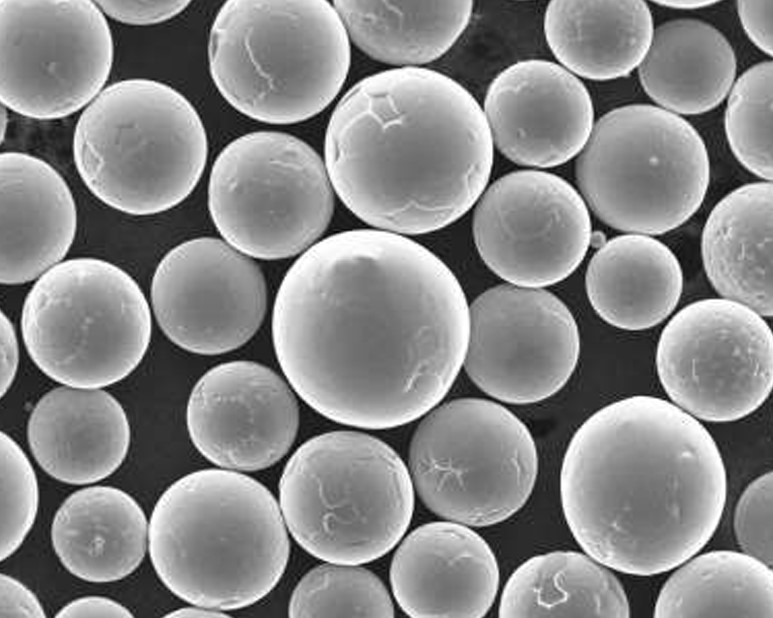
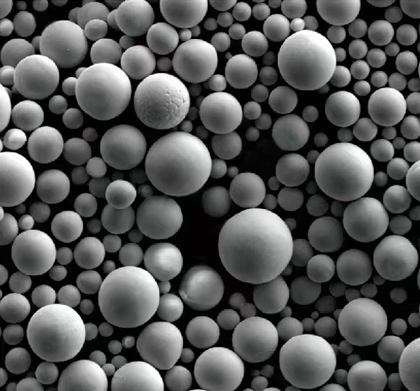
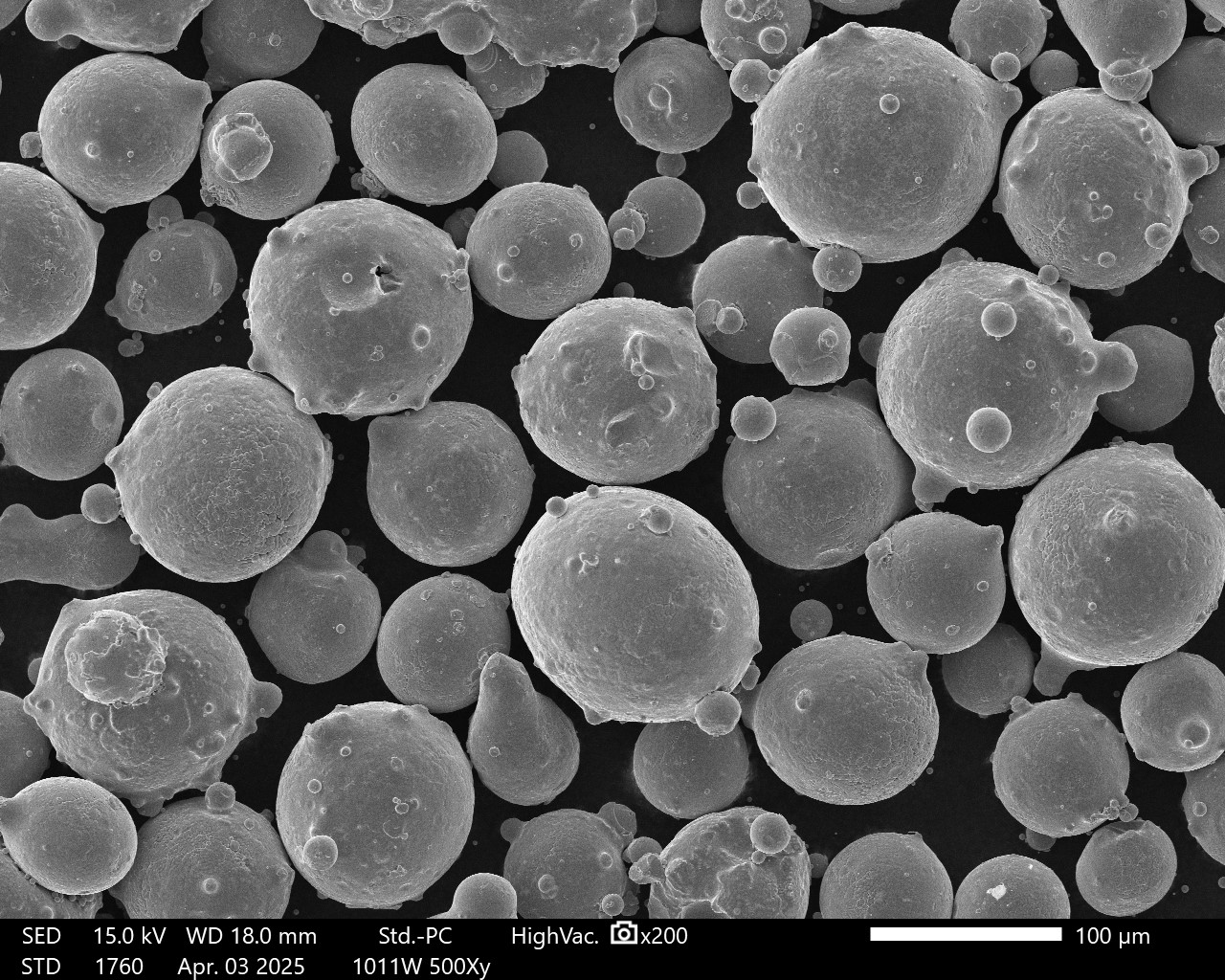
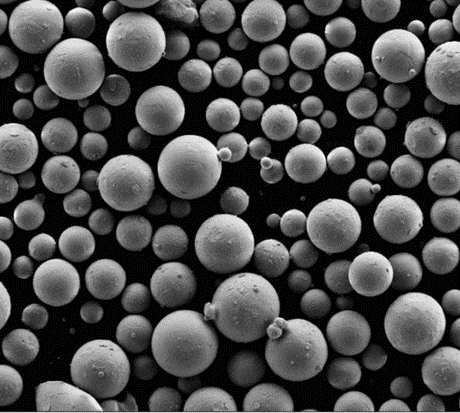
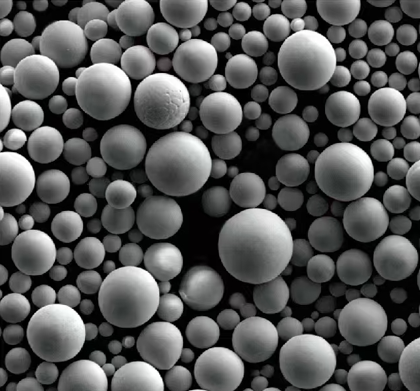
When supplied as spherical powder, the alloy is usually evaluated less like a commodity grade and more like a research-enabled engineering material. Users want stable flowability, low oxygen, repeatable PSD, and reliable melting behavior under fast solidification. The process language used for these routes follows the Begriffe gemäß ISO/ASTM 52900, which defines additive manufacturing as successive addition of material to build 3D geometry from model data.
Why Al0.3 Matters in This HEA Family
The practical reason Al(_{0.3}) receives attention is that it can improve strength while avoiding the more aggressive phase changes seen at higher aluminum contents. For engineers, that often translates into a promising compromise: retain useful ductility, lower density somewhat, and open the door to precipitation or ordering effects after process or heat-treatment control. That is why this composition is regularly discussed in relation to cryogenic service, lightweight structural concepts, and high-performance AM microstructure design.
High-entropy alloys use several principal elements in substantial proportions rather than one dominant base metal, enabling unusual combinations of strength, ductility, and phase stability.
Chemische Zusammensetzung
FeCoNiCrMnAl0.3 High Entropy Alloys are most commonly written in atomic-ratio form, but powder purchasing, ICP chemistry reports, and feedstock certificates are usually handled in weight percent. Converting the nominal formula FeCoNiCrMnAl(_{0.3}) to wt% gives a useful target chemistry for powder production, with aluminum remaining a minor but influential constituent by mass because of its much lower atomic weight. The values below are nominal, and commercial powder lots are typically released within agreed chemistry tolerances rather than at one immutable number.
| Element | Nominal Atomic Ratio | Approx. Nominal Content (wt%) | Typical Role in the Alloy |
|---|---|---|---|
| Fe | 1.0 | 19.36 | Contributes to FCC matrix stability, cost control, and overall solid-solution strength |
| Co | 1.0 | 20.43 | Supports strength, thermal stability, and deformation response in multicomponent FCC alloys |
| Ni | 1.0 | 20.34 | Helps stabilize FCC structure and supports ductility and corrosion behavior |
| Cr | 1.0 | 18.02 | Improves oxidation and corrosion resistance and affects short-range order and phase selection |
| Mn | 1.0 | 19.04 | Influences stacking-fault energy, ductility, and low-temperature deformation behavior |
| Al | 0.3 | 2.81 | Lowers density, increases lattice distortion, and can promote strengthening or ordered phases |
| O / N / C | - | controlled residuals | Interstitials are typically minimized because they can alter phase stability and embrittlement behavior |
From a metallurgical perspective, the defining move in this composition is the controlled addition of aluminum to a Cantor-like matrix. Fe, Co, Ni, Cr, and Mn together favor a tough FCC-rich framework; aluminum then changes bonding and atomic-size mismatch enough to raise strength and reduce density without automatically forcing the alloy into a fully BCC-dominated regime at this loading level. That is why single-phase FCC tendency is often discussed as a key feature of the Al(_{0.3}) composition window.
Chromium and manganese deserve separate attention because they do more than fill out the stoichiometry. Chromium is central to passivation and oxidation behavior, while manganese can strongly influence stacking-fault energy and the transition between dislocation glide, twinning, and other deformation modes. In high-entropy systems, those mechanisms are sensitive to both chemistry and thermal history, so the same nominal alloy may respond differently after casting, rolling, LPBF, or solution treatment.
The powder maker also has to control trace contamination carefully. Although FeCoNiCrMnAl0.3 is less reactive than titanium, surface oxygen, moisture exposure, and repeated powder reuse can still shift flowability, laser absorptivity, and defect formation. NIST’s metal powder metrology work emphasizes that particle size distribution, spreadability, and powder layer density all affect final part quality in commercial AM systems.
Physikalische und mechanische Eigenschaften
Like many high-entropy alloys, FeCoNiCrMnAl0.3 High Entropy Alloys should be described with “typical” values rather than one universal datasheet. Properties vary with route: as-cast, wrought, mechanically alloyed, powder-bed-fused, and heat-treated material can all differ substantially. Even so, literature summaries show a fairly consistent trend: the Al(_{0.3}) composition offers higher strength than the original Cantor alloy while preserving useful ductility, especially when the microstructure remains FCC-dominant and fine-grained.
| Eigentum | Typischer Wert | Einheit | Test Standard / Basis |
|---|---|---|---|
| Dichte | 7.4–7.8 | g/cm³ | Typical reported / calculated range for Al-containing Cantor-derived HEAs |
| Solidus-Liquidus Range | 1280–1380 | °C | Typical engineering estimate for multicomponent 3d transition-metal HEAs |
| Endgültige Zugfestigkeit | 650–950 | MPa | Typical room-temperature values depending on condition and route |
| Streckgrenze (0.2%) | 220–650 | MPa | Reported range from cast to refined or AM-processed conditions |
| Dehnung | 25–70 | % | Typical range; higher values associated with FCC-rich, well-homogenized states |
| Härte | 180–300 | HV | Typical microhardness / Vickers range for Al(_{0.3})-class variants |
| Elastischer Modul | 170–210 | GPa | Typical engineering range for 3d transition-metal HEAs |
| Wärmeleitfähigkeit | 10–16 | W/m-K | Typical low-to-moderate room-temperature estimate for HEA systems |
One important point is that the alloy’s strength-ductility balance is route-dependent. A search summary for LPBF Al(_{0.3})CoCrFeNiMn notes previously reported values around 220 MPa yield strength with 71.6% ductility in one condition, illustrating how soft but highly deformable FCC-rich states can exist. In contrast, refined AM microstructures, thermomechanical treatments, or precipitate-controlled variants can push yield strength much higher, often at some cost to elongation.
The density advantage is modest but real. Aluminum lowers the alloy density relative to many nickel superalloys and to some cobalt-rich alternatives, which is part of the reason HEAs are studied for aerospace and energy hardware. A Chalmers summary of HEA densities shows that Al-containing transition-metal HEAs can move into the mid-7 g/cm(^3) range, below Inconel 718 at about 8.19 g/cm(^3). That does not make FeCoNiCrMnAl0.3 a lightweight alloy in the titanium sense, but it does improve specific properties.
Another property discussion that matters in AM is not a line-item number at all, but microstructural stability. Engineers are interested in whether the alloy stays FCC, develops ordered nanoparticles, or shifts toward mixed FCC/BCC/B2 states after thermal cycling. In this sense, Al-controlled strengthening is both the alloy’s opportunity and its qualification challenge: the same chemistry that improves strength can also create phase-selection sensitivity during printing or post-heat treatment.
Technische Daten und verfügbare Güteklassen
There is no single globally dominant commodity specification for FeCoNiCrMnAl0.3 High Entropy Alloys comparable to mature aerospace grades such as IN718 or Ti-6Al-4V. Instead, powder is usually purchased to an agreed nominal chemistry, morphology requirement, and particle size cut suitable for the target AM process. In practice, buyers specify PSD, oxygen limit, Hall flow, apparent density, tap density, and lot-to-lot chemistry tolerances, then map those requirements onto general powder test standards rather than a dedicated HEA alloy standard.
| Supply Grade | Typischer PSD-Bereich | Scheinbare Dichte | Zapfstellendichte | Hall-Strömung | Sauerstoffgehalt | Sphärizität | Cross-Reference / Use Note |
|---|---|---|---|---|---|---|---|
| HEA-15/45 | 15-45 µm | 4.1–4.6 g/cm³ | 4,8–5,4 g/cm³ | 15–22 s/50 g | ≤1000 ppm typical | High, spherical | Fine LPBF feedstock; density and flow often checked by ASTM B212 / B213 / B527 |
| HEA-15/53 | 15-53 µm | 4.2–4.7 g/cm³ | 4,9–5,5 g/cm³ | 14–21 s/50 g | ≤1000 ppm typical | High, low-satellite | Common for laser PBF development and parameter studies |
| HEA-45/105 | 45-105 µm | 4,3–4,9 g/cm³ | 5,0–5,7 g/cm³ | 13–19 s/50 g | ≤900 ppm typical | High, free-flowing | DED, laser cladding, blown-powder repair trials |
| HEA-53/150 | 53-150 µm | 4,4–5,0 g/cm³ | 5,1–5,8 g/cm³ | 12–18 s/50 g | ≤900 ppm typical | High, coarse spherical | Higher-deposition-rate cladding and experimental spray routes |
The standards language around these powders is usually indirect. AM process categories are defined under ISO/ASTM 52900, while the powder measurements themselves often rely on long-established metal-powder methods. For example, apparent density may be specified under the ASTM B212 – Verfahren zur Bestimmung der scheinbaren Dichte, while the NIST powder program highlights spreadability, particle size distribution, and powder-layer behavior as critical variables for repeatable commercial AM production.
For LPBF, the most common commercial logic is to choose the finest fraction that still spreads consistently and maintains acceptable oxygen control. For DED and laser cladding, coarser fractions are usually preferred because feeding stability and deposition efficiency matter more than thin-layer resolution. Buyers looking across multiple compositionally complex systems often compare this alloy with other products in the high-entropy powder category when qualifying process windows for research or pilot production.
A final purchasing issue is compositional notation. Some suppliers may list the alloy as Al(_{0.3})CoCrFeMnNi, others as FeCoNiCrMnAl0.3, and still others may report atomic percent directly. The nominal chemistry is usually the same concept, but procurement teams should verify whether the certificate is expressed in at.% or wt.% to avoid specification drift during qualification.
Herstellungsprozess
FeCoNiCrMnAl0.3 High Entropy Alloys powder is typically made by atomization routes because AM demands high sphericity, low contamination, and predictable PSD control. Gas atomization remains the mainstream industrial method, but premium spherical feedstock may also be produced through vacuum inert gas atomization, electrode induction gas atomization, or plasma rotating electrode processing. NIST’s powder metrology work makes clear why these distinctions matter: even when chemistry is nominally identical, powder behavior changes with morphology, size distribution, and surface condition.
| Prozess | Feedstock Form | Typical Sphericity | Oxygen Pickup Risk | PSD-Steuerung | Durchsatz | Relative Kosten | Typischer Anwendungsfall |
|---|---|---|---|---|---|---|---|
| GA | Melted alloy stream | Hoch | Mittel | Gut | Hoch | Mäßig | General-purpose AM powder, R&D lots, LPBF and DED supply |
| VIGA | Vacuum-melted alloy | Hoch | Niedrig bis mittel | Gut bis sehr gut | Mittel | Mäßig bis hoch | Cleaner chemistry and more controlled HEA batches |
| EIGA | Induction-melted electrode | Sehr hoch | Niedrig | Sehr gut | Mittel | Hoch | Premium spherical feedstock with reduced contamination pathways |
| PREP | Rotating alloy electrode | Sehr hoch | Sehr niedrig | Mäßig | Niedrig bis mittel | Hoch | High-purity, high-sphericity powder for demanding AM trials |
Gas-Atomized FeCoNiCrMnAl0.3 Powder
GA is usually the first choice for this alloy because it offers the best balance of scalability and cost. The process can generate fine spherical particles appropriate for LPBF and broader cuts for DED or cladding, making it practical for companies that want several AM powder grades from one melt. It is also well suited to exploratory HEA development because composition tweaks can be translated to powder relatively quickly.
PREP for Premium Spherical AM Powder
PREP is attractive when users want cleaner, highly spherical particles with very low satellite content. That can benefit spreadability and reduce variability in high-value AM experiments, particularly where the alloy is being studied for defect sensitivity, cryogenic behavior, or phase-control heat treatment. The trade-off is lower throughput and higher cost, which limits PREP mainly to premium feedstock or specialized development programs.
VIGA and EIGA Trade-Offs
VIGA and EIGA occupy the middle ground between mass-market GA and premium PREP. They are often chosen when impurity control and repeatable chemistry are especially important, which is often the case for compositionally complex AM feedstock such as HEAs. For FeCoNiCrMnAl0.3, this can matter because small chemistry shifts may influence phase stability more than they would in a mature single-base alloy system.
Powder reuse deserves separate qualification. HEA powders are not exempt from the standard AM issues of oxidation, fines generation, or morphology drift after multiple build cycles. NIST specifically notes that flowability, spreadability, particle-size distribution, and powder-layer density correlate with resulting part quality, so a reuse policy should be validated rather than assumed.
Anwendungen nach Branche
FeCoNiCrMnAl0.3 High Entropy Alloys are still more common in advanced R&D, pilot production, and specialized prototyping than in fully commoditized serial manufacturing. Even so, the alloy sits in a strategically interesting zone for industries that want good strength-ductility balance, lower density than nickel superalloys, and better composition design flexibility than conventional stainless or cobalt systems. That makes it relevant not only to academic HEA research, but also to practical AM roadmaps in aerospace, energy, and advanced tooling.
Aerospace and Space Structures
Aerospace interest comes from the alloy’s specific strength potential and its tunable FCC-based microstructure. Transition-metal HEAs with aluminum additions are studied for components where engineers want a more damage-tolerant alternative to brittle high-temperature materials and a denser-but-stronger option than some lightweight alloys. Near-term use is more likely in coupons, brackets, inserts, and thermal-structural demonstrators than in heavily certified rotating hardware.
Cryogenic and Low-Temperature Engineering
The Cantor family is widely known for excellent low-temperature deformation behavior, and Al(_{0.3})-modified variants are being studied to preserve useful ductility while raising strength. That makes this chemistry relevant to cryogenic vessels, low-temperature fixtures, and scientific hardware where toughness and strain hardening are valuable. Recent LPBF-focused literature on Al(_{0.3})CoCrFeNiMn specifically highlights cryogenic and room-temperature mechanical behavior as an active research area.
Energy, Thermal Systems, and Functional Hardware
Energy applications are less about one fixed legacy use case and more about material-design flexibility. HEAs in this class are being explored for parts that combine thermal exposure, corrosion, and structural loading, especially where conventional alloy trade-offs are limiting. Engineers also compare them with the nickel superalloy powder range when evaluating whether a slightly lower-density, nontraditional AM alloy might offer enough performance for intermediate-temperature service.
Automotive, Tooling, and Wear-Adjacent Research
FeCoNiCrMnAl0.3 is not primarily a hardfacing alloy, but it is relevant to tooling and high-performance prototypes because it can be processed into dense parts with finely tunable microstructure. That matters in motorsport, advanced fixtures, and tribology studies where engineers want to optimize strength, ductility, and thermal response together rather than chasing maximum hardness alone. The alloy’s ability to be powder processed also fits exploratory geometries that would be difficult to produce by casting alone.
Research Platforms and Alloy-Design Programs
Perhaps the most realistic near-term “industry” is the research-and-development ecosystem itself. HEAs are frequently used as alloy-design platforms for machine development, parameter mapping, in-situ alloying, and post-build heat-treatment studies. In that context, FeCoNiCrMnAl0.3 is valuable because it is close enough to the Cantor baseline to be interpretable, yet modified enough to show how a small aluminum addition changes printability and properties. For broader context, some users also benchmark it against the refractory metal powder family when comparing lightweight-transition HEAs with ultra-high-temperature composition strategies.
Vergleich mit alternativen Materialien
Material selection for FeCoNiCrMnAl0.3 High Entropy Alloys is rarely about replacing every conventional alloy. The real comparison is whether this HEA offers a better property package than the nearest AM alternatives for a defined loading and temperature window. In most cases, the alloy competes with baseline Cantor alloy, CoCrFeNi-class HEAs, nickel superalloys such as IN718, and occasionally titanium alloys when density is part of the decision.
| Material | Dichte (g/cm³) | Typical Strength Profile | Druckbarkeit | Corrosion / Oxidation Behavior | Relative Powder Cost | Best-Known Advantage |
|---|---|---|---|---|---|---|
| FeCoNiCrMnAl0.3 HEA | 7.4–7.8 | Balanced strength and ductility; tunable FCC-rich behavior | Gut bei qualifizierten Parametern | Good, Cr-assisted | Hoch | Strength-ductility-density compromise with alloy-design flexibility |
| CrMnFeCoNi (Cantor) | 7.8–8.0 | Excellent ductility, lower baseline strength | Good in research AM | Gut | Hoch | Benchmark FCC HEA toughness and cryogenic response |
| CoCrFeNi HEA | 8.1–8.4 | Strong FCC stability, simpler chemistry | Gut | Gut bis sehr gut | Hoch | Phase stability and simpler compositional control |
| IN718 | 8.19 | High post-heat-treatment strength | Very mature | Gut | Hoch | Qualification maturity and elevated-temperature structural use |
| Ti-6Al-4V | 4.43 | High specific strength, lower absolute stiffness and hot capability | Very mature | Sehr gut | Mäßig bis hoch | Low density for lightweight structural AM |
Against the baseline Cantor alloy, the Al(_{0.3}) derivative is usually selected when more strength and lower density are worth the added phase-design complexity. Against CoCrFeNi, it offers the benefit of manganese-enabled deformation behavior plus aluminum-enabled tuning, but usually with a more complicated process-property relationship. Against IN718, it is less mature in standards and industrial qualification, yet potentially attractive where a designer wants a nontraditional balance of strength, ductility, and reduced density.
The comparison with titanium is different. Ti-6Al-4V still dominates many lightweight AM applications because its density is far lower, but FeCoNiCrMnAl0.3 can offer a very different mechanical and thermal response envelope. In other words, the HEA is not a titanium substitute by default; it is a candidate when the user needs more than low mass alone, or when FCC-based damage tolerance and high compositional tunability are the main goals. A separate titanium alloy powder portfolio is therefore the right comparison point when lightweighting is the first design driver.
From a feedstock standpoint, powder quality can outweigh small theoretical property differences. NIST’s AM powder program emphasizes that consistent particle size, flowability, spreadability, and powder-layer density underpin repeatable part performance. For HEAs, where chemistry and microstructure are already complex, that operational reality is especially important.
Unser Unternehmen
Shanghai Truer Technology Co., Ltd., which operates am-printing.com, was established in 2009 and created its additive manufacturing business in 2019. Based on the published Unternehmensprofilseite, the business focuses on integrating metal powder making equipment and powder services with spherical 3D-printing powders, including TiNi, TiTa, TiAl, TiNbZr, CoCrMo, and broader nickel-, cobalt-, titanium-, copper-, aluminum-, and stainless-based materials. The stated process capabilities include SEBM equipment, PREP powder making equipment, and gas atomization-related production, while supported end uses span SLM, SEBM, DED, laser cladding, PM, MIM, HIP, spraying, welding, and coating for industries such as medical, aerospace, nuclear power, 3C electronics, hand tools, and remote-control vehicles.
FAQ
Q1. Is FeCoNiCrMnAl0.3 High Entropy Alloys a single alloy or a family name?
It is best understood as a nominal composition within a broader Cantor-derived HEA family. In practice, users may see the same chemistry written as FeCoNiCrMnAl0.3 or Al(_{0.3})CoCrFeMnNi, with property changes driven by both chemistry tolerance and processing route.
Q2. Is FeCoNiCrMnAl0.3 High Entropy Alloys good for laser powder bed fusion?
Yes, it is a credible LPBF candidate, especially for research, pilot production, and alloy-development work. Its appeal comes from the ability to retain FCC-rich behavior while gaining some Al-enabled strengthening, although parameter optimization is still required to manage porosity, segregation, and phase selection.
Q3. How does FeCoNiCrMnAl0.3 compare with the Cantor alloy?
The main difference is the aluminum addition. Relative to equiatomic CrMnFeCoNi, the Al(_{0.3}) version generally targets higher strength and somewhat lower density, while preserving much of the ductility and FCC stability that made the parent system famous.
Q4. What particle size is typical for FeCoNiCrMnAl0.3 HEA powder?
For LPBF, 15–45 µm and 15–53 µm are common target cuts, while 45–105 µm and 53–150 µm are more typical for DED, cladding, or other blown-powder processes. The best range depends on the machine, layer thickness, and whether resolution or feed stability is the stronger requirement.
Q5. Are there mature ASTM or AMS material standards for this alloy?
Not in the way there are for long-established aerospace alloys. Most current procurement practice relies on agreed nominal chemistry and general powder test standards, while AM process definitions still follow ISO/ASTM 52900 and property qualification remains supplier- and application-specific.
Q6. Where does FeCoNiCrMnAl0.3 High Entropy Alloys make the most sense commercially?
Today it makes the most sense where property tailoring is worth more than commodity-grade familiarity: advanced R&D, cryogenic hardware development, alloy-design programs, and selective structural AM applications. Its strongest case is usually not lowest cost, but the ability to combine ductility, strength, and density reduction in one printable HEA platform.