Kurzantwort
GRCop42 copper alloy powder is a copper-chromium-niobium feedstock developed for high-heat-flux hardware, especially rocket combustion devices. It is chosen for additive manufacturing when the design needs a rare combination of high thermal conductivity, useful elevated-temperature strength, and good oxidation resistance rather than the maximum strength of a nickel superalloy. In practice, GRCop42 is most attractive for laser powder bed fusion and related processes that build channel-rich thrust chambers, injector faces, and other thermally loaded parts with complex internal geometry.

What Is GRCop42 copper alloy powder
GRCop42 copper alloy powder is the powder form of a NASA-developed Cu-Cr-Nb alloy created for propulsion hardware that must move heat quickly while still surviving severe thermal stress. NASA describes GRCop-42 as a high-conductivity, high-strength, dispersion-strengthened copper alloy intended for high heat-flux applications such as liquid rocket engine combustion devices, including chamber liners and injector face plates. That mission-driven origin is important because the alloy was designed around thermal management first, not around generic structural performance.
GRCop42 Copper Alloy Powder Within the Copper AM Family
Within the broader copper additive manufacturing family, GRCop42 occupies a specialized position. Pure copper powders offer very high conductivity but limited elevated-temperature strength, while CuCrZr is a more general engineering copper alloy used where conductivity and strength must be balanced. GRCop42 goes further toward propulsion-grade service by using a copper matrix strengthened by chromium-niobium precipitates, giving the alloy stronger creep and fatigue-related behavior at high temperature than many conventional conductive copper grades.
Why GRCop42 Exists
The alloy exists because rocket chambers and nozzles face a contradictory design problem: they must remove intense heat rapidly, yet they cannot soften or crack too quickly under repeated firing cycles. NASA’s published program material links GRCop42 to regeneratively cooled combustion chambers and other hardware where long firing life depends on both conductivity and retained strength in scorching environments. That is why GRCop42 is better understood as a thermal-structural alloy than as a simple copper alloy with “better strength.”
GRCop42 Additive Manufacturing Powder vs Conventional Product Forms
Powder form changes what engineers can do with the alloy. Additive manufacturing, as defined in Begriffe gemäß ISO/ASTM 52900, builds parts layer by layer, which is especially valuable for combustion chambers with integral cooling channels and closed-out internal passages that are difficult to machine or braze conventionally. NASA reported successful near-fully-dense printed GRCop42 components and continued hot-fire development specifically because powder routes enable those complex cooling geometries.
Core Characteristics of GRCop42 AM Powder
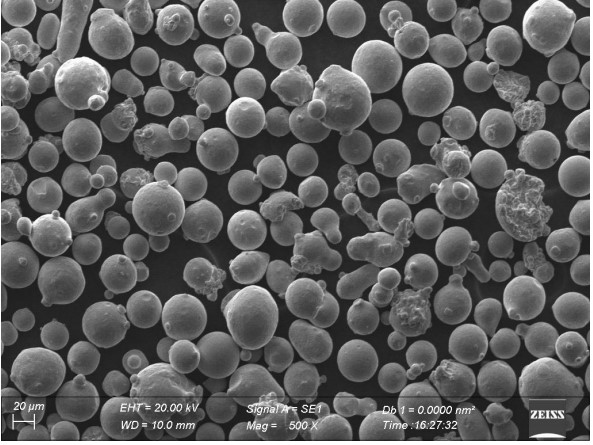
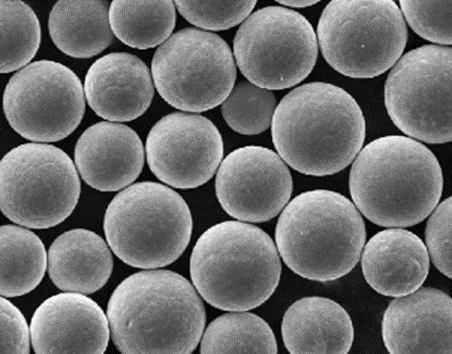
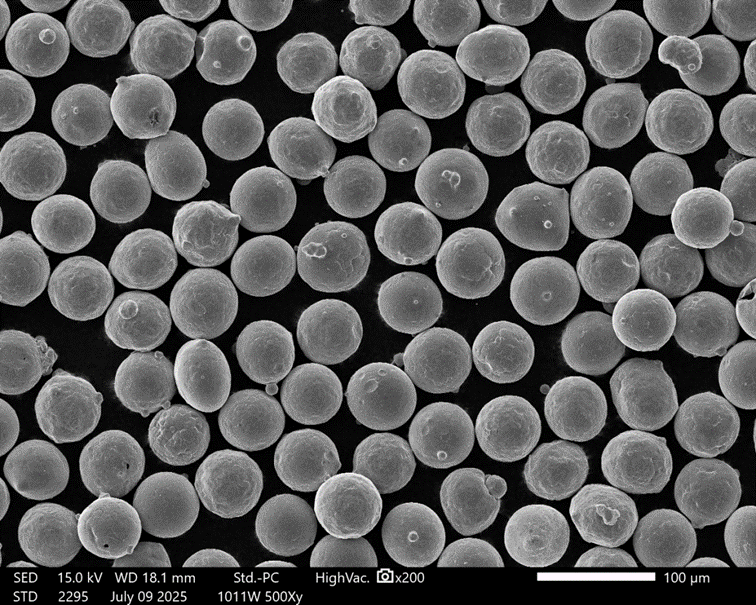
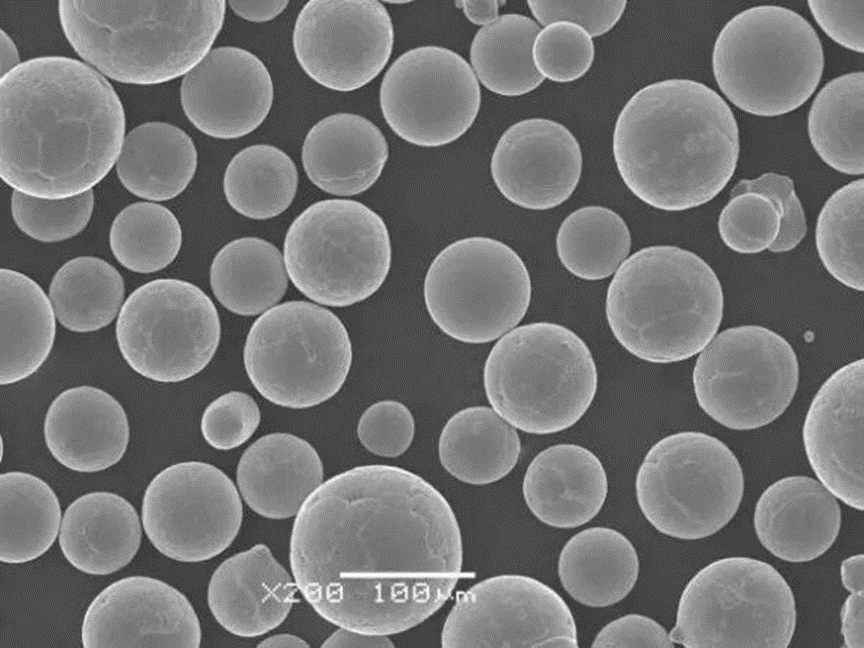
The defining traits of GRCop42 are high thermal conductivity, retention of useful strength above (500^\circ\text{C}), and microstructural strengthening through a fine Cr(_2)Nb dispersion. Powder suppliers also emphasize spherical morphology, high packing density, and low oxygen content because copper alloys are sensitive to powder cleanliness and flow consistency during printing. In other words, the value proposition of GRCop42 is not just the nominal chemistry; it is the ability to turn that chemistry into a repeatable, dense AM build with controlled thermal behavior.
For GRCop42, the selection driver is usually heat-flux survival, not maximum room-temperature strength.
Chemische Zusammensetzung
GRCop42 is commonly described in shorthand as Cu-4Cr-2Nb in atomic percent, but AM buyers usually work with nominal weight-percent ranges and impurity limits. Commercial powder datasheets and NASA-related literature consistently identify copper as the balance, chromium at roughly 3.1 to 3.4 wt.%, and niobium at roughly 2.7 to 3.0 wt.%, with low limits on aluminum, iron, silicon, and oxygen. Those limits matter because the alloy’s performance depends on a clean copper matrix and a controlled chromium-niobium ratio that supports the desired precipitate population.
Typical Composition of GRCop42 Copper Alloy Powder
| Element | Typical wt.% Range | Rolle in der Metallurgie | Functional Effect |
|---|---|---|---|
| Cu | Bilanz | Matrix metal | Provides very high thermal conductivity and the base for heat extraction in high-flux parts |
| Cr | 3.1–3.4 | Strengthening and precipitate former | Supports formation of Cr-rich phases and contributes to elevated-temperature strength and oxidation resistance |
| Nb | 2.7–3.0 | Precipitate former | Combines with chromium to form Cr(_2)Nb dispersion that improves creep resistance and high-temperature stability |
| O | ≤0.05 | Interstitial impurity control | Lower oxygen reduces oxide inclusions and helps preserve conductivity and print quality |
| Al | ≤0,04 | Residual impurity control | Kept low to avoid unwanted oxide formation and chemistry drift |
| Fe | ≤0.025 | Residual impurity control | Limited to maintain cleanliness and stable thermal-mechanical response |
| Si | ≤0.035 | Residual impurity control | Kept low because excess silicon can affect cleanliness and microstructure |
The most important line in the table is the relationship between chromium and niobium, not just their individual percentages. Sandvik’s published GRCop42 powder data specifies a Cr/Nb ratio of roughly 1.13 to 1.18, showing that the alloy is engineered around a controlled precipitate-forming balance rather than loose alloying additions. That control is central to why GRCop42 behaves differently from generic Cu-Cr or Cu-Cr-Zr grades.
Metallurgical Role of the GRCop42 Chemistry
Copper carries the thermal load. It is the continuous matrix and the reason GRCop42 can remove heat more effectively than most nickel-base AM alloys or refractory-rich powder systems, even though those alternatives may tolerate higher absolute temperatures. This is why engineers comparing chamber-liner materials often assess GRCop42 against not only other copper grades but also a refractory metal powder range for extreme-temperature concepts where conductivity, oxidation, and manufacturability must all be balanced.
Chromium and niobium provide the strengthening mechanism. NASA and supplier data both describe the alloy as dispersion strengthened, and Sandvik explicitly notes an evenly distributed Laves-type Cr(_2)Nb phase at sub-micron scale in powder cross-sections. That precipitate structure is the reason GRCop42 can trade some of the conductivity advantage of pure copper for far better hot strength and creep resistance.
Powder Chemistry and Additive Manufacturing Reliability
For GRCop42, powder chemistry is inseparable from processability. Copper powders can be challenging in AM because oxide films, fine contamination, and chemistry drift influence absorptivity, melt behavior, and final conductivity. As a result, a serious powder specification should not stop at bulk composition; it should also define oxygen control, impurity limits, lot traceability, and the intended process window for LPBF, DED, or cladding.
Physikalische und mechanische Eigenschaften
The appeal of GRCop42 lies in the balance between conductivity and strength rather than in any single headline number. NASA’s GRCop42 literature repeatedly frames the alloy around high thermal conductivity, excellent creep resistance, low-cycle fatigue life, and strength at elevated temperature for combustion hardware. Commercial AM powder data then adds room-temperature mechanical baselines for HIP-processed LPBF material, which help buyers judge whether the printed alloy is in the correct performance envelope.
Typical Properties of GRCop42 Copper Alloy Powder and Dense Printed Material
| Eigentum | Typischer Wert | Einheit | Test Standard |
|---|---|---|---|
| Theoretical density | 8.89 typical | g/cm³ | Reference alloy / pycnometry basis |
| Solidus | 1084 typical | °C | Thermal analysis / reference alloy data |
| Ultimate tensile strength | 347–360 typical after HIP LPBF | MPa | ASTM E8/E8M |
| Yield strength, 0.2% offset | 190–200 typical after HIP LPBF | MPa | ASTM E8/E8M |
| Dehnung | 31–37 typical | % | ASTM E8/E8M |
| Young’s modulus | 79–130 typical, process and method dependent | GPa | Mechanical or ultrasonic evaluation |
| Härte | 90–120 typical HV/HB equivalent | HV/HB | ASTM E384 / ASTM E10 |
| Wärmeleitfähigkeit | 285–345 typical, condition and temperature dependent | W/m-K | Comparative thermophysical testing |
| Service-temperature benchmark | Above 500 typical | °C | Application-oriented supplier/NASA guidance |
These values are best treated as process-dependent reference ranges, not universal guarantees. Sandvik reports room-temperature LPBF plus HIP values around 190 MPa yield strength, 347 MPa tensile strength, and 36.7% elongation, while another published AM datasheet reports similar tensile behavior but a different modulus value depending on measurement method and condition. NASA’s own materials discussions emphasize that GRCop42 is qualified through the process-structure-property relationship of the finished hardware rather than by chemistry alone.
Why Thermal Conductivity Dominates Material Selection
For propulsion parts, conductivity is not a secondary convenience. It determines wall temperature, cooling-channel efficiency, thermal gradients, and ultimately life. NASA’s published conductivity comparisons show GRCop42 was advanced in part because it offers better thermal conductivity than GRCop84 while preserving useful high-temperature strength, which is exactly the trade many rocket hardware designers need.
Strength and Ductility in Context
Room-temperature tensile values for GRCop42 are modest compared with precipitation-hardened nickel superalloys, but that comparison misses the design logic. The alloy is intended to withstand cyclic thermal and pressure loads while transporting heat rapidly, so its useful ductility and elevated-temperature stability matter as much as nominal ultimate strength. In printed chambers and injectors, designers are often using geometry and cooling strategy to control stress, while relying on the alloy to prevent thermal runaway and local softening.
GRCop42 Copper Alloy Powder in High-Heat-Flux Service
A useful rule of thumb is that GRCop42 becomes more attractive as heat-flux severity rises and geometry becomes more complex. In a simple room-temperature structural bracket, it would be a poor value proposition. In a channel-cooled liner or injector face where heat extraction and thermal fatigue dominate the failure mode, the alloy makes much more engineering sense than most steels, nickel alloys, or aluminum AM powders.
Technische Daten und verfügbare Güteklassen
Buying GRCop42 powder for additive manufacturing is mainly about matching the powder cut to the process. Fine LPBF grades prioritize recoating behavior, packing uniformity, and controlled melt response, while coarser cuts prioritize feeding stability for DED or cladding. Because GRCop42 is a specialized aerospace alloy rather than a commodity copper grade, suppliers typically qualify it through a combination of chemistry, PSD, morphology, and internal process guidance rather than through a single broad commodity specification.
Typical Supply Conditions for GRCop42 Copper Alloy Powder
| Grade / Supply Condition | Typischer PSD-Bereich | Scheinbare Dichte | Zapfstellendichte | Hall-Strömung | Sauerstoffgehalt | Kugelförmigkeit / Morphologie | Cross-Reference / Typical Use |
|---|---|---|---|---|---|---|---|
| Fine LPBF grade | 15-45 µm | 4,5–5,1 g/cm³ | 5.2–5.8 g/cm³ | 16–22 s/50 g | ≤0.05 wt.% typical | Highly spherical, low satellites | Fine-feature laser powder bed fusion |
| Standard LPBF grade | 20–53 µm | 4.8–5.3 g/cm³ | 5.4–6.0 g/cm³ | about 20 s typical | ≤0.05 wt.% typical | Spherical AM powder | General LPBF process qualification |
| DED / blown powder grade | 45-105 µm | 4.9–5.4 g/cm³ | 5.5–6.2 g/cm³ | 12–18 s/50 g | ≤0.05 wt.% typical | Kugelförmig bis nahezu kugelförmig | Directed energy deposition and repair |
| Coarse cladding grade | 53-150 µm | 5.0–5.5 g/cm³ | 5.7–6.3 g/cm³ | 11–17 s/50 g | ≤0.05 wt.% typical | Coarser spherical cut | Laser cladding and thermal applications |
| Standards alignment row | Supplier-specific | - | - | Measured per ASTM B213 – Hall-Flow-Verfahren | Supplier-specific | Morphology by SEM / image analysis | Often paired with ASTM B212, ASTM B527, laser diffraction, and internal AM qualification plans |
The numerical values above reflect typical AM practice and published supplier baselines rather than a single universal market standard. Sandvik’s currently published L-PBF GRCop42 distribution shows a typical D10 of 20.5 µm, D50 of 31.4 µm, D90 of 47.4 µm, and Hall flow of 20 seconds, which sits squarely inside the common LPBF window used for high-quality spherical copper alloy feedstock.
GRCop42 Powder Grades for LPBF and DED
For LPBF, the most important attributes are narrow PSD control, low oxygen, and good layer spreading. For DED, consistent powder feed and a coarser cut usually matter more than ultra-fine surface finish. Because GRCop42 is often used in critical thermal hardware, powder reuse limits tend to be stricter than for lower-value prototype materials, especially where conductivity loss from oxidation would compromise performance.
Standards and Qualification Logic
No single public AM standard fully certifies a GRCop42 build for propulsion duty. Instead, engineers combine alloy chemistry requirements, powder test methods, machine-specific parameter qualification, and application-specific inspection. Terminology and process classification follow the framework in ISO/ASTM 52900, while flow, density, and PSD measurements usually follow powder-metallurgy test methods adapted to the AM environment.
What a Complete GRCop42 Datasheet Should Include
A complete datasheet should include nominal chemistry, Cr/Nb ratio, PSD, Hall flow, apparent density, tap density, oxygen level, morphology images, and condition-specific tensile data. For aerospace-grade work, it should also state whether the data came from as-built, stress-relieved, HIPed, or otherwise post-processed material, because the final part response depends strongly on that history. Buyers comparing the alloy with a broader Sortiment an Kupferlegierungspulvern should therefore look beyond the chemistry name and compare the entire qualification package.
Herstellungsprozess
Powder manufacturing route matters as much as alloy choice for GRCop42. Copper alloys are highly sensitive to oxygen pickup and particle-shape quality, so feedstock intended for additive manufacturing is typically produced by inert gas atomization under tightly controlled conditions rather than by lower-cost water atomization. Current supplier information for commercial GRCop42 AM powder explicitly points to vacuum induction gas atomization, which is consistent with the need for clean, spherical particles.
Powder-Making Routes for GRCop42 Additive Manufacturing Powder
| Prozess | Sphärizität | Sauerstoffaufnahme | PSD-Steuerung | Durchsatz | Relative Kosten |
|---|---|---|---|---|---|
| Gaszerstäubung (GA) | Hoch | Gering bis mäßig | Gut | Hoch | Mäßig |
| Vakuum-Induktions-Gaszerstäubung (VIGA) | Sehr hoch | Niedrig | Sehr gut | Mittel bis hoch | Mäßig bis hoch |
| Elektrodeninduktions-Gaszerstäubung (EIGA) | Sehr hoch | Sehr niedrig | Sehr gut | Mittel | Hoch |
| Plasma-Rotations-Elektroden-Verfahren (PREP) | Extremely high | Sehr niedrig | Good, often coarser | Medium to low | Hoch |
| Wasserzerstäubung | Niedrig bis mittel | Höher | Mäßig | Hoch | Niedrig |
Gas Atomization and VIGA for GRCop42 Copper Alloy Powder
Gas atomization is the mainstream route because it balances production scale with good morphology. VIGA improves on it by combining vacuum induction melting with inert-gas atomization, reducing contamination and helping maintain low oxygen and low impurity levels. For a copper alloy such as GRCop42, that cleaner route is valuable because inclusions and oxide films can directly penalize conductivity and print consistency.
PREP, EIGA, and Why They Matter Even if They Are Not the Default
PREP and EIGA are premium routes more often discussed for reactive or high-value alloys where extremely round particles and low contamination justify added cost. They are technically relevant to GRCop42 because propulsion programs often impose strict cleanliness requirements, and some suppliers or equipment integrators evaluate these routes when morphology or oxygen control must be pushed beyond mainstream atomization. However, for most commercial AM use, VIGA or a high-quality inert-gas atomized route is the more practical choice.
Trade-Offs Between Powder Quality and Production Cost
The trade-off is straightforward: the cleaner and more spherical the powder, the higher the cost per kilogram. But for GRCop42, feedstock economics should be judged against component value, not commodity metal price. A rocket injector or chamber liner has a high qualification burden, so using a sphärisches AM-Pulver with better morphology and lower oxygen often saves money downstream by improving first-pass build success and reducing destructive requalification.
Post-Atomization Handling
After atomization, the powder still needs classification, blending if necessary, sieving, packaging, and controlled storage. Those stages influence moisture uptake, fines fraction, and lot-to-lot consistency. In copper AM, where process windows can be narrow and reflectivity already complicates melting behavior, sloppy downstream handling can erase the benefits of a good atomization route.
Anwendungen nach Branche
GRCop42 is not a general-purpose metal powder. Its strongest case is where intense heat must be removed through thin walls, internal channels, or locally overloaded faces. That makes the alloy especially relevant to aerospace and space propulsion, but its selection logic can extend to adjacent sectors that combine thermal cycling, oxidation, and geometric complexity.
Aerospace and Space Propulsion
This is the anchor application. NASA’s GRCop42 work centers on combustion chambers, channel-cooled liners, injector face plates, and related liquid rocket engine components. The alloy’s combination of conductivity, elevated-temperature strength, and printability makes it one of the few AM copper materials specifically tied to repeated hot-fire testing and long-life chamber concepts in published propulsion programs.
Energy and Thermal Management Hardware
Outside launch vehicles, any component exposed to concentrated heat flux with the need for rapid heat removal is a potential candidate. That includes burners, heat-transfer inserts, hot-wall cooling elements, and experimental power hardware where a printed copper alloy outperforms steel or nickel simply by keeping temperatures down. The opportunity is narrower than in aerospace, but the selection logic is similar.
Advanced Tooling and Process Equipment
GRCop42 is not a mainstream tooling material, yet it can be relevant in high-end thermal tooling where copper conductivity matters and conventional copper softens too quickly. Compared with pure copper, the alloy offers better hot strength; compared with many steels, it removes heat far faster. This places it in a niche for inserts or process components where thermal cycle time and local heat extraction are the governing concerns.
Hybrid and Bimetallic Structures
Another emerging use case is hybrid manufacturing. Research and development efforts have examined combinations such as Alloy 625 with GRCop42, aiming to place high-conductivity copper where heat extraction is critical and stronger nickel alloy where structural shell performance is needed. That design strategy reflects a broader trend already visible across the Überblick über Anwendungen der additiven Fertigung for functionally differentiated AM hardware.
Where GRCop42 Is Usually Not the Best Choice
The alloy is rarely the best answer for low-cost industrial parts, corrosion-dominated chemical service, or lightweight structural applications. In those areas, alternative material families usually win on cost, density, corrosion profile, or strength-to-weight ratio. GRCop42 should be selected when heat-flux management is the main problem to solve, not when it is merely a nice-to-have property.
Vergleich mit alternativen Materialien
Material selection for GRCop42 usually starts with three questions: Is thermal conductivity the main performance driver? Does the part need elevated-temperature strength beyond pure copper? And is the geometry complex enough that additive manufacturing adds real value? Once those questions are answered, the main alternatives are CuCrZr, pure copper, nickel superalloys such as Inconel 718, and in some extreme cases tungsten- or molybdenum-based materials.
GRCop42 Copper Alloy Powder vs Alternative AM Materials
| Material | Dichte (g/cm³) | Strength Level | Wärmeleitfähigkeit | Druckbarkeit | Relative Kosten | Optimaler Anwendungsfall |
|---|---|---|---|---|---|---|
| GRCop42 copper alloy powder | 8.89 | Mäßig | Sehr hoch | Good after copper-specific qualification | Hoch | Rocket chambers, injectors, high-heat-flux AM parts |
| CuCrZr powder | 8.8–8.9 | Mäßig | Hoch | Gut | Mittel bis hoch | General high-conductivity industrial AM parts |
| Pure copper powder | 8.96 | Niedrig | Extremely high | Challenging but improving | Mittel | Heat sinks and maximum-conductivity components |
| Inconel 718-Pulver | 8.19 | Hoch | Niedrig | Ausgezeichnet | Hoch | High-strength hot structural parts where conductivity is secondary |
| Tungsten or Mo-based powder | 10.2–19.3 | High at temperature | Lower to moderate, alloy-dependent | Process-challenging | Sehr hoch | Extreme-temperature components beyond copper service logic |
Against pure copper, GRCop42 gives up some conductivity to gain a much more useful elevated-temperature strength profile. Against CuCrZr, it is typically a more specialized aerospace thermal alloy with stronger pedigree in rocket combustion devices. Against Inconel 718, it loses decisively on strength but wins where the hardware must transport heat rather than merely survive it.
Selection Logic in Practice
If the part is a chamber liner, injector face, or thermal throat insert, GRCop42 is often the more logical starting point than a nickel alloy. If the part is a bracket, casing, or hot structural shell, a nickel alloy may still be better. If conductivity matters but the environment is less severe and cost sensitivity is higher, a broader nickel alloy powder selection or copper family comparison may reveal a simpler material with lower qualification burden.
Unser Unternehmen
Shanghai Truer Technology Co., Ltd, which operates am-printing.com, states that it was established in 2009 and launched its additive manufacturing business in 2019. According to the company’s published information, its scope includes integrating 3D-printing powder-making equipment and services with metal powder supply; core technologies include SEBM equipment, PREP powder-making equipment, and gas atomization; and its powder portfolio covers TiNi, TiTa, TiAl, TiNbZr, CoCrMo, plus nickel-based, cobalt-based, titanium-based, copper-based, aluminum-based, and stainless steel spherical powders. The company also describes a joint innovation center for metal 3D printing and support for processes including SLM, SEBM, DED, laser cladding, PM, MIM, HIP, cold and hot spraying, welding, and coating for sectors such as aerospace, medical, nuclear power, 3C electronics, hand tools, and remote control cars, as outlined in its Unternehmensprofil.
FAQ
Q1. What is GRCop42 copper alloy powder mainly used for?
It is mainly used for high-heat-flux hardware, especially liquid rocket engine components such as combustion chamber liners, injector face plates, and channel-cooled structures. NASA’s published development work consistently links GRCop42 to propulsion parts where thermal conductivity and elevated-temperature durability are both critical.
Q2. Is GRCop42 copper alloy powder better than CuCrZr for metal 3D printing?
Not in every case. GRCop42 is usually the better choice when the part is propulsion-grade or otherwise exposed to extreme heat flux and repeated thermal cycling, while CuCrZr is often more practical for broader industrial conductivity applications. The deciding factor is whether the design problem is truly rocket-class thermal loading or a more general heat-transfer requirement.
Q3. Can GRCop42 copper alloy powder be used in laser powder bed fusion?
Yes. NASA reported near-fully-dense GRCop42 components produced by powder bed fusion, and current commercial powder data is explicitly targeted at L-PBF systems with controlled PSD and spherical morphology. Successful use still depends on machine parameters, post-processing, and strict powder-quality control.
Q4. Why is oxygen control important for GRCop42 copper alloy powder?
Oxygen promotes oxide formation, which can reduce conductivity, degrade cleanliness, and complicate stable melting in copper AM. Supplier documentation for GRCop42 therefore highlights low oxygen and low impurity levels as key features of metallurgically clean powder intended for high-performance additive manufacturing.
Q5. What particle size is typical for GRCop42 copper alloy powder?
For LPBF, a common commercial distribution is centered around a D50 near 31 µm, with a typical fine range such as 15–45 µm or 20–53 µm. Coarser cuts such as 45–105 µm or 53–150 µm are more relevant to DED, laser cladding, or other blown-powder processes.
Q6. What should buyers request when sourcing GRCop42 copper alloy powder?
They should request nominal chemistry, Cr/Nb ratio, PSD, Hall flow, apparent density, tap density, oxygen level, morphology data, and condition-specific mechanical properties tied to the intended AM process. For critical aerospace programs, buyers should also ask whether the powder and property data are aligned with as-built, stress-relieved, or HIPed conditions before comparing suppliers.