簡単な回答
FeCoNiCrMn High Entropy Alloys are multi-principal-element alloys, typically based on the equiatomic Cantor system, used in powder form for metal additive manufacturing. They are chosen for AM parts when engineers need a rare combination of high toughness, stable face-centered cubic microstructure, cryogenic performance, and compositional flexibility rather than the lowest raw-material cost. In practice, they are especially relevant for research-intensive aerospace, energy, tooling, and advanced industrial components where conventional stainless steels or nickel alloys do not fully match the target balance of ductility, strength, and damage tolerance.
What Is FeCoNiCrMn High Entropy Alloys
FeCoNiCrMn High Entropy Alloys refer to a class of alloys built around five principal metallic elements—iron, cobalt, nickel, chromium, and manganese—mixed in near-equiatomic proportions. The most widely discussed version is the Cantor alloy, a landmark composition in high-entropy alloy research because it challenged the older assumption that engineering alloys must rely on one dominant base metal with minor additions. Instead, this system uses several major elements to stabilize a single-phase or near-single-phase solid solution, usually face-centered cubic, across a broad temperature range.
In additive manufacturing, the alloy is typically supplied as spherical metal powder for laser powder bed fusion, directed energy deposition, and related processes defined in ISO/ASTM 52900 積層造形用語集. What makes the system attractive is not only its chemistry, but the resulting deformation behavior: the alloy is known for excellent fracture toughness, high ductility, significant work hardening, and unusually strong low-temperature mechanical performance. Those traits make it one of the most studied high-entropy alloys in the AM field.
FeCoNiCrMn High Entropy Alloys in the HEA Family
The broader high-entropy alloy family includes refractory HEAs, lightweight HEAs, and transition-metal systems designed around different crystal structures and service conditions. FeCoNiCrMn sits in the transition-metal branch and is usually treated as the canonical FCC high-entropy alloy. Compared with refractory systems rich in Nb, Mo, Ta, or W, it is easier to process thermally and generally more forgiving in terms of room-temperature ductility, though it is less suited to the highest temperature regimes.
Why the Cantor Alloy Matters in Additive Manufacturing
The AM community values this alloy because it offers a useful bridge between scientific novelty and practical manufacturability. Many experimental HEAs are difficult to atomize, crack-prone in laser processing, or too brittle for structural use. FeCoNiCrMn, by contrast, has become a default reference composition for studying how high-entropy metallurgy behaves under rapid solidification, repeated thermal cycling, and layerwise remelting.
The Cantor alloy remains the benchmark FCC high-entropy system because it combines exceptional toughness with unusually stable deformation behavior across temperature.
FeCoNiCrMn High Entropy Alloys vs Conventional Engineering Alloys
The key distinction is design philosophy. Traditional stainless steels, superalloys, and tool steels are built around a primary matrix element. FeCoNiCrMn High Entropy Alloys distribute alloying influence more evenly across the composition, which changes phase stability, solid-solution strengthening, diffusion behavior, and fault-energy-driven deformation mechanisms. For designers comparing material families, this makes the alloy less of a direct replacement and more of a performance-driven alternative. In broader material screening, it is often evaluated alongside a dedicated high-entropy alloy powder range rather than being treated as a simple substitute for stainless steel.
化学組成
The standard FeCoNiCrMn composition is usually described in nominally equiatomic terms, but production lots are specified in weight percent because powder certification, melting control, and downstream testing are typically reported that way. The equiatomic target leads to non-equal weight fractions because each element has a different atomic mass. In real powder supply, producers may offer tight-equiatomic material for research use, slightly composition-tuned variants for AM optimization, or custom ranges intended to influence strength, stacking-fault energy, or oxidation behavior.
Typical Composition of FeCoNiCrMn High Entropy Alloys
| エレメント | Typical wt.% Range | 冶金上の役割 | Functional Effect in AM Parts |
|---|---|---|---|
| フェ | 18-22 | Matrix-forming principal element | Contributes to FCC solid-solution stability and cost balance |
| Co | 18-22 | Strength and phase-balance contributor | Supports work hardening and low-temperature toughness |
| ニー | 18-22 | FCC stabilizer | Improves ductility, toughness, and single-phase tendency |
| Cr | 18-22 | Corrosion and oxidation contributor | Enhances environmental resistance and solid-solution strengthening |
| ムン | 18-22 | FCC stabilizer and fault-energy modifier | Influences deformation mode, ductility, and work-hardening response |
| C | 0.05 max typical | Interstitial impurity control | Excess carbon can promote carbide formation and property scatter |
| O | 0.10 max typical for AM powder, often lower | Surface oxidation indicator | Elevated oxygen can reduce ductility and affect powder flow |
| N | 0.05 max typical | Interstitial control | Can strengthen the alloy but may also alter phase behavior |
| Si | 0.50 max typical impurity | Residual element control | Kept low to avoid unwanted inclusions or chemistry drift |
The chemistry looks simple, but the metallurgical interactions are not. Nickel and manganese both help maintain the FCC structure, while chromium supports corrosion resistance and iron helps anchor the composition in a more economically accessible transition-metal range than many refractory HEAs. Cobalt remains one of the cost-driving elements, yet it is also important for the alloy’s well-known strength-toughness balance.
Role of Each Principal Element
Iron provides part of the structural backbone and helps keep the alloy from becoming purely a premium nickel-cobalt material. Chromium contributes passivation behavior and often improves resistance to certain oxidizing environments, though the alloy should not be assumed to match all stainless steels in every corrosive service condition.
Nickel strongly favors the FCC phase and is a major reason the alloy remains highly ductile. Manganese influences stacking fault energy and can change how the alloy deforms under strain, especially when temperature varies. Cobalt supports the distinctive work-hardening behavior that has made the Cantor alloy so important in fundamental metallurgy.
Composition Control in AM Powder Production
For additive manufacturing, chemistry must be controlled together with particle morphology and interstitial contamination. High-entropy alloy performance is highly sensitive to segregation, oxide films, and evaporation of more volatile species during melting or remelting. This is why advanced buyers do not stop at nominal composition; they also review oxygen, nitrogen, carbon, ICP analysis, and powder history.
Because FeCoNiCrMn is often selected for demanding property targets, the release criteria can be stricter than for general-purpose steels. In research and pilot production, it is also common to request detailed compositional data by powder lot before parameter development begins.
物理的および機械的特性
The property profile of FeCoNiCrMn High Entropy Alloys is the main reason the material has become so influential. It is neither the lightest metallic AM feedstock nor the strongest at room temperature on a simple tensile chart, but it offers a highly unusual balance of ductility, fracture toughness, and work hardening. The alloy is especially notable for maintaining or even improving toughness at low temperatures, a behavior widely discussed in the literature surrounding the original Cantor alloy.
Typical Physical and Mechanical Properties of FeCoNiCrMn HEA Powder Builds
| プロパティ | 代表値 | 単位 | 試験基準 |
|---|---|---|---|
| 密度 | 7.8-8.1 typical | g/cm³ | Reference alloy data |
| Solidus / melting range onset | 1280-1330 typical | °C | DSC / reference alloy data |
| Ultimate tensile strength | 650-900 typical, condition dependent | MPa | ASTM E8/E8M |
| Yield strength (0.2%) | 250-450 typical, condition dependent | MPa | ASTM E8/E8M |
| 伸び | 30-60 typical | % | ASTM E8/E8M |
| 硬度 | 160-260 typical | HV | ASTM E384 |
| Young’s modulus | 180-210 typical | GPa | ASTM E111 |
| 熱伝導率 | 10-18 typical | W/m-K | Reference alloy data |
| 電気抵抗率 | 100-140 typical | µΩ·cm | Reference alloy data |
These values should be treated as typical for consolidated material or AM parts after appropriate parameter development and, where applicable, heat treatment or stress relief. Reported values vary significantly with porosity, residual stress, build orientation, grain structure, and whether the alloy remains fully FCC or contains minor secondary phases. That variation is normal in high-entropy alloy research and is one reason specification sheets often use “typical” language rather than promising a single universal property level.
Strength and Toughness Balance in FeCoNiCrMn High Entropy Alloys
The standout feature is exceptional toughness combined with high elongation. Many high-strength alloys gain strength at the expense of fracture resistance, but the FeCoNiCrMn system is valued because it can absorb energy and strain without catastrophic loss of ductility. This makes it attractive for components that may see impact, cyclic loading, or thermally variable service.
The alloy’s work-hardening capacity is also important. Instead of reaching an early plastic instability, it can continue hardening during deformation, which delays necking and helps sustain useful ductility. That combination is one reason it is frequently compared not only with stainless steels but also with more expensive specialty alloys.
Cryogenic and Temperature-Dependent Performance
One of the most discussed features of the Cantor alloy is its strong behavior at low temperature. Researchers have reported outstanding fracture toughness and ductility retention under cryogenic conditions, which has driven interest in hydrogen-adjacent hardware, scientific equipment, and cold-environment structures. This does not mean every AM-built part automatically inherits the best published values, but it explains why the alloy remains strategically important.
At elevated temperature, FeCoNiCrMn is generally not the first choice against top nickel superalloys. It can perform well in moderate high-temperature service, but it is not designed to replace the most creep-resistant turbine-class materials. Its real advantage lies in balanced mechanical behavior rather than peak hot-section capability.
Corrosion, Wear, and Thermal Considerations
Chromium helps, but corrosion performance depends strongly on environment, surface condition, and any processing-induced segregation. In many ambient and mildly aggressive conditions, the alloy behaves well, yet it should still be qualified for specific media rather than assumed to behave exactly like 316L or higher-alloy stainless grades.
Thermally, conductivity is modest compared with copper alloys and lower than many simple steels. That matters in laser processing because the alloy retains heat differently than highly conductive materials, which can influence melt pool stability and residual stress evolution. For wear-focused designs, the alloy is often used as a platform for process tuning or post-processing rather than as an automatic replacement for dedicated tool steels or hardfacing materials.
仕様および取り扱いグレード
Specifications for FeCoNiCrMn High Entropy Alloys in powder form usually combine chemistry control with particle engineering. Since there is no single universal AMS-style product form specification equivalent to those used for long-established aerospace alloys, buyers often qualify the powder through a combination of internal standards, AM process requirements, and test methods borrowed from general metal-powder practice. That is normal for advanced HEA feedstocks, especially in research, pilot production, and custom industrial builds.
Typical FeCoNiCrMn High Entropy Alloy Powder Grades
| Grade / Supply Condition | 代表的なPSD範囲 | 見かけ密度 | タップ密度 | ホールの流れ | 酸素含有量 | 真球度/形態 | Cross-Reference / Typical Use |
|---|---|---|---|---|---|---|---|
| Fine LPBF grade | 15-45 µm | 4.1-4.7 g/cm³ | 4.7-5.3 g/cm³ | 13-20 s/50 g | 0.03-0.10 wt.% typical | High spherical, low satellites | Laser powder bed fusion for fine-feature builds |
| Standard LPBF grade | 20-53 µm | 4.2~4.8 g/cm³ | 4.8-5.4 g/cm³ | 12~18秒/50 g | 0.03-0.08 wt.% typical | Spherical atomized powder | General AM parameter development |
| DED / cladding grade | 45-105 µm | 4.3~4.9 g/cm³ | 4.9-5.5 g/cm³ | 11-17 s/50 g | 0.03-0.08 wt.% typical | Coarser spherical cut | Directed energy deposition and repair |
| PM / HIP grade | 53~150 µm | 4.4-5.0 g/cm³ | 5.0-5.6 g/cm³ | 10-16 s/50 g | 0.03-0.10 wt.% typical | Broad spherical distribution | Hot isostatic pressing and powder metallurgy |
| Standards alignment row | Supplier-specific | - | - | - | - | - | Powder tests commonly aligned with ASTM B212 見かけ密度測定法, ASTM B213, ASTM B527, ISO/ASTM terminology, and internal HEA composition control |
Particle-size distribution should always be matched to the actual AM process window. A 15-45 µm cut may look ideal on paper for LPBF, but layer thickness, laser spot size, recoater type, and machine atmosphere all influence whether that fraction truly gives the best spreadability and melt stability. In some programs, a slightly coarser distribution produces more consistent powder handling and fewer airborne fines.
Spherical Powder Quality for FeCoNiCrMn High Entropy Alloys
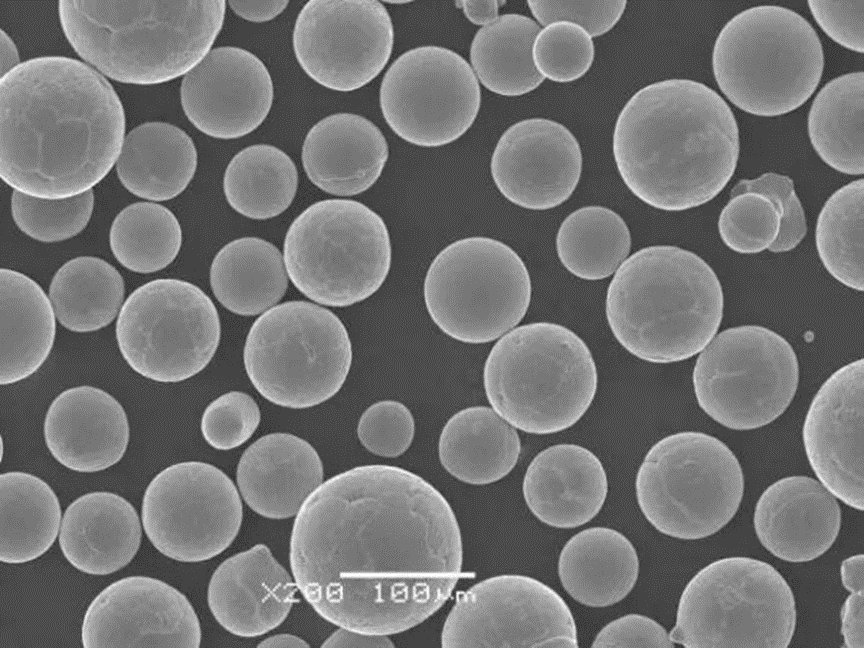
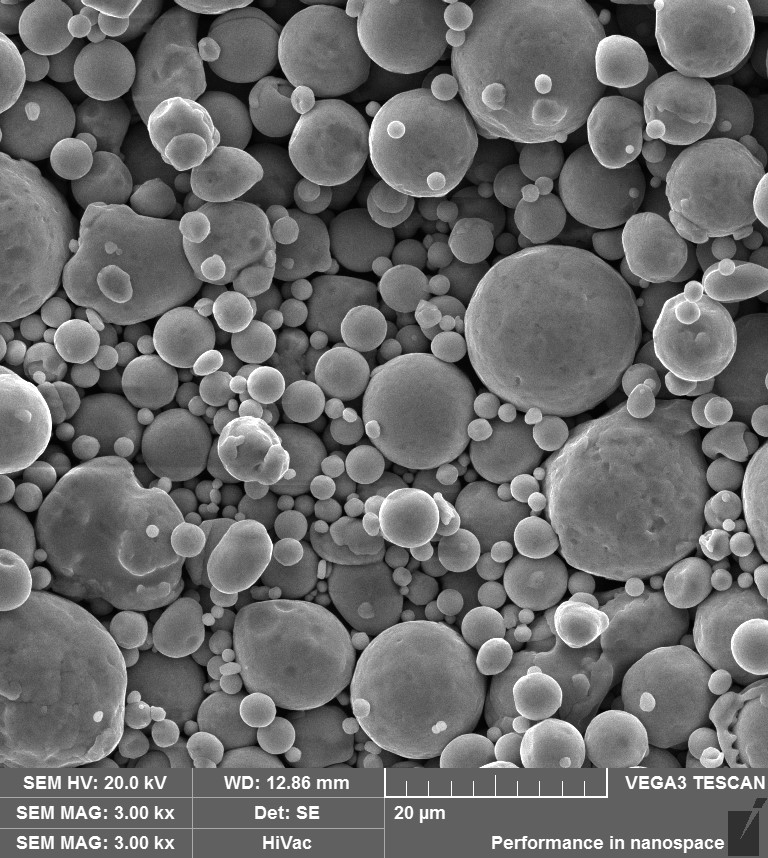
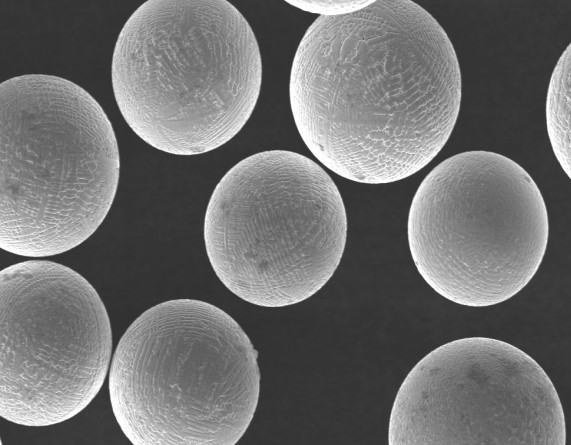
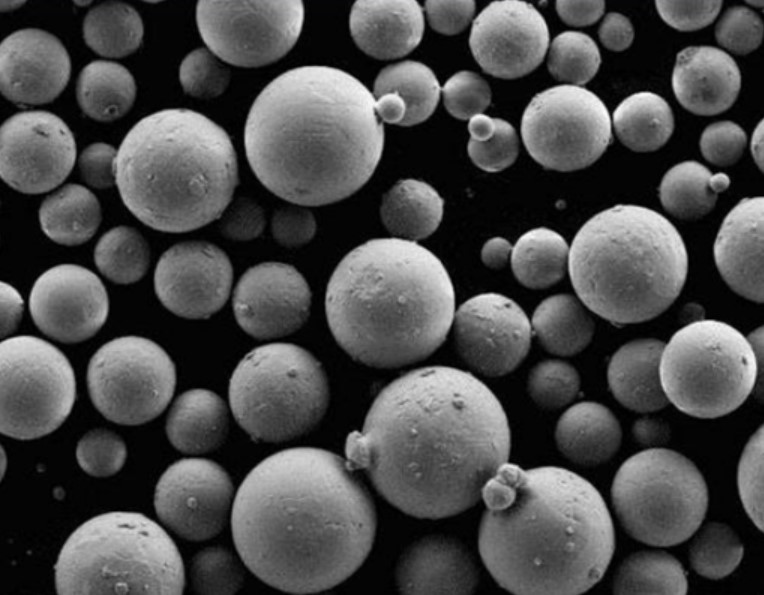
For this alloy family, sphericity matters because several principal elements must melt and resolidify uniformly during the build. Satellites, elongated particles, or excessive fines can reduce flow, disturb recoating, and increase oxygen pickup. Buyers should request D10, D50, D90, SEM morphology, and interstitial data along with the chemistry certificate.
Standards and Cross-Reference Logic
There is no single universal product standard that fully defines FeCoNiCrMn HEA powder the way a commodity stainless steel powder grade might be standardized. Instead, qualification is built from cross-referenced methods: chemistry by spectrometric analysis, powder characterization by established ASTM methods, and process vocabulary under ISO/ASTM frameworks. A useful supporting reference for powder metrology is the NIST overview of additive manufacturing powders, which highlights how particle size, shape, and powder-bed behavior influence AM repeatability.
Available Supply Forms and Customization
Commercially, the alloy may be offered as near-equiatomic FeCoNiCrMn powder, chemistry-tuned derivatives, or custom fractions for LPBF, DED, HIP, and thermal spray-related development. Some suppliers also integrate the material into a wider portfolio that includes cobalt-rich and nickel-rich systems; for users comparing adjacent chemistries, cobalt-based alloy powders and a broader ニッケル合金粉末ポートフォリオ often define the nearest commercial alternatives.
製造工程
Powder manufacturing route has an outsized effect on FeCoNiCrMn performance because the alloy depends on chemical uniformity, clean particle surfaces, and predictable packing behavior. The most common production route for AM-grade powder is gas atomization, though vacuum-assisted routes and PREP can also be used depending on target cleanliness, sphericity, and cost.
FeCoNiCrMn High Entropy Alloy Powder Process Comparison
| プロセス | 球形度 | 酸素ピックアップ | PSDコントロール | スループット | 相対的なコスト |
|---|---|---|---|---|---|
| ガスアトマイズ(GA) | 高い | 低~中程度、大気の状態による | グッド | 高い | 中程度 |
| 真空誘導ガスアトマイズ法(VIGA) | 非常に高い | 低い | 非常に良い | 中~高 | 中~高 |
| 電極誘導ガスアトマイズ法(EIGA) | 非常に高い | 非常に低い | 非常に良い | ミディアム | 高い |
| プラズマ回転電極プロセス(PREP) | Extremely high | 非常に低い | Good, often coarser | Medium to low | 高い |
| Post-atomization classification | Depends on input powder | No inherent reduction | Excellent after sieving | Added secondary step | Added cost |
Gas Atomization for HEA Spherical Powder
Gas atomization is usually the industrial baseline because it offers a workable combination of throughput, particle morphology, and cost control. The alloy melt is disintegrated by a high-velocity inert gas stream, forming droplets that solidify into mostly spherical particles. For FeCoNiCrMn, the process must hold composition tightly enough that manganese loss, oxide formation, and elemental segregation stay within the application envelope.
Gas atomized powder is commonly the first choice for LPBF and DED development because it is scalable. It also allows suppliers to classify multiple particle-size ranges from one atomization batch, which is useful when the same nominal alloy is being qualified across different AM platforms.
VIGA, EIGA, and PREP Trade-Offs
VIGA improves cleanliness by combining vacuum induction melting with inert-gas atomization, reducing contamination risk before the droplets form. EIGA minimizes melt-contact contamination even further by using an electrode feed rather than a conventional crucible arrangement, which can matter for premium reactive or high-purity alloys.
PREP is often associated with extremely spherical powder and very clean surfaces. For FeCoNiCrMn High Entropy Alloys, that can be valuable when uniform flow and low oxygen are higher priorities than maximum output volume. The trade-off is cost and, in some cases, a coarser size tendency compared with atomization routes optimized for fine LPBF cuts.
Process Selection and AM Printability
No powder route can fully replace machine parameter development, but route quality influences how difficult that development becomes. 球状粉末の形態 improves spreadability, while low interstitial pickup helps preserve the alloy’s ductility and toughness. Because HEAs are often purchased for performance-led rather than cost-led programs, users may accept a more expensive powder route if it lowers variability during qualification.
Powder Handling After Production
Post-atomization handling is just as important as primary production. Powders are sieved, sampled, characterized, and packaged under controlled conditions to avoid moisture, contamination, and particle-size drift. Reuse protocols should also be defined carefully, since oxidation, fine-particle enrichment, and chemistry drift can change the behavior of recycled high-entropy powder more quickly than users expect.
業界別の用途
FeCoNiCrMn High Entropy Alloys are still more common in advanced development than in commodity serial production, but that does not make them niche in a trivial sense. Their industrial relevance lies in applications where unusual property combinations justify qualification effort, especially when fracture toughness, cryogenic response, and design freedom are more important than minimum raw-material price.
Aerospace and Space Structures
In aerospace, the material is of interest for brackets, housings, valve-adjacent hardware, cryogenic handling components, and structurally complex parts exposed to thermal or mechanical uncertainty. The alloy’s damage tolerance profile is often more relevant than its absolute room-temperature yield strength. That makes it a candidate for non-traditional structural problems rather than a universal replacement for titanium or nickel superalloys.
Space systems are another natural fit, particularly for hardware linked to propellant management, thermal cycling, and low-temperature service. Additive manufacturing strengthens the case by enabling internal channels, integrated mounting features, and mass-efficient geometries that would be difficult to machine conventionally.
Energy, Cryogenic, and Hydrogen-Adjacent Systems
The cryogenic reputation of the Cantor alloy has drawn attention from energy-sector engineers working on storage, transfer, and cold-environment equipment. In such systems, materials must tolerate thermal gradients, pressure changes, and the risk of brittle behavior. FeCoNiCrMn’s strong low-temperature ductility makes it worth investigating for valves, manifolds, experimental vessels, and test hardware.
For energy users exploring harsher thermal envelopes, the alloy is often compared with refractory metal powder solutions when the question shifts from toughness-dominated service to extreme-temperature resistance.
Tooling, Wear Components, and Functional Prototypes
The alloy is also relevant for tooling inserts, high-value prototypes, and experimental wear components where conventional steels may not provide the desired combination of toughness and manufacturability. While it is not a dedicated tool steel, its strain-hardening behavior can be advantageous in applications involving local deformation or repeated contact loading.
Medical and Scientific Equipment
Medical use is more selective. The alloy contains cobalt, nickel, and manganese, so it is not treated as a default implant material in the same way as Ti-6Al-4V. Even so, it can be relevant for non-implant scientific, laboratory, and specialty instrument hardware where toughness, dimensional complexity, and low-temperature performance matter more than established implant pedigree.
Industrial R&D and Cross-Sector Development
Many present-day applications sit in R&D, pilot, or limited-series production rather than high-volume manufacturing. That is typical for advanced HEAs: the alloy serves as a platform for new product development, process science, and application-specific optimization. For organizations comparing end uses across sectors, the broader industry application overview provides context for how AM powders move between aerospace, medical, electronics, tooling, and energy environments.
代替材料との比較
Material selection for AM is not a contest of novelty. FeCoNiCrMn High Entropy Alloys must compete against mature materials with known data, established standards, and lower qualification friction. The right comparison therefore depends on whether the project prioritizes cryogenic toughness, room-temperature ductility, corrosion behavior, printability, or cost.
FeCoNiCrMn High Entropy Alloys vs Alternative AM Materials
| 素材 | 密度 (g/cm³) | 一般的な筋力レベル | 印刷適性 | 耐食性 | 相対的なコスト | 最適なユースケース |
|---|---|---|---|---|---|---|
| FeCoNiCrMn High Entropy Alloys | 7.8-8.1 | Moderate to high with excellent ductility | Moderate to good after qualification | グッド | 高い | Tough, damage-tolerant AM parts and cryogenic-capable components |
| 316L stainless steel | 7.9-8.0 | 中程度 | 素晴らしい | 非常に良い | 低~中 | General corrosion-resistant AM components |
| インコネル718 | 8.19 | 高い | 素晴らしい | 良い~非常に良い | 高い | High-temperature aerospace and energy hardware |
| CoCrMo alloy | 8.3-8.5 | High hardness, moderate ductility | グッド | グッド | 高い | Wear-resistant and medical-grade non-cryogenic applications |
| Ti-6Al-4V | 4.43 | 高い比強度 | 素晴らしい | 素晴らしい | 高い | Lightweight aerospace and biomedical structures |
Against 316L, FeCoNiCrMn usually wins on ductility-work-hardening sophistication and advanced low-temperature behavior, but it loses on cost and standardization maturity. Against Inconel 718, it offers a different value proposition: superior toughness and deformation behavior in some regimes rather than maximum high-temperature strength. Against Ti-6Al-4V, it cannot compete on density, yet it may offer a distinct balance of toughness and FCC-based deformation mechanisms for designs where low-temperature structural reliability matters more than lightweighting alone.
This is why the alloy tends to enter the conversation after conventional options have already been screened. If 316L, Inconel 718, cobalt alloys, or titanium clearly meet the design brief, the HEA may be unnecessary. If they do not, FeCoNiCrMn becomes a serious candidate rather than an academic curiosity.
当社
Shanghai Truer Technology Co., Ltd., operating am-printing.com, was established in 2009 and created its additive manufacturing business in 2019. According to its published company profile, Truer integrates 3D printing powder-making equipment and related services with metal powder supply, including TiNi, TiTa, TiAl, TiNbZr, CoCrMo, nickel-based, cobalt-based, titanium-based, copper-based, aluminum-based, and stainless steel spherical powders. Its stated technical scope includes Selective Electron Beam Melting equipment, Plasma Rotating Electrode Process powder-making equipment, gas atomization-related capability, and a joint innovation center for metal 3D printing; its process coverage spans SLM, SEBM, DED, laser cladding, powder metallurgy, MIM, HIP, cold and hot spraying, welding, and coating for industries such as aerospace, medical, nuclear power, 3C electronics, hand tools, and remote control cars. Additional company background is presented on the manufacturer profile page.
よくあるご質問
Q1. Are FeCoNiCrMn High Entropy Alloys good for 3D printing?
Yes, they are good candidates for metal AM when the goal is high toughness, stable FCC behavior, and advanced property development rather than minimum material cost. Their printability is generally more manageable than many brittle experimental HEAs, but they still require proper powder quality and process qualification.
Q2. What is the main advantage of FeCoNiCrMn High Entropy Alloys over stainless steel?
The main advantage is the alloy’s unusual combination of ductility, work hardening, and damage tolerance, especially under low-temperature service conditions. Stainless steels such as 316L are easier and cheaper to print, but they do not always match the same research-proven toughness profile.
Q3. Are FeCoNiCrMn High Entropy Alloys suitable for cryogenic applications?
They are widely studied for cryogenic use because the Cantor alloy family is known for retaining impressive toughness and ductility at low temperature. Final suitability still depends on build density, post-processing, surface state, and part-specific qualification.
Q4. What particle size is typical for FeCoNiCrMn High Entropy Alloy powder in LPBF?
Typical LPBF cuts are in the 15-45 µm or 20-53 µm range, with the exact window chosen around layer thickness, recoating behavior, and machine settings. A narrower fraction can improve consistency, but too many fines may reduce flow and complicate powder handling.
Q5. How does FeCoNiCrMn compare with Inconel 718 for additive manufacturing?
Inconel 718 is generally the more mature choice for high-temperature service and established industrial qualification routes. FeCoNiCrMn is more attractive when the design case emphasizes toughness, ductility, and cryogenic or deformation-sensitive performance rather than maximum hot-section strength.
Q6. What should buyers ask for when sourcing FeCoNiCrMn High Entropy Alloys powder?
Buyers should request nominal chemistry, lot chemistry, oxygen and nitrogen limits, PSD data, morphology images, apparent and tap density, flow data, and intended AM process compatibility. For application-specific development, it is also sensible to ask whether custom chemistry adjustments or alternative size fractions are available through the supplier’s 技術窓口.