簡単な回答
FeNiMo soft magnetic powder is an iron-nickel-molybdenum alloy powder designed for applications that require magnetic responsiveness, low core loss potential, and processable spherical feedstock for additive manufacturing or powder metallurgy. It is chosen when engineers need high magnetic permeability and dimensional flexibility in parts such as electromagnetic cores, sensors, actuators, and inductive hardware. In metal AM, it is most relevant for functional magnetic components where mechanical strength matters, but magnetic behavior is the real selection driver.
What Is FeNiMo soft magnetic powder
FeNiMo soft magnetic powder is a ferromagnetic alloy powder based primarily on iron and nickel, with molybdenum added to tune magnetic behavior, electrical resistivity, and thermal stability. In practical terms, it belongs to the wider family of soft magnetic alloys, which are engineered to magnetize and demagnetize easily under an applied field. That differentiates them from permanent magnet materials, which are intended to retain magnetization.
For additive manufacturing and powder-based processing, the material is typically supplied as spherical or near-spherical powder in controlled particle-size ranges. Its role is not to compete with structural alloys such as Ti-6Al-4V or Inconel 718 on strength-to-weight ratio or hot-section capability. Instead, it is selected because it can deliver a combination of magnetic response, compactability, and process compatibility that conventional structural powders do not target.
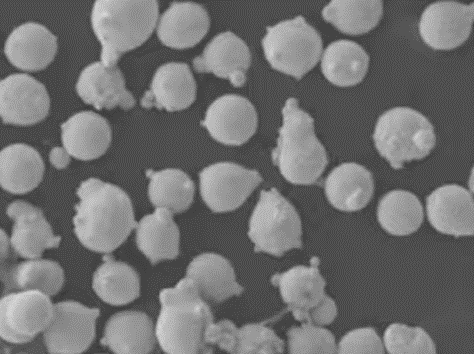
FeNiMo Soft Magnetic Powder in the Alloy Family
Within the broader soft magnetic category, FeNiMo compositions sit between pure iron powders and higher-nickel precision magnetic alloys. Pure iron offers strong saturation magnetization but can be more vulnerable to eddy-current loss and property instability if powder shape, insulation, or density are not carefully managed. Nickel-rich alloys often provide improved permeability and lower coercivity, while molybdenum helps refine the balance by affecting resistivity, microstructure, and temperature response.
This makes FeNiMo especially relevant when designers want a middle ground: better soft magnetic behavior than ordinary iron powder, but without moving directly into the highest-cost specialty magnetic chemistries. In AM, that balance is useful for prototypes and low-volume functional parts that require complex geometry as well as magnetic performance.
Why FeNiMo Exists as a Powder Product
The material exists in powder form because many magnetic parts benefit from near-net-shape manufacturing. Traditional laminated electrical steels dominate large motors and transformers, but they are less suitable for intricate three-dimensional geometries, internal channels, integrated mounting features, or compact electromagnetic assemblies. Powder-based routes allow designers to produce magnetic components with shapes that would be difficult or wasteful to stamp, machine, or braze from sheet stock.
For additive manufacturing users, FeNiMo powder also opens a path to rapid iteration. Flux concentrators, inductive cores, and actuator subcomponents can be redesigned quickly without retooling. That advantage is particularly relevant in aerospace electronics, advanced automotive systems, robotics, and laboratory equipment.
Distinguishing Characteristics of FeNiMo Soft Magnetic Powder
The most important traits are low coercive force, useful permeability, and the ability to tailor density and geometry through powder processing. Compared with hard magnetic materials, FeNiMo is intended to switch magnetic state efficiently. Compared with common stainless or tool steel powders, it is selected for electromagnetic function first and structural function second.
Soft magnetic alloys are valued not because they stay magnetized, but because they respond quickly and predictably to changing magnetic fields.
Another important distinction is that AM-built magnetic performance depends heavily on porosity, oxygen content, residual stress, and post-processing. The alloy chemistry matters, but so do recoating behavior, layer fusion, and thermal treatment. That is why powder specification is inseparable from application performance in this material family.
化学組成
FeNiMo soft magnetic powder is usually specified by nominal chemistry bands rather than one single universal composition. In industry, several Fe-Ni-Mo balances may be used depending on whether the goal is higher permeability, lower coercivity, better compact density, or a more economical nickel level. For AM and powder metallurgy supply, buyers normally request both the principal-element ranges and strict impurity limits because interstitials and residuals can degrade magnetic behavior.
Typical Composition of FeNiMo Soft Magnetic Powder
| エレメント | Typical wt.% Range | 冶金上の役割 | Functional Effect |
|---|---|---|---|
| フェ | Balance, typically 74-84 | Primary ferromagnetic matrix | Provides base magnetic saturation and structural framework |
| ニー | 12-20 | Soft magnetic tuning element | Improves permeability, reduces magnetostriction, supports stable magnetic response |
| モ | 2-6 | Resistivity and stability modifier | Helps lower losses, refines magnetic behavior, can improve thermal stability |
| C | 0.03 max typical | Impurity control | Excess carbon can increase hardness and impair soft magnetic response |
| O | 0.10 max typical for AM grades, often lower | Surface oxidation indicator | Higher oxygen can reduce density, worsen flow, and degrade magnetic properties |
| Si | 0.50 max typical residual | Residual control | Kept low unless intentionally alloyed, as excess can shift processing behavior |
| S | 0.03 max typical | Inclusion control | Elevated sulfur can reduce cleanliness and impair part quality |
| P | 0.03 max typical | Brittleness control | Higher phosphorus can embrittle consolidated parts and disturb magnetic consistency |
The exact Fe-Ni-Mo balance depends on the product concept. A lower-nickel FeNiMo grade may emphasize cost control and good magnetic response for general electromagnetic hardware, while a higher-nickel version may be tuned toward lower coercivity and more refined soft magnetic characteristics. Molybdenum content is usually modest, but its effect is disproportionate to its percentage because it influences both magnetic losses and metallurgical stability.
Role of Iron, Nickel, and Molybdenum
Iron is the main magnetic contributor and provides the base ferromagnetic matrix. It supports high saturation induction compared with many non-ferrous systems and gives the alloy its practical industrial relevance. However, iron alone is not enough to deliver the full soft magnetic performance required in precision electromagnetic parts.
Nickel plays a major role in reducing magnetic hysteresis and improving permeability. It also helps stabilize properties across operating conditions and supports lower magnetostriction than simple iron-rich systems. That is why Fe-Ni alloys have long been important in precision magnetic applications, and why FeNiMo variants remain useful when designers need more than just low-cost magnetic response.
Molybdenum fine-tunes the alloy. It can raise electrical resistivity, which is helpful for reducing eddy-current losses in some frequency ranges, and it may contribute to more stable microstructural behavior during thermal treatment. In powder systems, modest Mo additions can improve the overall property balance without fundamentally changing the alloy into a different magnetic family.
Impurities and Their Importance in Magnetic Powders
For soft magnetic powders, chemistry quality is not just an academic concern. Carbon, oxygen, sulfur, and phosphorus can all interfere with magnetic efficiency, sintering behavior, or AM process consistency. In particular, low coercivity is easier to achieve when the powder is clean, dense, and minimally oxidized after processing.
That is why buyers should review both nominal alloy composition and impurity ceilings. A powder can be chemically close to target while still underperforming magnetically if oxygen or residual contamination is too high. This issue is especially important in recycled or repeatedly handled AM powder streams.
物理的および機械的特性
The physical and mechanical profile of FeNiMo soft magnetic powder must be read differently from that of a structural AM alloy. Designers care about density, hardness, and strength because the part still has to survive handling, assembly, and service loads. Even so, the decisive properties are magnetic response, electrical resistivity, and the way those characteristics evolve after compaction, sintering, hot isostatic pressing, or additive manufacturing followed by heat treatment.
Typical Properties of FeNiMo Soft Magnetic Powder and Consolidated Parts
| プロパティ | 代表値 | 単位 | 試験基準 |
|---|---|---|---|
| Density of consolidated material | 7.9-8.3 typical | g/cm³ | Reference alloy data |
| 融点範囲 | 1420-1480 typical | °C | DSC / reference alloy data |
| Ultimate tensile strength | 450-800 typical, condition dependent | MPa | ASTM E8/E8M |
| Yield strength (0.2%) | 250-550 typical, condition dependent | MPa | ASTM E8/E8M |
| 伸び | 5-20 typical, condition dependent | % | ASTM E8/E8M |
| 硬度 | 120-260 typical | HV | ASTM E384 |
| 電気抵抗率 | 35-70 typical | µΩ·cm | Reference alloy data |
| Initial permeability | Application and condition dependent | - | Magnetic test method by internal or industry practice |
| 保磁力 | Low, condition dependent | A/m or Oe | Magnetic test method by internal or industry practice |
| 熱伝導率 | 15-30 typical | W/m-K | Reference alloy data |
These values are typical ranges rather than guaranteed catalog minima, because magnetic powder properties vary strongly with density, porosity, microstructure, and post-process condition. A laser powder bed fusion specimen, a sintered compact, and a hot-isostatically-processed part of the same nominal chemistry can show noticeably different behavior. For that reason, qualification should always be part-specific.
Magnetic Performance vs Mechanical Performance
FeNiMo powders are selected primarily for electromagnetic function. A designer evaluating this alloy should ask first whether the required permeability, coercive force, and loss behavior can be achieved at the intended operating frequency. Mechanical properties then act as enabling constraints rather than the main reason to choose the material.
This is an important distinction. A stronger structural alloy can still be the wrong choice if it causes poor magnetic switching efficiency or excessive hysteresis loss. In functional electromagnetic parts, soft magnetic performance is the primary metric, not just tensile strength.
Density, Porosity, and Their Effect on Magnetic Behavior
Density matters because pores interrupt magnetic flux paths. In powder metallurgy and AM, incomplete fusion or insufficient sintering can increase reluctance, reduce permeability, and raise magnetic losses. That is why processing parameters for FeNiMo often aim not only at dimensional accuracy but also at density optimization.
Residual porosity may still be acceptable in some applications, especially where weight or thermal behavior is part of the design brief. However, the user should assume that increasing density generally improves magnetic continuity, provided the microstructure is not simultaneously damaged by oxidation or excessive grain-boundary defects.
Thermal and Electrical Considerations
Electrical resistivity is a practical advantage in powder-based magnetic materials because higher resistivity can help reduce eddy-current losses, especially where geometry does not permit classic lamination strategies. Molybdenum contributes to this behavior, though the final performance also depends on microstructure and any insulating treatment used in non-AM powder compaction routes.
Thermally, FeNiMo is more conductive than many specialty non-ferrous alloys but less conductive than copper-based materials. For electromagnetic assemblies that combine magnetic flux management with thermal loading, engineers sometimes compare it with a [copper alloy powder portfolio] to decide whether the design is magnetically limited or heat-transfer limited.
仕様および取り扱いグレード
In commercial practice, FeNiMo soft magnetic powder is supplied according to particle-size distribution, shape quality, chemistry range, and powder-flow characteristics rather than one globally harmonized material code. That is common for advanced powder products used across additive manufacturing, metal injection molding, and powder metallurgy. The most useful purchasing specification therefore combines nominal chemistry with clear test methods for PSD, apparent density, tap density, flowability, and oxygen content.
Typical FeNiMo Soft Magnetic Powder Grades
| Grade / Supply Condition | 代表的なPSD範囲 | 見かけ密度 | タップ密度 | ホールの流れ | 酸素含有量 | 真球度/形態 | Cross-Reference / Typical Use |
|---|---|---|---|---|---|---|---|
| Fine LPBF grade | 15-45 µm | 4.0-4.8 g/cm³ | 4.8-5.8 g/cm³ | 14-22 s/50 g | 0.03-0.10 wt.% typical | High spherical, low satellites | Laser powder bed fusion for fine electromagnetic parts |
| Standard LPBF grade | 20-53 µm | 4.2-4.9 g/cm³ | 5.0-5.9 g/cm³ | 13-20 s/50 g | 0.03-0.08 wt.% typical | Spherical atomized powder | General AM development and prototyping |
| DED / cladding grade | 45-105 µm | 4.3-5.0 g/cm³ | 5.1-6.0 g/cm³ | 12~18秒/50 g | 0.03-0.08 wt.% typical | Coarser spherical cut | Directed energy deposition and functional repairs |
| PM / MIM grade | 10-45 µm or 20-63 µm | 3.8-4.7 g/cm³ | 4.6-5.6 g/cm³ | 15-25 s/50 g | 0.03-0.12 wt.% typical | Spherical or near-spherical | Press-and-sinter, MIM, and magnetic compaction routes |
| Standards alignment row | Supplier-specific | - | - | - | - | - | Testing commonly aligned with ASTM B212 見かけ密度測定法, ASTM B213, ASTM B527, and NIST additive manufacturing guidance |
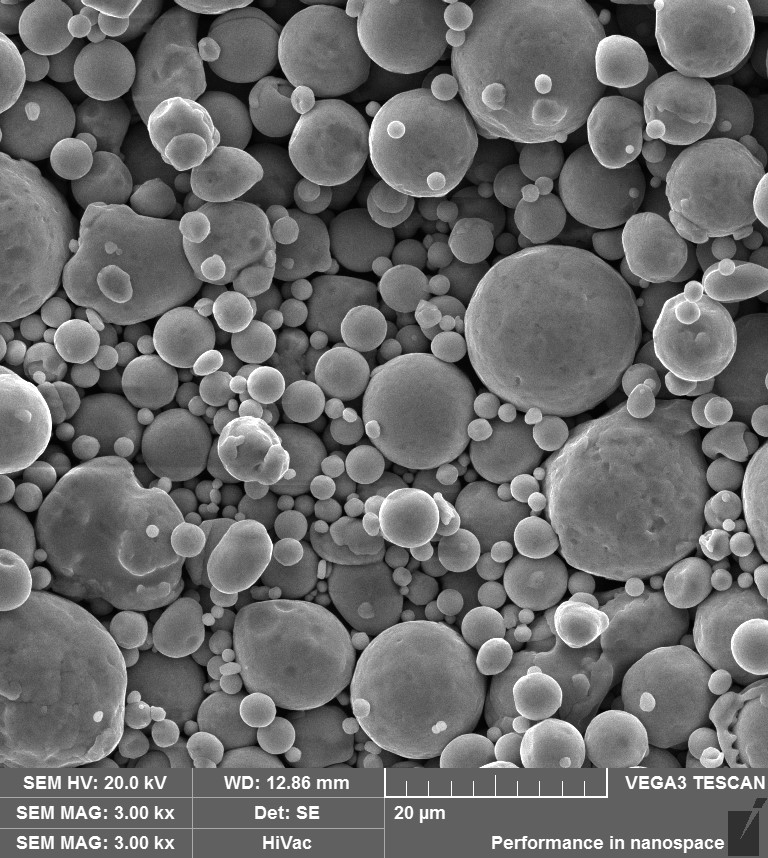
The PSD range should match the selected process. Laser powder bed fusion generally favors tighter distributions with controlled fines, while DED can tolerate larger cuts. MIM and PM routes may prefer finer fractions for packing and sintering, but too many ultrafine particles can hurt flow and raise oxygen exposure.
FeNiMo Soft Magnetic Powder for SLM, DED, and PM
For SLM or LPBF, users usually prioritize spherical shape, consistent D50, and stable recoating. For DED, broader size cuts may be acceptable if feed consistency remains good. In traditional press-and-sinter routes, the design focus shifts toward compressibility, green density, and the way the powder responds to lubricant or binder systems.
Standards and Cross-Reference Logic
FeNiMo soft magnetic powder does not map cleanly to one universal aerospace-style product specification. Instead, quality systems usually draw from established powder test methods and broader AM terminology such as ISO/ASTM additive manufacturing vocabulary. The result is a practical specification framework rather than a single-grade code.
This is normal in magnetic powder supply. Mechanical test methods can often be borrowed from conventional metallurgy standards, while magnetic tests are frequently application-specific because geometry and post-processing influence results so strongly.
What Buyers Should Specify
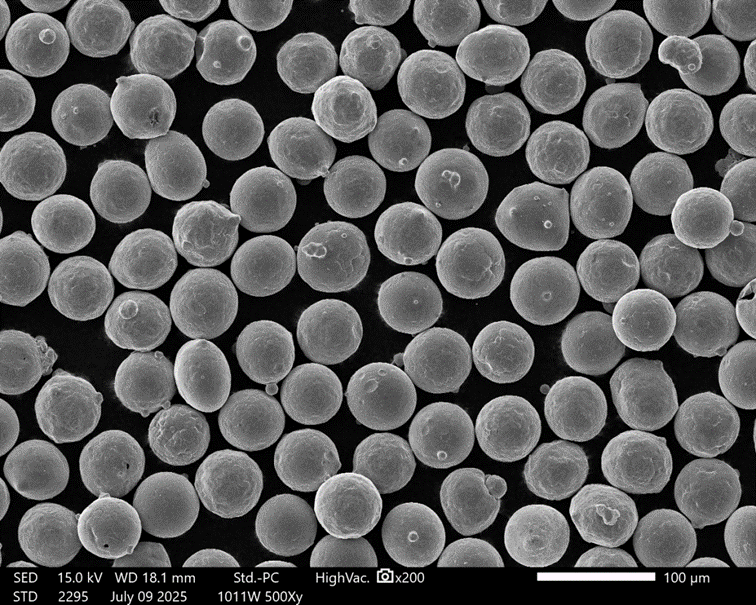
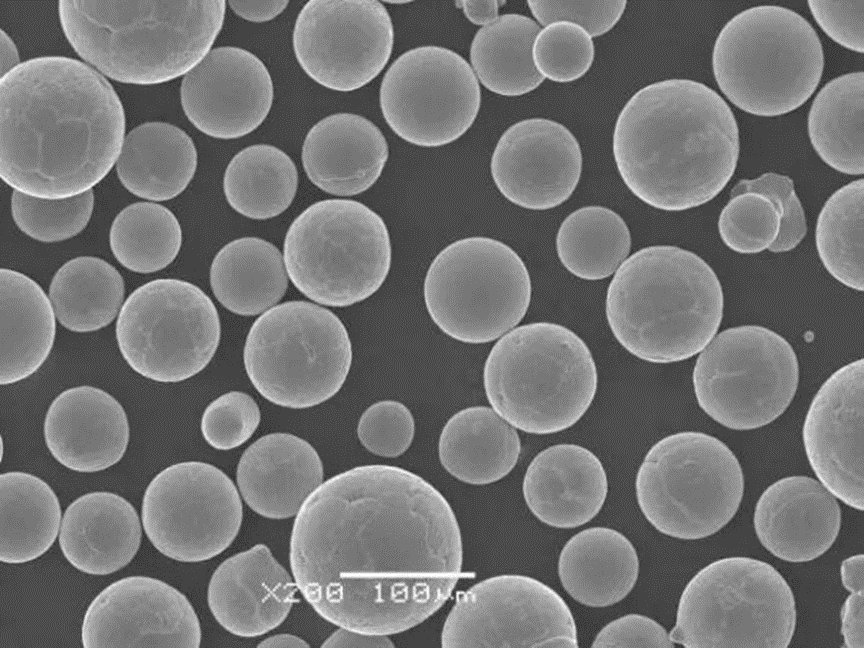
A robust purchase specification should define nominal chemistry, allowable residuals, PSD limits, flowability, apparent density, tap density, and packaging condition. For higher-value programs, it should also request particle morphology images, lot traceability, and test coupons reflecting the intended consolidation route. In functional magnetic applications, specifying the post-process target properties is often more useful than specifying chemistry alone.
製造工程
The manufacturing route has a direct effect on FeNiMo soft magnetic powder quality because it influences particle shape, oxygen pickup, segregation risk, and usable size distribution. Gas atomization is the most common route for AM-grade spherical powders, but vacuum-assisted atomization and PREP can also be relevant depending on purity targets and production economics.
FeNiMo Soft Magnetic Powder Process Comparison
| プロセス | 球形度 | 酸素ピックアップ | PSDコントロール | スループット | 相対的なコスト |
|---|---|---|---|---|---|
| ガスアトマイズ(GA) | 高い | 低~中程度、大気の状態による | グッド | 高い | 中程度 |
| 真空誘導ガスアトマイズ法(VIGA) | 非常に高い | 低い | 非常に良い | 中~高 | 中~高 |
| 電極誘導ガスアトマイズ法(EIGA) | 非常に高い | 非常に低い | 非常に良い | ミディアム | 高い |
| プラズマ回転電極プロセス(PREP) | Extremely high | 非常に低い | Good, often coarser | Medium to low | 高い |
| 水の霧化 | 低~中 | より高い | 中程度 | 高い | 低い |
Gas Atomization for Spherical Magnetic Powder
Gas atomization works by breaking a molten alloy stream into droplets with high-velocity inert gas. Those droplets solidify into mostly spherical particles, which then pass through classification and quality-control steps. For FeNiMo, this route usually offers the best balance between production scale, shape quality, and cost.
From an AM perspective, GA powder is attractive because good sphericity improves layer spreading and reduces flow interruptions. For magnetic alloys, the route also helps control chemistry more tightly than lower-cost methods that produce irregular particles.
VIGA and EIGA for Cleaner Feedstock
VIGA improves cleanliness by melting the alloy under vacuum before gas atomization. That matters because controlled oxygen content can influence both printability and final magnetic behavior. EIGA can reduce contamination risk even further by atomizing from an electrode feedstock rather than a crucible-held melt.
These premium routes are not always necessary for every FeNiMo application. However, they become more attractive when the design places a high value on powder purity, low interstitial content, and reduced lot-to-lot variability.
PREP and Its Trade-Offs
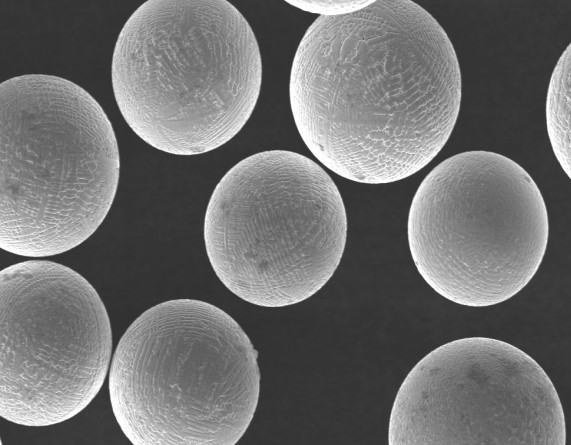
PREP is best known for producing highly spherical powder with very smooth surfaces. For some specialty powders, that can improve flow and reduce defect risk during feeding or recoating. The trade-off is cost, and PREP often produces a distribution that may require more aggressive classification if fine LPBF cuts are needed.
For FeNiMo, PREP is usually a premium solution rather than the default route. It can be justified when powder cleanliness and morphology outweigh volume economics, especially in advanced R&D or demanding functional parts.
Post-Processing and Powder Conditioning
After primary powder production, the material is sieved, blended if necessary, sampled, and packaged. These steps are not secondary details; they are part of the powder-engineering process. Even high-quality atomized powder can perform poorly if classification is inconsistent or if moisture and oxygen exposure occur during handling.
For magnetic applications, annealing after part fabrication is also important. Many FeNiMo components require stress relief or magnetic anneal cycles to recover permeability and lower coercivity after AM thermal history or mechanical finishing.
業界別の用途
FeNiMo soft magnetic powder is used where geometry and magnetic function intersect. It is not a universal replacement for laminated electrical steel, ferrites, or pure iron cores. Instead, it addresses applications that benefit from three-dimensional magnetic pathways, compact packaging, or process routes that do not rely on stamping sheet stock.
Aerospace and Defense Electronics
Aerospace systems increasingly require compact electromagnetic devices that fit into constrained volumes. FeNiMo powders are relevant for magnetic cores, sensor housings, compact inductive features, and actuator subcomponents where design freedom matters. Additive manufacturing can simplify part integration by combining mounting features, ducts, and electromagnetic geometry into one build.
In defense-adjacent applications, low-volume production and rapid redesign are often more important than the lowest material cost. That plays to the strengths of powder-based magnetic materials.
Automotive, E-Mobility, and Industrial Motion
Automotive electrification has expanded interest in soft magnetic powders for motors, sensors, converters, and electromagnetic actuators. While mass-production traction motors still rely heavily on laminated steels, FeNiMo powder can be useful in specialized parts, prototypes, and integrated components where traditional lamination is impractical.
Industrial motion systems show a similar pattern. Robotics, precision positioning equipment, and solenoid-driven devices often need compact magnetic circuits with unusual shapes. Powder-based processing makes those geometries more achievable.
Energy, Instrumentation, and Electronics
In energy and electronics hardware, FeNiMo soft magnetic powder can be used for inductors, magnetic shields, flux concentrators, and current-sensing components. The alloy is relevant where designers need a ferromagnetic path with controlled geometry and acceptable losses across a defined operating range.
Compared with standard structural powder choices, the value here is functional rather than purely mechanical. Engineers often compare it with [iron-based powder options] when the question is whether better magnetic refinement justifies the nickel and molybdenum additions.
Medical Devices and Scientific Equipment
Medical implant use is limited because this alloy family is not a default biomaterial category. However, non-implant device hardware, analytical instruments, and laboratory automation systems may benefit from compact magnetic parts with repeatable response. Examples include actuator elements, magnetic fixtures, and sensor-related components.
Tooling, Prototyping, and Multi-Material Development
FeNiMo is also valuable in R&D environments that need fast iteration. Engineers can test different core geometries, wall thicknesses, and magnetic path layouts without committing to stamping dies or laminated tool sets. In multi-material concept work, it may be assessed alongside a broader [industrial applications catalog] to determine where a magnetic alloy best fits among structural, thermal, and corrosion-resistant powder systems.
代替材料との比較
Material selection for electromagnetic parts depends on frequency, geometry, mechanical loading, operating temperature, and production scale. FeNiMo soft magnetic powder competes not only with other powder alloys but also with sheet laminations, ferrites, and pure iron systems. In AM, the most relevant comparison is usually with other metallic powders that can be built into dense, complex functional shapes.
FeNiMo Soft Magnetic Powder vs Alternative Materials
| 素材 | 密度 (g/cm³) | 磁気特性 | 印刷適性 | 耐食性 | 相対的なコスト | 最適なユースケース |
|---|---|---|---|---|---|---|
| FeNiMo soft magnetic powder | 7.9-8.3 | Soft magnetic, low coercivity, useful permeability | Good after qualification | 中程度 | 中~高 | Complex electromagnetic parts needing balanced magnetic performance |
| Pure iron powder | 7.8-7.9 | Very high saturation, less refined loss behavior | Good in PM, moderate in AM | 低~中程度 | 低い | General magnetic parts where cost matters most |
| FeSi alloy powder | 7.2-7.5 | Good electrical steel analog behavior, higher resistivity | 中程度 | 中程度 | ミディアム | Core applications emphasizing lower eddy-current loss |
| NiFe soft magnetic alloy powder | 8.0-8.7 | 透磁率が非常に高く、保磁力が非常に低い | 中程度~良好 | 中程度 | 高い | Precision magnetic devices and sensitive electromagnetic systems |
| Ferrite materials | 4.8-5.2 | Soft magnetic ceramic, high resistivity, brittle | Not typical for metal AM | High in many environments | 低~中 | High-frequency components with lower structural demands |
FeNiMo generally sits in a balanced position. It usually outperforms plain iron in refined soft magnetic behavior and process stability, while often costing less than very high-nickel precision magnetic alloys. Against ferrites, it offers far better mechanical toughness and metal-part form factor, though ferrites can remain superior in high-frequency loss management because of their much higher electrical resistivity.
The key question is not which material is universally best, but which one fits the operating window. If the part must carry structural load, survive machining, and still switch magnetically with good efficiency, FeNiMo often becomes more attractive than brittle ceramic alternatives.
当社
Shanghai Truer Technology Co., Ltd., operating am-printing.com, was established in 2009 and created its additive manufacturing business in 2019. According to its published company information, the company integrates 3D printing powder-making equipment and related services with metal powder supply, including TiNi, TiTa, TiAl, TiNbZr, CoCrMo, and spherical nickel-based, cobalt-based, titanium-based, copper-based, aluminum-based, and stainless steel powders. Its stated technical scope includes Selective Electron Beam Melting equipment, Plasma Rotating Electrode Process equipment, gas atomization capability, and a joint innovation center for metal 3D printing, while its supported downstream processes include SLM, SEBM, DED, laser cladding, PM, MIM, HIP, cold and hot spraying, welding, and coating for sectors such as aerospace, medical, nuclear power, 3C electronics, hand tools, and remote control cars. Additional background appears on the 会社概要ページ.
よくあるご質問
Q1. Is FeNiMo soft magnetic powder suitable for 3D printing?
Yes, it can be suitable for additive manufacturing when the target part requires magnetic functionality and complex geometry. Success depends on powder sphericity, size distribution, oxygen control, and post-build annealing rather than chemistry alone.
Q2. What makes FeNiMo soft magnetic powder different from pure iron powder?
FeNiMo adds nickel and molybdenum to improve permeability, reduce coercivity, and tune loss behavior compared with plain iron. Pure iron is often cheaper and offers high saturation, but FeNiMo usually provides a more refined soft magnetic balance for precision parts.
Q3. Which AM processes can use FeNiMo soft magnetic powder?
The most relevant processes are laser powder bed fusion, directed energy deposition, and some hybrid powder-metallurgy routes. Process choice depends on whether the priority is fine detail, larger feature size, repair work, or maximum magnetic density after consolidation.
Q4. Does FeNiMo soft magnetic powder need heat treatment after printing?
In many cases, yes. Stress relief or magnetic annealing can reduce residual stress, improve permeability, and lower coercive force after additive manufacturing. The exact cycle should be qualified against the final geometry and target operating frequency.
Q5. How does FeNiMo soft magnetic powder compare with NiFe magnetic alloys?
NiFe alloys often deliver even higher permeability and lower coercivity, but they typically come with higher material cost. FeNiMo is often selected when engineers want strong soft magnetic behavior with a more balanced cost-performance position and acceptable mechanical robustness.
Q6. What should buyers ask for when sourcing FeNiMo soft magnetic powder?
Buyers should request nominal chemistry, lot chemistry, impurity limits, PSD data, Hall flow, apparent and tap density, particle morphology, and the intended process route. If the project is application-driven, it is also sensible to ask through the technical inquiry channel whether magnetic test data and custom size fractions are available.