
簡単な回答
Stellite 6 alloy powder is a cobalt-chromium-tungsten-carbon material used in additive manufacturing and related surface-engineering processes when wear, galling, corrosion, and hot-hardness matter more than low cost or low density. It is a strong choice for AM parts and repair builds exposed to abrasion, valve-seat contact, erosion, or elevated temperature because it combines a tough cobalt-rich matrix with hard chromium- and tungsten-rich carbides. In practice, that makes it especially relevant for aerospace hardware, oil and gas components, energy valves, cutting edges, and industrial hardfacing programs.
What Is Stellite 6 alloy powder
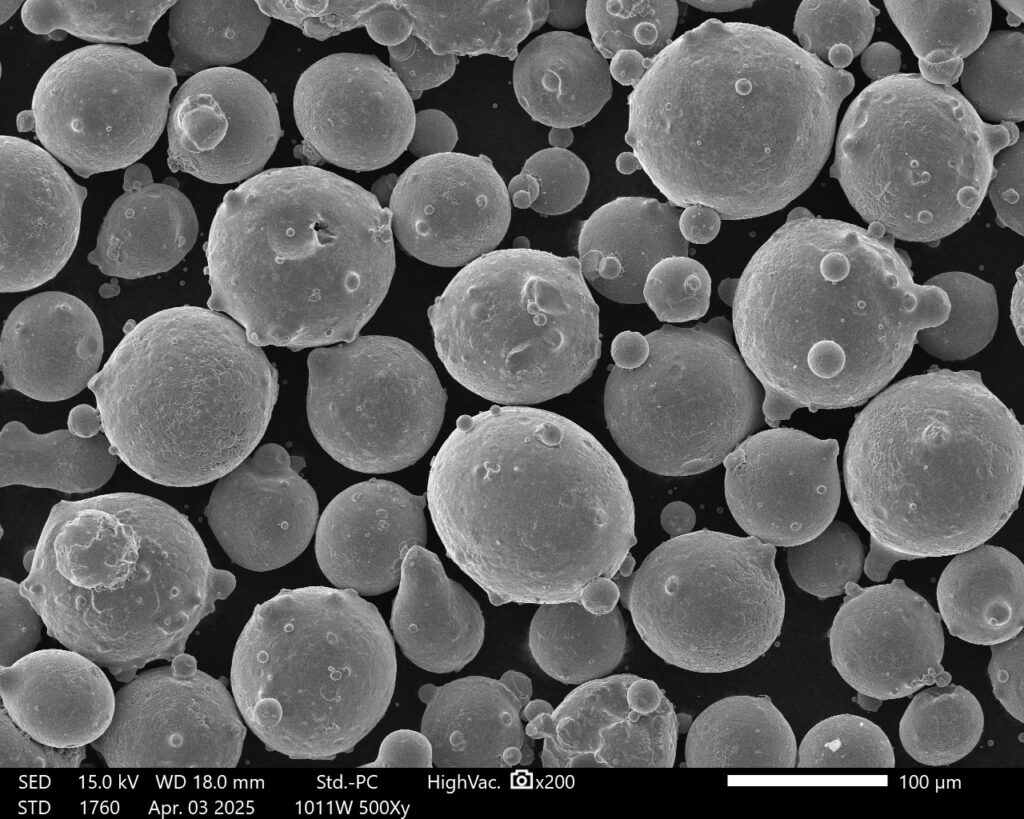
Stellite 6 alloy powder is a spherical metal feedstock based on the well-known Stellite family of cobalt-based wear-resistant alloys. The broader Stellite group is defined by cobalt as the matrix element, with chromium providing corrosion and oxidation resistance and carbon plus tungsten contributing carbide hard phases that raise wear resistance and hot hardness. In the case of grade 6, the alloy is widely treated as the “general-purpose” member of the family because it balances wear performance, toughness, and process versatility better than many higher-carbon grades.
In additive manufacturing, Stellite 6 alloy powder sits at the intersection of structural alloy and hardfacing alloy. Unlike lightweight titanium grades or precipitation-hardened nickel superalloys, it is usually selected when engineers need surfaces or near-net-shape parts that must survive metal-to-metal contact, erosive particles, corrosive media, or thermal cycling. That is why the alloy appears not only in powder bed fusion discussions, but also in laser cladding, directed energy deposition, thermal spray, and repair-oriented AM workflows. The terminology around these process categories follows the ISO/ASTM 52900 積層造形用語集, which defines additive manufacturing as joining materials from 3D model data, usually layer upon layer.
From a metallurgical standpoint, the alloy is usually described as a cobalt-rich solid solution reinforced by complex carbides. That combination explains why Stellite 6 can resist adhesive wear and maintain useful hardness at temperatures where many tool steels soften. It also explains a common design trade-off: the same carbide network that gives the alloy its durability can reduce elongation and machinability compared with softer corrosion-resistant AM powders.
Stellite 6 is also different from cobalt-chromium medical alloys such as CoCrMo. Implant-grade cobalt alloys are generally optimized around biocompatibility, castability, or fatigue response in a different regulatory and service environment, while Stellite 6 is primarily a wear and hard-surface alloy. For readers comparing families, the broader cobalt alloy powder collection provides useful context on how Stellite-type materials differ from other cobalt-based AM feedstocks used for structural or corrosion-focused applications.
Stellite alloys are cobalt-based alloys designed for wear resistance and commonly used where abrasion, corrosion, or heat make conventional alloys fail sooner.
化学組成
The nominal chemistry of Stellite 6 alloy powder varies slightly by producer and product form, but the core design is consistent: a cobalt base, high chromium, moderate tungsten, and about 1 wt% carbon. Minor additions such as nickel, iron, manganese, and silicon are commonly present as controlled residuals or small balancing elements. Commercial powder certificates usually report chemistry in weight percent, since that remains the preferred language for purchasing, lot release, and cross-comparison with welding and hardfacing grades.
| エレメント | 代表的な組成(wt%) | Typical Control Range (wt%) | Metallurgical Role in Stellite 6 Alloy Powder |
|---|---|---|---|
| コバルト | バランス | バランス | Forms the tough matrix, retains strength at elevated temperature, and supports galling and wear resistance |
| クロム(Cr) | 27.0–30.0 | 26.0–32.0 | Builds passive corrosion-resistant films and contributes chromium-rich carbide formation |
| タングステン(W) | 4.0–6.0 | 3.5–6.0 | Strengthens the matrix and supports hard carbide phases for abrasion and hot-hardness performance |
| カーボン(C) | 1.0–1.3 | 0.9–1.4 | Drives carbide content and is a primary lever for hardness and wear resistance |
| ニッケル(Ni) | 1.0–3.0 | 0–3.0 | May improve toughness and corrosion balance in some commercial chemistries |
| 鉄(Fe) | 1.0–3.0 | 0–3.0 | Usually a controlled residual; excessive levels can dilute wear-focused performance |
| ケイ素 (Si) | 1.0–1.5 | 0.8–1.5 | Supports deoxidation during melting and can influence fluidity and solidification |
| マンガン (Mn) | 0.5–1.5 | 0–1.5 | Secondary deoxidation and processing aid, usually controlled at modest levels |
The most important variables are chromium, tungsten, and carbon. Chromium underpins the alloy’s corrosion and oxidation resistance through passive-film formation, while tungsten and carbon create the hard carbide population that distinguishes Stellite 6 from softer cobalt alloys. If carbon is pushed too low, wear resistance drops; if it climbs too high, toughness and printability can suffer because the material becomes more brittle and more crack-sensitive during rapid solidification or service impact.
This chemistry also explains why Stellite 6 performs differently from iron- and nickel-based AM powders. Iron-based systems often rely on martensitic hardening or carbide additions after heat treatment, while Stellite 6 derives much of its wear performance directly from its as-solidified microstructure. That distinction matters in repair and cladding because it can reduce dependence on complex post-processing. Engineers comparing hardfacing options often benchmark it against the iron-based powder portfolio when balancing cost against service life in sliding or erosive environments.
For powder users, interstitial control is still important even though Stellite 6 is more forgiving than highly reactive titanium alloys. Oxygen, moisture pickup, and contamination from recycling can alter flow, spatter behavior, oxide inclusion content, and ultimately coating or build consistency. NIST’s work on metal AM feedstock characterization underscores that particle chemistry, morphology, and size distribution all influence repeatability, not just the nominal alloy name on the label.
物理的および機械的特性
Stellite 6 alloy powder is generally purchased for the performance of the deposited or printed alloy rather than for standalone powder properties. In service, the material is valued for moderate-to-high hardness, good corrosion resistance, strong galling resistance, and the ability to keep useful wear performance at elevated temperature. Because the alloy can be cast, welded, clad, sprayed, or additively manufactured, published property values vary with product form, cooling rate, dilution, heat input, and post-processing. The figures below should therefore be read as typical engineering ranges rather than one universal datasheet.
| プロパティ | 代表値 | 単位 | Test Standard / Reference Basis |
|---|---|---|---|
| 密度 | 8.34–8.44 | g/cm³ | Typical supplier and literature range |
| 溶解範囲 | 1280–1390 | °C | Typical reported solidus-liquidus range |
| 極限引張強さ | 750–900 | MPa | Typical cast or deposited alloy values |
| 降伏強度 (0.2%) | 500–650 | MPa | Typical room-temperature engineering range |
| 破断伸度 | 1–5 | % | Typical low-ductility cobalt hardfacing alloy range |
| 硬度 | 36–45 | HRC | Typical cast/deposited Stellite 6 range |
| ビッカース硬度 | 380–500 | HV | Typical converted or directly measured range |
| 弾性係数 | 210–240 | GPa | Typical cobalt-base engineering range |
| 熱伝導率 | 13–16 | W/m-K | Typical room-temperature engineering range |
| Oxidation / Hot-Hardness Retention | グッド | qualitative | Service-property descriptor from cobalt wear-alloy use |
The density is comparable to many nickel superalloys and well above titanium or aluminum AM materials. That means Stellite 6 is rarely selected for weight-sensitive hardware, but the same mass that limits lightweighting can be acceptable in valves, sleeves, cutting edges, nozzles, or wear pads where longevity matters more than specific strength. In addition, a density around 8.34 g/cm³ is consistent with reported commercial Stellite 6 powder data and supplier technical sheets.
Hardness is the headline property most buyers notice first, but it should not be read in isolation. Stellite 6 is usually less hard than very high-carbon cobalt grades such as Stellite 1, yet it is tougher and more versatile across impact, corrosion, and mixed-wear conditions. That is one reason it became the best-known “all-around” grade within the family rather than the absolute hardest one.
A more subtle advantage is hot hardness and galling resistance. Many stainless steels and tool steels can perform well at room temperature but lose surface stability when sliding contact, elevated heat, or poor lubrication combine in service. Stellite 6 retains a wear-oriented microstructure under those harsher conditions, which is why it remains common in valve trims, seat surfaces, and severe-contact components.
Thermal conductivity is moderate rather than high, which affects process tuning in laser-based additive manufacturing and cladding. Heat tends to remain localized enough for stable melt pools, but the alloy’s carbide-forming chemistry and thermal gradients still require disciplined parameter development to avoid dilution issues, cracking, or coarse microstructural zones. That balance is familiar in laser cladding literature on Stellite 6 and is one reason parameter transfer from steels or nickel powders cannot be assumed.
仕様および取り扱いグレード
Commercial Stellite 6 alloy powder is usually ordered by particle size distribution, chemistry, morphology, and target process rather than by a single global AM grade code. In the powder market, buyers typically specify a PSD window such as 15–45 µm, 15–53 µm, 45–105 µm, or 53–150 µm; minimum sphericity; maximum oxygen; and standard powder metrics including apparent density, Hall flow, and tap density. These measurements align with common powder-characterization practice summarized by NIST and by ASTM standards used across metal powder supply chains.
| Supply Grade | 代表的なPSD範囲 | 見かけ密度 | タップ密度 | ホールの流れ | 酸素含有量 | 真球度/形態 | 代表的な規格の相互参照 |
|---|---|---|---|---|---|---|---|
| STL6-15/45 | 15-45 µm | 4.4–4.9 g/cm³ | 5.1~5.8 g/cm³ | 14–20 s/50 g | ≤1000 ppm | 背が高く、ほぼ球形 | Fine LPBF feedstock; powder checks often aligned with ASTM B212/B213/B527 |
| STL6-15/53 | 15–53 µm | 4.5-5.0 g/cm³ | 5.2–5.9 g/cm³ | 14–19 s/50 g | ≤1000 ppm | High, low-satellite spherical powder | Common for laser powder bed and binder-jet feedstock development |
| STL6-45/105 | 45-105 µm | 4.7–5.2 g/cm³ | 5.4–6.0 g/cm³ | 13–18 s/50 g | ≤900 ppm | Spherical, broader cut | Typical for DED, laser cladding, and some EBM-style evaluations |
| STL6-53/150 | 53-150 µm | 4.8–5.3 g/cm³ | 5.5–6.1 g/cm³ | 12–17 s/50 g | ≤900 ppm | Spherical coarse powder | Preferred for cladding, spray, and high-deposition-rate repair work |
Because Stellite 6 is widely used outside powder bed fusion, purchasing documents often mix AM standards with welding or hardfacing references. A buyer may request particle testing by the ASTM B212 見かけ密度測定法, flow by ASTM B213, tap density by ASTM B527, and chemistry consistent with a Stellite 6 or UNS R30006-type nominal composition, even when no single aerospace powder specification controls the whole order. That hybrid approach is normal for legacy hardfacing alloys entering modern AM workflows.
In practice, the “best” grade depends on process physics. Fine powder supports thin layers and better resolution in LPBF, but it generally carries higher specific surface area and can be more sensitive to oxygen pickup or flow issues. Coarser fractions offer more stable feeding for cladding and DED, especially when deposition rate, repair geometry, and low overspray are the main priorities. This is one reason Stellite 6 is often adopted first in repair or coating programs before moving into fully dense freeform AM parts.
Engineers comparing Stellite 6 against lower-density build materials should keep process intent in mind. If the requirement is surface durability, the alloy may compete not with titanium at all, but with tool steels, cobalt weld wires, or nickel hardfacing powders. By contrast, if the goal is a full lightweight structural part, the titanium powder product range will often be a more logical baseline.
製造工程
Most Stellite 6 alloy powder for additive manufacturing is produced by atomization-based methods. Gas atomization is the mainstream route because it offers commercially practical throughput and good spherical morphology, while more controlled routes such as vacuum inert gas atomization, electrode induction gas atomization, and plasma rotating electrode processing are used when tighter impurity control or premium morphology is required. Since the alloy is also widely consumed for cladding and spray applications, some producers optimize the process for flow stability and deposition efficiency rather than only for very fine LPBF cuts.
| Process Route | Typical Feed Form | 球形度 | Oxygen Pickup Risk | PSDコントロール | スループット | 相対的なコスト | 最適なユースケース |
|---|---|---|---|---|---|---|---|
| GA (Gas Atomization) | Melted master alloy | 高い | ミディアム | グッド | 高い | 中程度 | General-purpose AM and cladding powder production |
| VIGA (Vacuum Inert Gas Atomization) | Vacuum-melted alloy | 高い | 低~中 | 良い~非常に良い | ミディアム | 中~高 | Cleaner chemistry and tighter batch control |
| EIGA (Electrode Induction Gas Atomization) | Solid bar or electrode | 非常に高い | 低い | 非常に良い | ミディアム | 高い | High-purity spherical powder with reduced contamination risk |
| PREP(プラズマ回転電極プロセス) | Rotating electrode | 非常に高い | 非常に低い | 中程度 | 低~中 | 高い | Premium spherical powder for demanding AM feedstock requirements |
Gas-Atomized Stellite 6 Alloy Powder
GA is the dominant commercial method because it breaks a molten metal stream into droplets using high-pressure inert gas, yielding mostly spherical powder with broad industrial relevance. For Stellite 6, gas atomization usually provides enough roundness, flowability, and cost efficiency for LPBF screening, binder jetting, laser cladding, and spray applications. It also makes it easier to generate multiple particle cuts from one melt, which matters when a supplier wants to serve both fine AM and coarser hardfacing demand from the same alloy batch.
PREP and Premium Spherical Stellite Powder
PREP begins with a rotating electrode melted by plasma, producing droplets that solidify into very clean, highly spherical particles. The route is well known for low contamination and low satellite content, which can be valuable where powder spreadability and repeatability are critical. The trade-off is higher cost and lower throughput, so PREP is often reserved for premium or highly specialized feedstock rather than routine high-volume hardfacing powder.
VIGA and EIGA for Cleaner Chemistry
VIGA improves gas control by combining vacuum melting with inert gas atomization, while EIGA reduces contamination pathways by starting from a solid electrode. For cobalt alloys such as Stellite 6, these routes are attractive when impurity control, tighter lot-to-lot chemistry, or advanced R&D reproducibility matters. They are less critical when the powder will be used in high-dilution repair cladding, but more relevant in powder-bed AM where feedstock consistency strongly affects spreadability and final part density.
A second manufacturing consideration is powder recycling. Stellite 6 generally tolerates industrial handling well, but reuse strategy still needs qualification because repeated thermal exposure can shift fine-particle content, oxygen level, and satellite population. NIST’s work on metal powder metrology makes the broader point clearly: AM quality depends on continuous measurement of powder state, not just on the original certificate of analysis.
業界別の用途
Aerospace and Aero-Engine Hardware
Stellite 6 alloy powder is widely relevant in aerospace wherever parts face hot wear, fretting, erosion, or valve-seat contact rather than extreme lightweighting requirements. Typical targets include seat inserts, seal surfaces, anti-galling interfaces, and repair deposits on higher-value components. In these cases, AM is often used to add localized performance rather than to replace the full part with a monolithic cobalt build.
Oil, Gas, and Industrial Valves
Few application areas fit Stellite 6 better than aggressive valve service. The alloy’s mix of wear resistance, corrosion resistance, and galling resistance is why it has long been used on valve seats, gate surfaces, nozzles, and sealing elements in chemical processing and oil and gas equipment. Additive and cladding routes allow those surfaces to be applied only where needed, reducing the amount of expensive cobalt alloy in the finished part.
エネルギーと発電
Energy hardware often combines heat, sliding contact, particulates, and corrosive media, which is precisely the type of environment that favors cobalt hardfacing alloys. Stellite 6 is therefore common in steam, thermal, and process-plant hardware such as valve trims, pump sleeves, wear rings, and other contact surfaces. One caution is that cobalt-containing materials have been discouraged in some nuclear contexts because cobalt release can create radiological concerns, so use in nuclear systems is application-specific rather than universal.
Automotive, Tooling, and Cutting Environments
Historically, Stellite alloys were used in tool edges and valve-seat applications, and those use patterns still inform modern powder demand. In automotive and tooling, Stellite 6 is usually chosen for severe-contact parts, hot wear zones, dies, knives, and trim geometries that see abrasion or adhesive wear. It is not the cheapest option, but it can outperform common steels where lubrication is poor and contact stresses are repeated.
Medical and Dental Contexts
Some Stellite-family alloys have appeared historically in dental and implant-related contexts, but Stellite 6 should not be treated as a drop-in substitute for regulated implant cobalt-chromium-molybdenum alloys. In medical manufacturing, its more realistic role is specialized wear surfaces, instruments, or non-implant hardware unless a full biocompatibility and regulatory path has been established. That distinction is essential because alloy family familiarity does not equal equivalence in qualification.
Laser Cladding, Repair, and Hybrid AM
For many industrial users, the strongest business case is not a fully printed Stellite 6 part but a repaired or functionally reinforced one. Laser cladding and DED enable localized deposition on steel, nickel, or other substrates so that only the wear surface uses cobalt alloy. This strategy often delivers the best cost-performance ratio because it places the premium material exactly where service damage occurs. A broader industrial application sectors overview is helpful when mapping those repair-driven use cases across aerospace, tooling, energy, and medical manufacturing.
代替材料との比較
Material selection for wear-critical AM is always comparative. Stellite 6 alloy powder competes with nickel hardfacing alloys, cobalt-chromium-molybdenum alloys, martensitic or precipitation-hardening steels, and in some cases tungsten-carbide-reinforced systems. The correct benchmark depends on whether the design priority is hot wear, corrosion, galling resistance, toughness, price, or regulatory familiarity.
| 素材 | 密度 (g/cm³) | Typical Strength / Hardness Profile | 印刷適性 | 耐食性 | Relative Powder Cost | Best-Known Advantage |
|---|---|---|---|---|---|---|
| ステライト6合金 | 8.34–8.44 | Moderate tensile strength, 36–45 HRC typical | Good after parameter tuning | 高い | 高い | Balanced wear, galling, and hot-hardness performance |
| CoCrMo | 8.3–8.4 | Strong structural cobalt alloy, often lower wear focus than Stellite 6 | マチュア | 非常に高い | 高い | Medical and structural cobalt-alloy familiarity |
| IN718 | 8.1–8.2 | High strength after heat treatment | Very mature | グッド | 高い | High-temperature structural capability and qualification maturity |
| H13工具鋼 | 7.7–7.8 | High hardness after heat treatment | グッド | 中程度 | 中程度 | Lower cost hot-work tooling and repair |
| WC-Reinforced Ni Alloy | 8.5–10.5 | Very high hardness, often lower toughness | Process-sensitive | 中~高 | 非常に高い | 極度の耐摩耗性 |
Against CoCrMo, Stellite 6 usually wins when adhesive wear, galling, or hard-surface durability is the main problem. Against IN718, it is not the first choice for precipitation-strengthened high-temperature structural parts, but it can be superior on wear surfaces and valve-style contact conditions. Against H13, the cobalt alloy costs more, yet it often outlasts tool steel when corrosion, thermal shock, and sliding wear occur together.
The toughest comparison is often with carbide-reinforced nickel systems. Those materials can beat Stellite 6 in pure abrasion, but they may give up toughness, crack resistance, or repair simplicity. That is why wear-corrosion balance remains the key selling logic of Stellite 6 from an engineering perspective: it is rarely the most extreme material in one property, but it is frequently the most practical multi-threat choice.
For feedstock buyers, the evaluation should also include powder behavior. NIST’s metal powder characterization research highlights that chemistry, particle shape, size distribution, and surface condition all influence AM repeatability. A theoretically superior alloy can still underperform if its powder spreads poorly, absorbs too much oxygen, or varies too much from lot to lot.
当社
Shanghai Truer Technology Co., Ltd., which operates am-printing.com, was established in 2009 and created its additive manufacturing business in 2019. According to the company’s organization background page, its AM activities include metal powder making equipment and powder supply, with core technologies such as SEBM equipment, PREP powder making equipment, and gas atomization-related capabilities. The published portfolio includes TiNi, TiTa, TiAl, TiNbZr, CoCrMo, and broader nickel-, cobalt-, titanium-, copper-, aluminum-, and stainless-based spherical metal powders, while the supported end processes include SLM, SEBM, DED, laser cladding, PM, MIM, HIP, spraying, welding, and coating for industries such as medical, aerospace, nuclear power, 3C electronics, hand tools, and remote-control vehicles.
よくあるご質問
Q1. Is Stellite 6 alloy powder mainly used for full 3D-printed parts or for hardfacing?
Both are possible, but hardfacing, repair, and localized wear-surface deposition remain the most established use cases. In many factories, the alloy creates the highest value when applied only to the service-critical zone rather than when the entire component is built from cobalt alloy.
Q2. What makes Stellite 6 alloy powder different from CoCrMo powder?
Stellite 6 is engineered around wear resistance, hot hardness, and galling resistance through its cobalt matrix plus carbide-forming chromium, tungsten, and carbon. CoCrMo is generally discussed more often as a structural and biomedical cobalt alloy family, so the two materials overlap only partially in service logic.
Q3. What particle size is typical for Stellite 6 alloy powder in additive manufacturing?
Fine grades such as 15–45 µm or 15–53 µm are commonly used for laser powder bed fusion and binder-jet evaluations. Coarser fractions such as 45–105 µm or 53–150 µm are more typical for DED, laser cladding, and thermal spray style applications where feed stability and deposition rate are more important than very fine layer resolution.
Q4. Is Stellite 6 alloy powder hard to machine after printing or cladding?
Yes, compared with common stainless steels it is usually more difficult to machine because the alloy’s carbide-rich structure is designed to resist wear. That is one reason near-net-shape AM, localized deposition, and finish grinding are often preferred over heavy subtractive removal.
Q5. Can Stellite 6 alloy powder be used in corrosive environments as well as abrasive ones?
Yes. Chromium gives the alloy meaningful corrosion and oxidation resistance, so it performs well in many mixed wear-corrosion conditions where plain tool steels degrade quickly. It is still important to validate the exact medium, temperature, and dilution level, especially for cladded surfaces on dissimilar substrates.
Q6. When should engineers choose Stellite 6 alloy powder instead of a cheaper steel or nickel powder?
It is usually the right candidate when the component faces several damage modes at once: sliding wear, galling, erosion, corrosion, and heat. If a lower-cost steel fails too quickly and a structural nickel alloy does not provide enough surface durability, Stellite 6 often becomes the more technically efficient compromise.


