간단한 답변
GRCop42 copper chromium niobium powder is a precipitation-strengthened copper alloy powder, more commonly written as GRCop-42, developed for additive manufacturing of parts that need very high thermal conductivity together with useful elevated-temperature strength. It is usually the right choice when a design must move heat quickly, survive repeated thermal cycling, and support intricate internal channels that are difficult to machine conventionally. In practice, that makes it especially relevant to laser powder bed fusion of rocket combustion hardware, heat-flux components, and other demanding copper AM parts.
What Is GRCop42 copper chromium niobium powder
GRCop42 copper chromium niobium powder belongs to the NASA-developed GRCop family of copper-chromium-niobium alloys. In standard technical notation, the alloy is usually described as Cu-4 at.% Cr-2 at.% Nb, and NASA developed it for high-heat-flux propulsion hardware that needed high thermal conductivity, good creep resistance, low-cycle fatigue capability, and strength at elevated temperature.
Unlike pure copper, which conducts heat extremely well but softens rapidly as service temperature rises, GRCop-42 uses chromium-niobium precipitates to retain more mechanical integrity under hot operating conditions. That is the key reason the material exists: it narrows the usual trade-off between conductivity and hot strength. NASA has also documented that additive manufacturing routes such as powder bed fusion can produce near-fully-dense GRCop-42 components for propulsion applications.
GRCop42 copper chromium niobium powder in the copper AM family
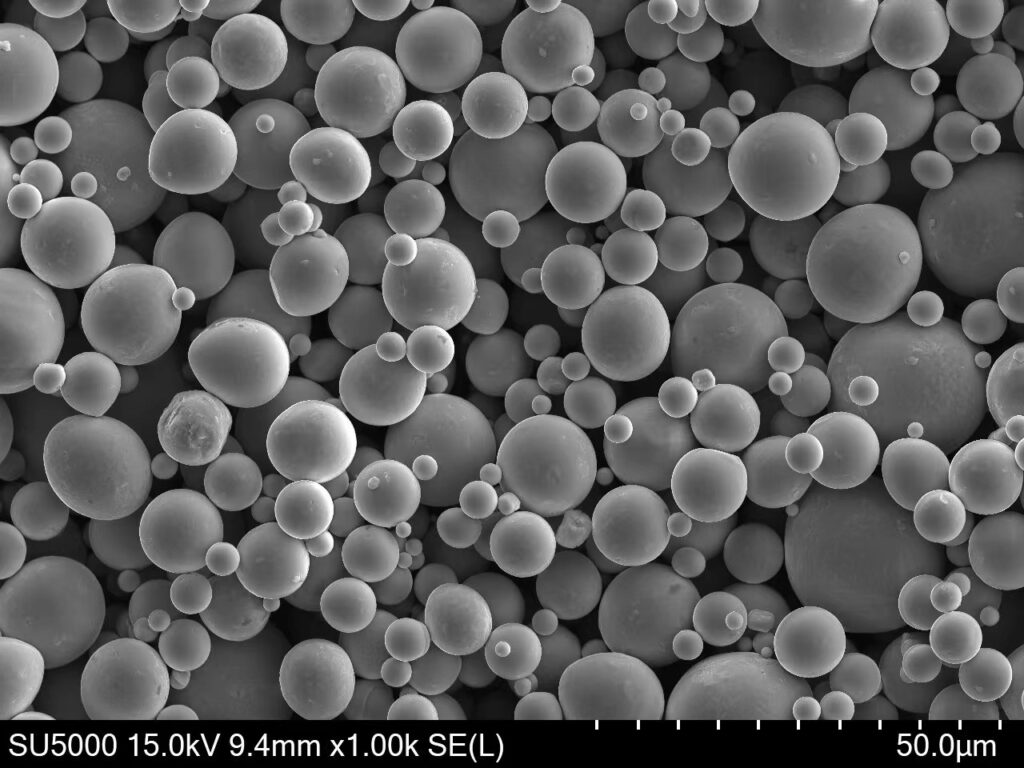
Within the broader copper AM landscape, GRCop42 sits between pure-copper thermal performance and the stronger but less conductive nickel- or cobalt-based high-temperature alloys. Compared with generic copper alloys, it is purpose-built for severe heat flux, especially where internal cooling channels are required. Compared with many non-copper hot-section materials, it offers much better heat transfer but lower absolute high-temperature strength.
Why the alloy matters for additive manufacturing
Copper is notoriously difficult to print because of its high reflectivity and high thermal conductivity, especially in laser systems. Even so, additive manufacturing remains attractive for GRCop-42 because the alloy’s target parts often contain regenerative channels, manifolds, closeouts, and integrated geometries that are expensive or impossible to produce efficiently by drilling, brazing, or multi-piece joining. NIST also notes that powder bed fusion builds three-dimensional geometries by melting successive layers of metal powder, which is exactly the process advantage exploited in these complex copper components.
Core characteristics of GRCop42 AM powder
The defining features are high thermal conductivity, useful hot strength, good low-cycle fatigue intent, and compatibility with advanced copper-alloy AM process development. NASA reports that GRCop-42 was advanced specifically for components such as combustion chamber liners and injector faceplates, where the material must conduct heat away rapidly while maintaining structural reliability during repeated firing cycles.
GRCop-42 was developed to combine high conductivity with strength in extreme heat-flux environments.
Distinguishing GRCop-42 from GRCop-84 and pure copper
GRCop-42 is often discussed beside GRCop-84 because both are NASA copper-chrome-niobium alloys for hot propulsion environments. NASA has reported that GRCop-42 can offer higher conductivity, faster build speeds than GRCop-84, and a simplified powder supply chain, which is one reason it gained momentum for powder bed fusion work. Pure copper still leads in conductivity, but GRCop-42 is designed to preserve a more useful balance once temperature, strength, and part geometry become the real engineering constraints.
화학 성분
GRCop42 copper chromium niobium powder is compositionally simple compared with many AM superalloys, but its metallurgical behavior is driven by a precise precipitation system rather than by a large number of alloying additions. NASA commonly describes it as Cu-4 at.% Cr-2 at.% Nb, and a NASA characterization paper reported measured chemistry around 3.22 wt% chromium and 2.81 wt% niobium, with the balance copper. Because commercial powder specifications are usually written in weight percent, certificates of analysis normally present composition in wt% rather than atomic percent.
| 요소 | Typical Content (wt%) | Typical Range (wt%) | 야금학적 역할 |
|---|---|---|---|
| Cu | 잔액 | about 93.5–94.5 | Primary matrix; provides very high thermal conductivity and electrical conductivity |
| Cr | 3.0–3.4 | about 2.8–3.6 | Forms strengthening precipitate constituents and improves hot strength retention |
| Nb | 2.6–3.0 | about 2.4–3.2 | Combines with Cr to form stable precipitates, supports creep and thermal stability |
| O | ≤0.10 typical for AM powder | by powder grade | Impurity control; excess oxygen can hurt ductility, flow, and print consistency |
| Fe + Ni + Si + others | low residuals | by certificate | Controlled impurities that should remain low to protect conductivity and consistency |
Copper is the continuous matrix, so it governs heat-transfer behavior and much of the alloy’s density and melt response. Chromium and niobium are present in much smaller amounts, but they are the real reason GRCop-42 behaves differently from unalloyed copper. Their interaction produces fine precipitate structures that raise strength while preserving more conductivity than many stronger copper alloys can maintain at elevated temperature.
Metallurgical role of chromium and niobium in GRCop42 copper chromium niobium powder
Chromium contributes to precipitation and hot-property retention, while niobium works with chromium to form the phase population often described around Cr(_2)Nb in technical discussions. Those precipitates are central to the alloy’s identity: without them, the powder would behave much more like a conventional high-conductivity copper feedstock with limited high-temperature durability. NASA and commercial powder descriptions both tie the alloy’s performance to that precipitation-strengthened structure.
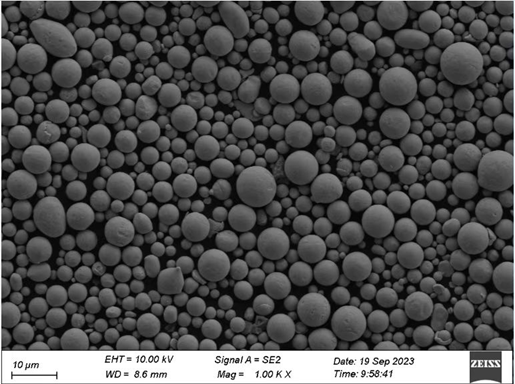
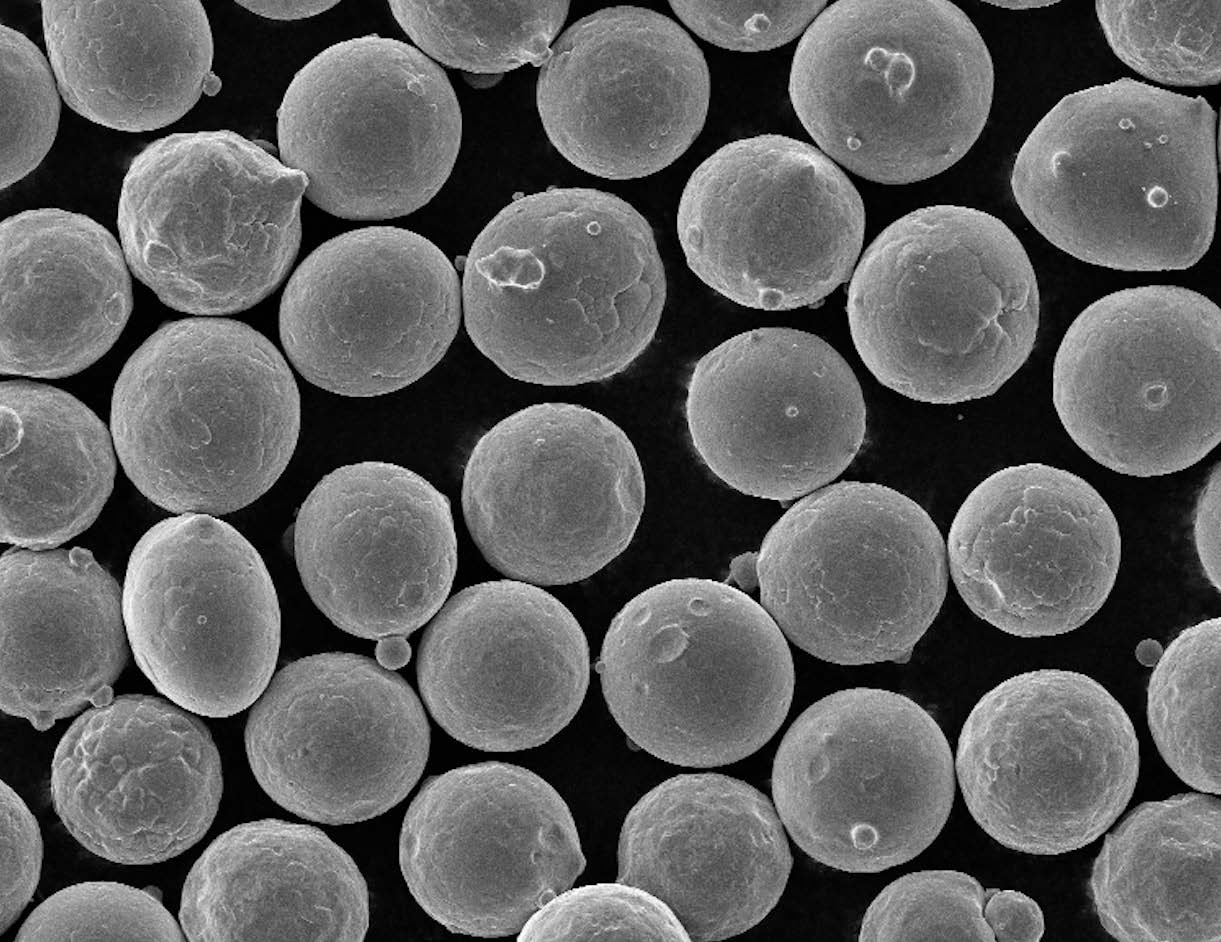
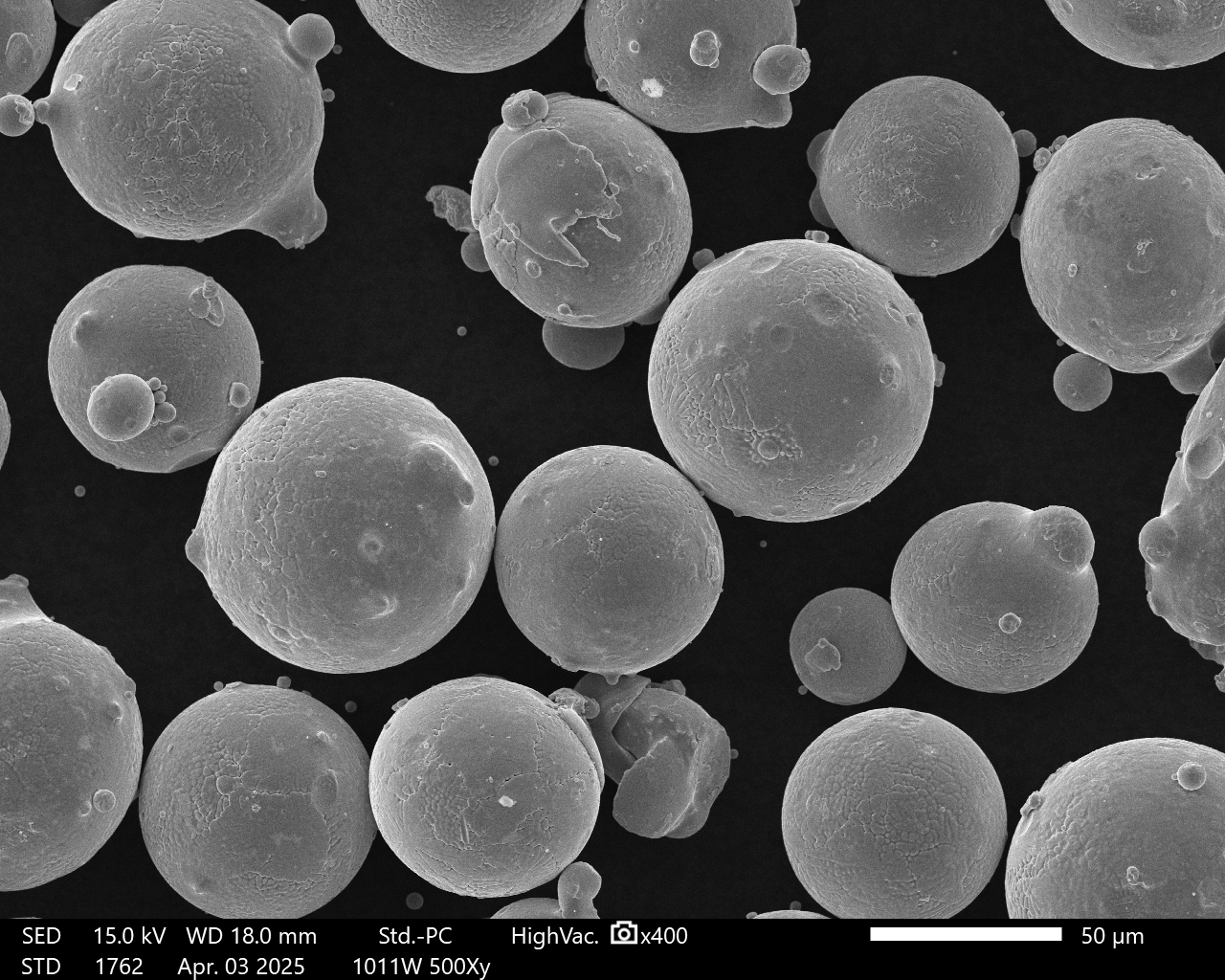
Why chemistry control matters in spherical copper AM powder
Copper alloys can be unforgiving when impurity levels drift, especially because oxygen and surface condition influence absorptivity, flow, and final porosity. NIST’s powder-metrology work emphasizes that properties such as flowability, size distribution, and powder condition affect part quality and repeatability in AM, and that is particularly important for reflective copper-based powders. For GRCop42 powder, chemistry control is therefore inseparable from morphology and oxygen control.
Practical note on certificates of analysis
Most buyers should expect a powder certificate to list Cu as balance, chromium and niobium as target elements, and oxygen as a controlled impurity. Some lots may also report nitrogen, hydrogen-loss or related cleanliness indicators, and trace metallic residuals where the production route or customer qualification plan requires them. ASTM maintains multiple powder-characterization standards that are commonly used as part of this documentation framework.
물리적 및 기계적 특성
Property data for GRCop-42 must always be tied to condition. Wrought, annealed, as-built LPBF, hot isostatically pressed, and post-heat-treated material can all behave differently, especially in tensile ductility and conductivity. Even so, NASA and later technical reporting provide enough guidance to establish realistic engineering ranges for screening purposes.
| 속성 | 일반 값 | 단위 | 시험 기준 / 조건 |
|---|---|---|---|
| 밀도 | 8.8–8.9 | g/cm³ | Typical consolidated value at room temperature |
| Solidus / melting range | about 1070–1085 | °C | Typical copper-alloy engineering range |
| Ultimate tensile strength | 330–380 | MPa | Typical wrought or well-consolidated AM range at room temperature |
| Yield strength (0.2%) | 170-220 | MPa | Typical wrought or AM-developed range at room temperature |
| 휴식 시 신장 | 20–35 | % | Condition-dependent, dense material |
| 경도 | 75–110 | HRB | Typical precipitation-strengthened copper-alloy range |
| 열 전도성 | about 300–350 | W/m-K | Reported engineering range; NASA data cite about 344 W/m·K for extruded alloy |
| 전기 전도성 | moderate to high for strengthened copper | % IACS equivalent varies | Condition-dependent, usually lower than pure copper |
| Service intent | high heat flux, elevated temperature | qualitative | Propulsion and thermal-management environments |
A widely cited room-temperature property set for extruded GRCop-42 gives thermal conductivity near 344 W/m·K, yield strength around 200 MPa, and ultimate tensile strength around 354 MPa. Those figures are lower in strength than nickel superalloys, but that misses the point of the alloy: it is selected when heat extraction is paramount and still needs better 고온 강도 than pure copper can deliver.
Thermal performance of GRCop42 additive manufacturing powder
Thermal conductivity is the headline property because it underpins chamber-liner, injector, and heat-exchanger logic. NASA’s conductivity work shows GRCop-42 has a meaningful conductivity advantage over GRCop-84 and easily exceeds many structural high-temperature alloys used elsewhere in propulsion systems. In design terms, that means thinner thermal gradients, more effective channel cooling, and better response in high-heat-flux walls when printing is successful.
Strength and ductility after printing
NASA reported that powder bed fusion GRCop-42 can achieve high density and strengths equivalent to wrought GRCop-42, which is an important threshold for AM adoption. However, actual tensile performance depends on scan strategy, part orientation, porosity level, post-build heat treatment, and whether hot isostatic pressing is applied. As with most advanced AM copper alloys, users should qualify the build condition they intend to ship, not rely only on brochure values.
Conductivity versus strength trade-off
Every strengthening mechanism in copper tends to threaten conductivity, so GRCop-42 is fundamentally a compromise alloy. Its value lies in reaching a better middle ground than pure copper or some stronger low-conductivity alternatives. For propulsion, that compromise is often preferable because chamber walls and injectors need to move heat fast first, then retain sufficient structure second.
사양 및 제공 등급
Commercial GRCop42 copper chromium niobium powder is usually specified by chemistry, powder morphology, and particle size distribution rather than by a single mature aerospace stock-number system. Buyers often qualify it as a project-grade AM powder using generic metal-powder standards for flow, density, and PSD, together with internal requirements for oxygen, sphericity, and recycling behavior. NIST and ASTM both underscore the importance of repeatable powder characterization in metal AM.
| Supply Grade / Reference | 일반적인 PSD 범위 | 겉보기 밀도 | 탭 밀도 | 홀 흐름 | 산소 함량 | 구형성 | Cross-Reference / Notes |
|---|---|---|---|---|---|---|---|
| GC42-LP15 | 15-45 µm | 4.8–5.4 g/cm³ | 5.3–6.0 g/cm³ | 16–24 s/50 g | ≤0.08 wt% typical | 높은 | Fine LPBF grade for thin layers and dense spreading |
| GC42-LP15/53 | 15-53 µm | 4.9–5.5 g/cm³ | 5.4–6.1 g/cm³ | 16–25 s/50 g | ≤0.08 wt% typical | 높은 | Common laser powder bed fusion window |
| GC42-DED45 | 45-105 µm | 5.0–5.7 g/cm³ | 5.6–6.3 g/cm³ | 14–22초/50g | ≤0.06 wt% typical | 높은 | Directed energy deposition or laser cladding feedstock |
| GC42-Coarse53 | 53-150 µm | 5.1–5.8 g/cm³ | 5.7–6.4 g/cm³ | 13–21 s/50 g | ≤0.06 wt% typical | 높은 | Coarser thermal-spray or broad deposition use |
| PSD methods row | 합의에 따라 | n/a | n/a | n/a | n/a | n/a | Sieve analysis often aligns with ASTM B214 for coarser fractions; laser diffraction may supplement |
| Flow / density methods row | n/a | ASTM B212 | ASTM B527 | ASTM B213 | inert-gas fusion or supplier method | image analysis | Project documentation usually references standard powder tests |
| AM terminology row | n/a | n/a | n/a | n/a | n/a | n/a | AM process naming commonly follows ISO/ASTM 52900 용어 |
| Cross-family materials row | n/a | n/a | n/a | n/a | n/a | n/a | Buyers often benchmark it against copper alloy powder grades and other AM feedstocks |
The 15–45 µm and 15–53 µm cuts are the most natural for laser powder bed fusion because they balance layer uniformity, packing, and recoating behavior. Coarser fractions are more relevant to feeder-based processes such as DED, where consistent mass flow matters more than fine-layer resolution. In all cases, PSD should be evaluated alongside spreadability, not in isolation.
GRCop42 copper chromium niobium powder size selection
Fine powder improves geometric definition and often helps achieve denser thin layers, but it also tends to be more oxidation-sensitive and more demanding during handling. Coarser powder may feed more reliably in nozzles and can reduce the fraction of ultrafines, though it is less suited to intricate thin-wall LPBF work. The right size band is therefore machine-specific rather than universally “best.”
Standards framework and tolerance logic
There is still no broadly adopted alloy-specific ASTM or AMS purchase sheet for every AM use of GRCop-42 powder. In practice, the framework is built from generic powder standards, internal aerospace drawing requirements, and process-specific machine qualifications. That is common for advanced AM copper alloys whose use cases are still driven by application programs rather than commodity stock specifications.
Lot-to-lot repeatability
For this alloy, powder quality should be judged by lot repeatability in chemistry, flow, oxygen, PSD, and print response. NASA’s later inter-vendor build work on GRCop-42 underscores that repeatability across builds and machines matters as much as nominal composition.
제조 프로세스
Most commercial GRCop42 powder for additive manufacturing is produced by inert-gas atomization or closely related vacuum-assisted atomization routes. That is because copper alloys need spherical morphology, controlled oxidation, and predictable PSD to print well. PREP is technically possible for some copper alloy systems, but gas atomization and VIGA-style routes are the more practical industrial choices for this grade.
| 프로세스 | Feedstock Form | Typical Sphericity | 산소 픽업 | PSD 제어 | 처리량 | 상대적 비용 | Practical Trade-Off |
|---|---|---|---|---|---|---|---|
| 가스 분무(GA) | pre-alloyed melt | 높은 | low to medium | good | 높은 | 중간 | Most common route; good cost-output balance for AM copper powder |
| 진공 유도 가스 분무법 (VIGA) | vacuum-melted pre-alloyed melt | 매우 높음 | 낮음 | very good | 중간 | 중간에서 높음 | Cleaner powder and tighter chemistry control |
| 전극 유도 가스 분무법 (EIGA) | alloy electrode | 매우 높음 | very low | very good | 중간 | 높은 | Lower contamination risk, especially where crucible contact matters |
| 플라즈마 회전 전극 공정(PREP) | rotating alloy electrode | 매우 높음 | very low | good | 낮음 | 매우 높음 | Excellent morphology but limited economic appeal for most copper powder programs |
| Mechanical alloying + spheroidization | blended or pre-alloyed feed | 중간에서 높음 | 중간 | 중간 | 낮음 | 높은 | More experimental path; homogeneity and contamination need close verification |
Gas-atomized GRCop42 copper chromium niobium powder
Gas atomization remains the mainstream option because it can deliver spherical powder at useful volume with controlled impurity levels. Sandvik’s recent GRCop-42 launch, for example, describes inert-gas atomization and oxidation-protected production flow for a clean powder product, which matches the broader industrial logic for advanced copper AM feedstock. When the melt is properly alloyed and atomized under a controlled atmosphere, GA is usually the most economical path to production-scale powder.
VIGA, EIGA, and premium cleanliness
Vacuum-assisted and electrode-based routes improve cleanliness and can reduce contamination from melting hardware. That can be valuable for copper alloys because surface oxide and impurity variation affect absorptivity, flow, and final conductivity more noticeably than in some darker, less reflective alloys. A Chinese patent record also specifically references VIGA preparation of GRCop-42 spherical powder, reflecting the process interest around this alloy.
PREP trade-offs for copper alloy AM powder
PREP is often associated with excellent sphericity and low satellite content, but it is not automatically the most practical choice for GRCop-42. Throughput is lower, the cost is higher, and the route is more commonly emphasized for premium reactive or specialty alloys where the morphology advantage justifies the economics. For copper AM programs, many buyers will prefer high-quality atomized powder before considering PREP.
Printing process considerations
Copper’s reflectivity makes LPBF process development harder than for steels or nickel alloys, often requiring higher laser power, parameter refinement, or wavelength strategies. NIST recently highlighted that highly reflective metals such as copper and aluminum often suffer substantial energy losses in LPBF, which explains why machine settings for GRCop-42 cannot simply be copied from stainless steel playbooks. That challenge is also why this alloy is usually evaluated only where its thermal-performance payoff is substantial.
In broader sourcing discussions, engineers often compare GRCop42 not only with nickel-based AM powders for hot hardware, but also with 내화 금속 분말 종류 when chamber-wall temperature margins become extreme.
산업별 적용 사례
GRCop42 copper chromium niobium powder is most relevant where heat-transfer performance is the design driver. It is not a general-purpose copper powder for every conductive bracket or busbar. Its strongest value appears when high heat flux, repeated thermal cycling, and complex internal geometry all exist at the same time.
Aerospace and propulsion
Aerospace is the flagship use case. NASA explicitly developed GRCop-42 for propulsion hardware such as combustion chamber liners and injector face plates, and later demonstrated hot-fire testing of additively manufactured chambers under the LLAMA program. Those facts make rocket combustion chambers the clearest industrial example of where the alloy’s conductivity-strength balance is most meaningful.
Launch systems and space hardware
Beyond classic chambers, the same design logic extends to regeneratively cooled thrust chambers, nozzles, manifolds, and integrated thermal-management features. NASA’s reporting on GRCop-42 combustion chambers and related programs shows how AM reduces part count, minimizes joints, and supports internal channels that would otherwise require difficult assembly methods. In this context, the alloy is less about raw tensile strength and more about heat removal, durability, and manufacturable geometry.
Energy and high-heat-flux industrial components
Outside space propulsion, the material can make sense for burners, thermal liners, heat sinks with severe flux density, and prototype energy hardware where copper’s heat transfer is indispensable but pure copper lacks enough hot strength. It can also be considered for advanced heat-exchanger features where internal topology matters as much as conductivity. These remain narrower markets than aerospace, but the logic is technically sound.
Tooling and thermal management
Conformal-cooled tooling is a possible secondary use, especially where rapid heat extraction can shorten cycle time or protect hot surfaces. Even so, many tooling applications will still choose CuCrZr or other mature copper alloys because they are easier to source and qualify. GRCop-42 becomes compelling only when temperature exposure and repeated duty cycles exceed what simpler conductive alloys manage comfortably.
Why medical and oil-and-gas use is limited
The alloy is not primarily a medical material, and its established literature is overwhelmingly aerospace-focused. Oil and gas could use copper alloys in some thermal contexts, but GRCop-42 is generally too specialized and expensive for routine downhole or corrosion-driven service compared with nickel, cobalt, or stainless alternatives. A broader industry overview of use sectors for metal AM powder can be seen in the site’s application sectors for additive powders, though GRCop-42 itself remains most strongly tied to hot copper aerospace hardware.
Use-case boundary conditions
This powder is best justified when AM geometry and thermal duty together create a clear performance advantage. If a part does not need fast heat transfer or does not benefit from internal channels, then more mature copper or nickel systems usually provide an easier supply and qualification path. GRCop-42 wins on a narrow but important engineering problem, not on universality.
대체 소재와의 비교
Material selection should compare GRCop42 copper chromium niobium powder against the powders engineers are most likely to use instead: pure copper, CuCrZr, GRCop-84, and Inconel 718 or similar nickel superalloys. These alternatives differ in thermal conductivity, printability, cost, and high-temperature structural capability. The correct benchmark depends on whether the part is limited by heat flux, temperature, mechanical load, or qualification maturity.
| 재질 | 밀도(g/cm³) | 열 전도성 | Strength Level | 상대적 비용 | 인쇄 가능성 | Best-Fit Position |
|---|---|---|---|---|---|---|
| GRCop42 copper chromium niobium powder | 8.8–8.9 | 매우 높음 | 중간 | 높은 | moderate after parameter tuning | High-heat-flux AM parts needing conductivity plus hot strength |
| Pure copper powder | about 8.9 | extremely high | low at temperature | 중간 | challenging in LPBF | Maximum conductivity where hot strength is secondary |
| CuCrZr powder | about 8.9 | 높은 | 중간 | 중간 | moderate to good | Conformal cooling, tooling, and general conductive AM use |
| GRCop-84 powder | about 8.8–8.9 | high but below GRCop-42 | moderate to good | 높은 | established in propulsion R&D | NASA copper-alloy option with a different conductivity-strength balance |
| 인코넬 718 분말 | about 8.2 | 낮음 | high to very high | 높은 | very mature | Structural hot-section AM where strength dominates over heat transfer |
Compared with pure copper, GRCop-42 sacrifices some conductivity in exchange for much better hot strength and durability. Compared with CuCrZr, it is typically more specialized for severe heat-flux aerospace environments. Compared with GRCop-84, NASA has reported higher conductivity and faster build speeds for GRCop-42, which is a meaningful advantage in LPBF copper development.
Against Inconel 718, the contrast is straightforward: nickel superalloys win on structural high-temperature strength, while GRCop-42 wins decisively on heat transfer. That means the two materials often complement one another in propulsion systems rather than directly competing on the same design objective. Where needed, some programs even pair copper-alloy chambers with stronger outer jackets or adjacent nickel-based hardware.
당사
Shanghai Truer Technology Co., Ltd., operating am-printing.com, was established in 2009 and created its additive manufacturing business in 2019. According to the company profile, it integrates powder-making equipment and powder supply, with capabilities including SEBM equipment, PREP powder-making equipment, and gas atomization, and it supplies spherical metal powders across titanium-based, nickel-based, cobalt-based, copper-based, aluminum-based, stainless steel, and specialty alloy categories for SLM, SEBM, DED, laser cladding, powder metallurgy, MIM, HIP, spraying, welding, and coating. Its company profile and history also describes a joint innovation center for metal 3D printing and service coverage for industries including 3C electronics, hand tools, remote-control cars, medical, aerospace, and nuclear power.
자주 묻는 질문
Q1. Is GRCop42 copper chromium niobium powder difficult to print in LPBF?
Yes, it is generally more challenging than stainless steel or nickel alloys because copper reflects laser energy and conducts heat away very quickly. Successful printing usually depends on optimized laser power, scan strategy, powder quality, and tight oxygen control, which is why laser powder bed fusion parameters for GRCop-42 are usually application-specific.
Q2. What is the difference between GRCop42 and pure copper powder?
Pure copper offers even higher thermal conductivity, but it loses strength more rapidly at elevated temperature and is not designed around a precipitation-strengthened hot-service structure. GRCop-42 adds chromium and niobium so the alloy can retain more useful strength and durability in severe thermal environments such as regenerative rocket hardware.
Q3. What particle size is common for GRCop42 copper chromium niobium powder?
For LPBF, common commercial practice centers on fine spherical cuts such as 15–45 µm or 15–53 µm. Coarser cuts such as 45–105 µm are more typical for feeder-based processes like DED or cladding, where powder flow stability matters more than fine layer resolution.
Q4. Is GRCop42 powder only for aerospace applications?
No, but aerospace and propulsion are the best-established use cases in the public literature. The alloy can also be considered for other high-heat-flux thermal-management components, advanced tooling, and specialized energy hardware when geometry complexity and hot conductivity are both critical.
Q5. How does GRCop42 compare with GRCop-84?
NASA has reported that GRCop-42 can provide higher conductivity, faster build speeds, and a simpler powder supply chain than GRCop-84 in its AM development context. The choice between them still depends on the exact temperature window, required mechanical margin, and the qualification data available for the target hardware.
Q6. What should buyers request when sourcing GRCop42 copper chromium niobium powder?
They should ask for full chemistry, oxygen limits, PSD data, apparent and tap density, Hall flow, morphology evidence, and condition-specific mechanical and conductivity data after printing and any post-processing. It is also prudent to ask how the powder was atomized, how recycled powder is managed, and whether the supplier has prior experience with high-conductivity AM alloys and hot-fire or thermal-management applications.