Kurzantwort
1045 PREP spherical steel powder is a powder form of AISI 1045 medium-carbon steel produced by Plasma Rotating Electrode Process for high sphericity, low contamination, and stable powder flow. It is usually chosen for additive manufacturing, directed energy deposition, and powder metallurgy when a project needs a cost-conscious carbon steel with higher strength and hardenability than low-carbon iron powders. The main advantage is a practical balance of machinability, heat-treat response, and feedstock cleanliness, while the main limitation is lower corrosion resistance and more demanding crack control than stainless or low-carbon AM steels.
What Is 1045 PREP spherical steel powder
1045 PREP spherical steel powder is the spherical powder form of AISI 1045, a widely recognized medium-carbon steel containing roughly 0.45% carbon with manganese as its principal alloy support. In bar, plate, forging, and machined-part markets, 1045 is known as a general engineering steel used where moderate strength, toughness, and heat treatability are needed without the alloy cost of chromium-molybdenum or nickel steels. In powder form, especially when made by PREP, that familiar steel chemistry becomes relevant for additive manufacturing, cladding, HIP, MIM, and specialized powder metallurgy routes.
The alloy belongs to the plain carbon steel family rather than the stainless, tool steel, or nickel superalloy families. That makes its value proposition relatively straightforward: it offers stronger response to quenching and tempering than low-carbon steels, while remaining simpler and more economical than many highly alloyed engineering powders. In AM terms, it sits in the middle ground between soft, low-strength iron powders and premium alloy steels designed for extreme wear, corrosion, or high-temperature service.
1045 PREP spherical steel powder in the carbon steel family
AISI 1045 is often grouped with medium-carbon steels such as 1035, 1040, 1045, 1050, and 1060. As carbon rises through that family, achievable hardness and strength generally increase, but weldability and crack tolerance become more difficult. That trade-off carries directly into powder applications, where 1045 offers a meaningful bump in post-heat-treatment strength over low-carbon feedstocks without moving fully into the behavior of high-carbon tool steels.
For engineers comparing broader ferrous feedstocks, 1045 is easier to understand than many proprietary AM alloys because its metallurgical behavior is already familiar from conventional manufacturing. That familiarity is one reason it remains relevant in functional prototyping, repair, surface engineering, and industrial parts research alongside more specialized [iron-based alloy powder materials].
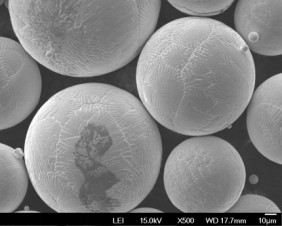
Why PREP matters for 1045 spherical powder
PREP is not just a shape-control method; it materially affects how the powder behaves during feeding and melting. Because the process produces highly spherical particles from a rotating electrode, it can reduce satellites, improve flow, and limit contamination from crucibles or surrounding media. Those benefits are particularly useful for medium-carbon steel, where oxygen pickup, irregular morphology, and inconsistent PSD can make already sensitive processing even less forgiving.
Why 1045 exists as an additive manufacturing powder
1045 powder fills a practical niche. Not every AM or coating application requires stainless corrosion resistance, superalloy temperature strength, or martensitic tool-steel hardness. Many industrial parts simply need moderate wear resistance, good machinability after printing, a known heat-treatment pathway, and reasonable feedstock cost. In those cases, 1045 becomes a logical candidate.
For medium-carbon steel powders, process stability and post-build heat treatment are often more important than nominal chemistry alone.
Distinguishing traits of 1045 AM powder
The alloy’s most important features are its balanced carbon level, straightforward metallurgy, and responsive heat-treatment behavior. It can be normalized, quenched, and tempered to tailor strength and hardness for shafts, fixtures, couplings, sleeves, and repaired surfaces. At the same time, its carbon content makes it less forgiving than ultra-low-carbon steel in welding-like AM thermal cycles, so successful use depends on preheat, energy input, and post-process stress relief.
Chemische Zusammensetzung
The chemistry of 1045 steel is simple compared with superalloys or precipitation-hardening stainless grades, but each element still has a clear role in performance. Carbon drives hardenability and achievable strength. Manganese supports strength, deoxidation, and response to heat treatment. Residuals such as phosphorus and sulfur must remain controlled, because they can improve machinability in some variants but also reduce toughness or increase hot shortness if excessive.
Typical composition of 1045 PREP spherical steel powder
| Element | Typical wt% | Rolle in der Metallurgie | Relevance in Powder Processing |
|---|---|---|---|
| Fe | Bilanz | Base matrix, provides structural framework | Determines bulk ferrous behavior and melting response |
| C | 0.43–0.50 | Increases hardness, strength, and martensitic response | Central to heat treatment, crack sensitivity, and final hardness |
| Mn | 0.60–0.90 | Improves strength, hardenability, and deoxidation | Supports consistent solidification and heat-treat response |
| Si | 0.15–0.35 | Deoxidizer and modest strength contributor | Helps cleanliness in melting; excess can reduce ductility |
| P | ≤0.040 | Residual impurity kept low | Too much phosphorus lowers toughness and can embrittle parts |
| S | ≤0.050 | Residual impurity, sometimes machinability-related | Excess sulfur can reduce ductility and hot workability |
| O | Controlled, typically low | Indicator of oxide contamination | Important for flow, fusion behavior, and defect control |
| N | Controlled, typically low | Residual gas element | Excess nitrogen can influence brittleness and porosity risk |
These windows are typical of standard 1045 chemistry used across conventional steel supply chains. Powder producers may impose tighter internal controls on oxygen, nitrogen, and trace inclusions than a bulk steel mill would for bar stock, because AM and fine powder processing are more sensitive to surface condition and contamination.
Carbon as the defining element in 1045 PREP spherical steel powder
Carbon is what separates 1045 from low-carbon steels such as 1018 or many soft iron powders. At roughly 0.45%, it allows meaningful transformation hardening and higher as-heat-treated strength. That same feature also increases susceptibility to residual stress and cracking in rapid thermal cycles, which is why processing windows for 1045 powder are narrower than for some low-carbon feedstocks.
The role of manganese and silicon
Manganese improves hardenability and helps offset some brittleness risk by supporting a more uniform transformation response. Silicon mainly acts as a deoxidizer, though it also contributes modestly to strength. In powder manufacturing, both elements help stabilize melting and solidification, but they are secondary compared with carbon in determining final hardness potential.
Residual control and powder cleanliness
Residual phosphorus and sulfur should remain within standard limits, but for AM-critical parts, users often prefer even tighter control than general mill chemistry requires. Oxide films, entrapped inclusions, and nitrogen pickup can undermine the advantages of PREP morphology by introducing fusion defects or embrittlement sites. That is why buyers should review not only bulk chemistry but also gas content and particle-surface quality.
For readers comparing medium-carbon steels with higher-value ferrous feedstocks, the broader taxonomy of [metal powder standards and terminology] is useful for separating commodity chemistry designations from AM-specific quality metrics.
Physikalische und mechanische Eigenschaften
1045 is usually selected because its mechanical properties can be shifted across a useful engineering range with familiar heat treatments. In normalized condition, it offers moderate strength and decent machinability. In quenched and tempered condition, it can achieve significantly higher hardness and strength, making it useful for load-bearing industrial parts, wear surfaces, and service components that would overwhelm low-carbon steels.
Typical properties of consolidated 1045 steel parts
| Eigentum | Typischer Wert | Einheit | Prüfnorm / Prüfbedingungen |
|---|---|---|---|
| Dichte | 7.83–7.87 | g/cm³ | Typical nominal alloy density |
| Schmelzbereich | 1420–1490 | °C | Typical carbon steel range |
| Zugfestigkeit | 570–850 | MPa | Typical normalized to quenched-and-tempered range |
| Streckgrenze (0.2%) | 310–650 | MPa | Typical condition-dependent range |
| Dehnung | 12–20 | % | Typical consolidated and heat-treated condition |
| Härte | 170–260 | HB | Typical normalized condition |
| Hardness After Q&T | 28–50 | HRC | Typical attainable range, section-size dependent |
| Wärmeleitfähigkeit | 45–50 | W/m-K | Typischerweise nahe der Raumtemperatur |
| Elastischer Modul | 200–210 | GPa | Typical steel value |
| Bearbeitbarkeit | ~55–65 | % of B1112 | Typical comparative index |
These values should be interpreted as typical engineering ranges rather than guarantees for every powder-built part. AM components can differ from wrought 1045 because porosity, microsegregation, retained stresses, and layerwise thermal history affect both baseline properties and heat-treatment response. The same nominal chemistry can therefore produce different hardness or elongation depending on whether the part was laser-built, DED-repaired, HIPed, or conventionally sintered.
Strength and hardness response of 1045 AM powder parts
The biggest attraction of 1045 is its ability to move from a machinable state into a stronger and harder state through quenching and tempering. That makes it suitable for prototypes and near-net-shape parts that need final finishing after printing. A supplier or end user can print, stress relieve, machine critical surfaces, and then apply final heat treatment to meet the application target.
Heat-treatment flexibility
Normalizing can refine the microstructure and improve consistency. Quenching increases hardness by forming martensite, while tempering reduces brittleness and restores useful toughness. This heat treatability is one of the main reasons 1045 remains valuable despite the wider availability of stainless and pre-alloyed AM steels.
Wear, toughness, and service limitations
1045 usually provides better wear resistance than low-carbon steel, especially after heat treatment. However, it is not a true tool steel, and it will not match the hot hardness or abrasion resistance of high-carbon, high-chromium tool alloys. It also lacks inherent corrosion resistance, so humid, chemical, or marine environments typically require coating, plating, oiling, or a different alloy choice altogether.
Thermal and processing considerations
Thermal conductivity is higher than in many nickel and stainless alloys, which can affect melt-pool behavior and cooling profiles. Carbon content also means the alloy can harden locally in the heat-affected zone, creating stress concentrations if process parameters are poorly controlled. For that reason, successful 1045 AM practice often includes preheat, slower cooling, and post-build stress relief as part of the route card.
Technische Daten und verfügbare Güteklassen
Powder buyers do not purchase 1045 solely by chemistry; they purchase by chemistry plus morphology, PSD, gas content, and intended process route. PREP powder is generally sold in distinct size cuts for powder bed fusion, directed energy deposition, cladding, thermal spray, or conventional PM. The most relevant metrics are particle size distribution, apparent density, tap density, Hall flow, oxygen level, and sphericity.
Typical 1045 PREP spherical steel powder grades
| Supply Grade / Condition | PSD-Bereich | Scheinbare Dichte | Zapfstellendichte | Hall-Strömung | Oxygen / Sphericity / Cross-Reference |
|---|---|---|---|---|---|
| 1045-PREP-15-45 | 15-45 µm | 4.4–5.1 g/cm³ | 5,0–5,8 g/cm³ | 14–22 s/50 g | O typically ≤0.08 wt%; high sphericity; fine LPBF cut |
| 1045-PREP-15-53 | 15-53 µm | 4.5–5.2 g/cm³ | 5,1–5,9 g/cm³ | 14–21 s/50 g | O typically ≤0.08 wt%; standard AM fraction |
| 1045-PREP-45-105 | 45-105 µm | 4,7–5,4 g/cm³ | 5.3–6.1 g/cm³ | 13–20 s/50 g | O typically ≤0.06 wt%; suited to DED and cladding |
| 1045-PREP-53-150 | 53-150 µm | 4,8–5,5 g/cm³ | 5,4–6,2 g/cm³ | 12–19 s/50 g | O typically ≤0.06 wt%; coarser repair and spray fraction |
| Test / Standards Context | - | ASTM B212 typical | ASTM B527 typical | ASTM B213 typical | Chemistry aligned with AISI 1045 / C45 family references |
The packing values above describe how the powder behaves as loose particulate, not the final density of a built part. Fine fractions are generally chosen for laser powder bed fusion because they spread well in thin layers, while coarser cuts are more natural for DED, cladding, and spray processes.
1045 PREP spherical steel powder by process window
For LPBF and similar fine-layer AM methods, 15–45 µm and 15–53 µm are typical. For DED nozzles, laser cladding, and other fed-powder processes, 45–105 µm is often a practical compromise between flow consistency and melt efficiency. Larger 53–150 µm cuts are more common in thermal spray, repair deposition, or PM routes where layer thickness and feeder characteristics differ substantially from PBF.
Standards and cross-reference logic
1045 is commonly referenced by AISI/SAE designation in North America, by C45 or C45E in DIN/EN systems, and by related medium-carbon grades in GB standards. AM powders still rely heavily on generic test methods for flow, density, and PSD rather than a single universal product standard for every steel chemistry. In practice, buyers use documents such as the [ASTM B212 apparent density method], the [ASTM B527 tap density method], and the [ISO/ASTM 52900 additive manufacturing terminology] to frame powder specifications in qualification packages.
What purchasers should confirm
For a production purchase, the minimum useful data set usually includes chemistry certificate, PSD curve, morphology images, Hall flow, apparent density, tap density, and oxygen content. For critical parts, it is also wise to request recommended preheat range, stress-relief guidance, and indicative hardness after specific heat treatments. That is especially important for 1045 because final performance is highly process-dependent.
Herstellungsprozess
1045 powder can be produced by several atomization and droplet-formation methods, but PREP occupies a premium position because it emphasizes roundness and cleanliness. For medium-carbon steel, that can be a meaningful advantage: irregular particles and excessive oxidation can worsen flowability, reduce layer uniformity, and increase the likelihood of lack-of-fusion or inclusion-related defects. The manufacturing route therefore matters not only to handling but also to final part quality.
Process comparison for spherical 1045 steel powder
| Prozess | Sphärizität | Sauerstoffaufnahme | PSD-Steuerung | Durchsatz | Relative Kosten |
|---|---|---|---|---|---|
| PREP | Ausgezeichnet | Sehr niedrig | Gut | Mittel | Hoch |
| Gaszerstäubung (GA) | Hoch | Gering bis mäßig | Gut | Hoch | Mittel |
| Vakuum-Induktions-Gaszerstäubung (VIGA) | Sehr hoch | Niedrig | Sehr gut | Mittel | Mittel-hoch |
| Elektrodeninduktions-Gaszerstäubung (EIGA) | Sehr hoch | Sehr niedrig | Sehr gut | Mittel | Hoch |
| Wasserzerstäubung | Gering bis mäßig | Höher | Breite | Sehr hoch | Niedrig |
How PREP produces 1045 spherical powder
In PREP, a consumable steel electrode rotates at high speed while plasma melts its end. Centrifugal force throws molten droplets away from the electrode, and those droplets solidify into highly spherical particles. Because there is limited contact with refractories and the environment can be tightly controlled, PREP powder often shows lower contamination and smoother particle surfaces than lower-cost alternatives.
GA versus PREP for 1045 steel AM powder
Gas atomization is the more common industrial method when cost, scale, and broad availability matter most. It can produce very good spherical powder and is often sufficient for many AM steels. PREP, however, typically offers cleaner surfaces, fewer satellites, and more consistent roundness, which can improve spreadability and feeder stability in demanding applications.
VIGA, EIGA, and water atomization trade-offs
VIGA and EIGA are premium methods that also aim for cleanliness and controlled atmosphere, making them attractive for reactive or higher-value alloys. Water atomization is cost-efficient and widely used in PM, but it yields more angular particles and higher oxidation levels, so it is less attractive for high-end AM routes. For 1045, the decision often comes down to whether the project values volume economics or premium powder behavior.
Process route and practical outcomes
The route chosen influences not just powder aesthetics but build consistency, porosity risk, and post-process response. PREP powder often offers better spreading and less erratic feeding, while gas-atomized material may be more economical for larger-volume use. In medium-carbon steels, PREP-derived morphology can be especially helpful because the alloy itself is less forgiving than low-carbon iron powders when the thermal cycle becomes unstable.
Engineers screening neighboring feedstocks sometimes compare 1045 with [copper-based engineering powders] when conductivity matters more than hardenability, or with stainless and nickel alloys when corrosion or heat resistance dominate the design brief.
Anwendungen nach Branche
1045 PREP spherical steel powder is best understood as an industrial engineering material rather than a prestige aerospace alloy. Its strength lies in practical parts, repair strategies, and functional components that benefit from a known carbon-steel response to machining and heat treatment. The most suitable applications are those where moderate strength, wear resistance, and economic material selection matter more than corrosion resistance or extreme temperature capability.
Automotive and general machinery
Automotive development, motorsport prototyping, and industrial machinery are logical homes for 1045 powder. Typical use cases include shafts, sleeves, couplings, brackets, jigs, fixture bodies, and wear-exposed mechanical parts that need stronger response than low-carbon steel. In these sectors, the alloy’s familiarity is an advantage because downstream machining, induction hardening, or quench-and-temper treatment are already well understood.
Tooling, fixtures, and manufacturing aids
Production tooling does not always require a premium maraging or hot-work tool steel. Many fixtures, nests, assembly aids, and moderate-duty dies can work well in a medium-carbon steel if geometry complexity favors AM. Printing near-net-shape 1045 parts and then finish-machining key surfaces is often more economical than building from a difficult-to-machine high-alloy grade.
Oil and gas and heavy equipment repair
Laser cladding and DED repair are important application areas for 1045 powder, especially when rebuilding shafts, journals, and other wear surfaces. A chemistry close to conventional carbon steel substrates can be useful for metallurgical compatibility. Corrosion-heavy offshore environments may require coatings or different alloys, but in dry or lubricated service, 1045 remains a practical option.
Agricultural, mining, and power-transmission hardware
Medium-carbon steel is widely used in mechanical systems subject to impact, torsion, and moderate abrasion. Powder routes allow local repair, geometry restoration, or low-volume manufacture of replacement parts that would be expensive to tool conventionally. This aligns well with the broader [industrial application sectors] served by additive manufacturing, powder metallurgy, spraying, and coating routes.
Where 1045 is less suitable
1045 is rarely the first choice for implantable medical devices, salt-spray environments, or sustained high-temperature oxidation exposure. It also tends to be less forgiving in thin, crack-sensitive AM geometries than low-carbon or austenitic stainless grades. Where cleanliness, corrosion, and biocompatibility dominate, titanium, stainless, or cobalt systems are usually better candidates.
Vergleich mit alternativen Materialien
Material selection around 1045 usually comes down to balancing strength, heat-treatment response, printability, corrosion behavior, and price. The closest alternatives are low-carbon steel or pure iron powders, 4140 low-alloy steel, and 17-4 PH stainless steel. Each solves a different engineering problem, and none is a universal replacement for the others.
1045 PREP spherical steel powder versus alternative materials
| Material | Dichte (g/cm³) | Strength / Hardness Potential | Relative Kosten | Druckbarkeit | Korrosionsbeständigkeit |
|---|---|---|---|---|---|
| 1045 PREP spherical steel powder | 7.83–7.87 | Moderate to high after heat treatment | Mittel | Mäßig | Niedrig |
| Low-carbon steel / pure iron powder | 7.8–7.9 | Gering bis mäßig | Niedrig | Gut | Niedrig |
| 4140er legierter Stahl in Pulverform | 7.83–7.87 | High with deeper hardenability | Mittel-hoch | Mäßig | Niedrig |
| 17-4 PH-Edelstahlpulver | 7.7–7.8 | High after aging | Hoch | Gut bis sehr gut | Mäßig bis hoch |
| H13 Werkzeugstahlpulver | 7.75–7.80 | Very high wear and hot-hardness capability | Hoch | Moderate to challenging | Gering bis mäßig |
Against low-carbon steel, 1045 offers a clear gain in heat-treatment response and wear resistance, though usually with a narrower processing window. Against 4140, 1045 is simpler and often less expensive, but it does not provide the same depth of hardenability or alloy-assisted toughness. Against 17-4 PH stainless, 1045 often wins on raw material economy but loses on corrosion resistance and general AM convenience.
The most important comparison is use case, not just property maximums. If the goal is a machine part that will be quenched, tempered, and machined in a dry industrial environment, 1045 often delivers an efficient cost-to-performance balance. If the part must survive wet service, chlorides, or minimal post-processing, a stainless or nickel alloy is usually easier to justify.
Unser Unternehmen
Shanghai Truer Technology Co., Ltd., which operates am-printing.com, was established in 2009 and created its additive manufacturing business in 2019. Based on the company information it publishes, its work combines 3D printing powder-making equipment and powder supply, including Selective Electron Beam Melting equipment, Plasma Rotating Electrode Process powder-making equipment, and Gas Atomization, while its powder portfolio includes TiNi, TiTa, TiAl, TiNbZr, CoCrMo, and nickel-, cobalt-, titanium-, copper-, aluminum-, and stainless-steel spherical powders. The same published profile states that it serves SLM, SEBM, DED, laser cladding, powder metallurgy, MIM, HIP, cold and hot spraying, welding, and coating for industries such as 3C electronics, hand tools, remote control cars, medical, aerospace, and nuclear power; those details are summarized on the [company background page].
FAQ
Q1. Is 1045 PREP spherical steel powder suitable for laser powder bed fusion?
Yes, it can be used for laser powder bed fusion, but it generally requires tighter thermal control than low-carbon or austenitic stainless powders. Preheating, optimized scan strategy, and post-build stress relief are commonly needed to reduce cracking and distortion risk.
Q2. What is the main advantage of 1045 PREP spherical steel powder over low-carbon steel powder?
The main advantage is stronger response to heat treatment. Compared with low-carbon steel, 1045 can reach higher hardness and strength after quenching and tempering, which makes it more useful for functional mechanical parts and wear-exposed surfaces.
Q3. Why choose PREP instead of water-atomized 1045 powder?
PREP usually delivers much higher sphericity, lower contamination, and better flowability. Those characteristics are valuable in AM and fed-powder processes, where irregular or oxidized particles can lead to inconsistent feeding, poor layer quality, and more defects.
Q4. What particle sizes are typical for 1045 PREP spherical steel powder?
Fine cuts such as 15–45 µm and 15–53 µm are common for powder bed fusion. Coarser distributions such as 45–105 µm and 53–150 µm are more typical for directed energy deposition, laser cladding, and some spray or PM routes.
Q5. How does 1045 powder compare with 17-4 PH stainless powder?
1045 is usually more economical and offers familiar carbon-steel heat treatment pathways, but it has much poorer corrosion resistance. 17-4 PH is often easier to justify when the part needs both high strength and stainless behavior in humid or chemically exposed service.
Q6. What should buyers verify before ordering 1045 PREP spherical steel powder?
They should verify chemistry, oxygen and nitrogen levels, PSD, morphology, Hall flow, apparent density, tap density, and intended manufacturing route. For production use, it is also wise to confirm recommended preheat, stress-relief, and final heat-treatment conditions because 1045 performance depends heavily on the full thermal history.