Kurzantwort
Hastelloy X nickel alloy powder is a nickel-chromium-iron-molybdenum superalloy powder designed for high-temperature service, oxidation resistance, and structural stability in aggressive thermal environments. For additive manufacturing, it is chosen when a part must retain useful strength and resist oxidation at elevated temperatures, especially in combustor, hot-gas, furnace, and industrial thermal-processing hardware. In practice, it is one of the more established AM powders for heat-resistant components that need complex geometry, good weldability, and reliable post-build heat-treatment response rather than maximum room-temperature strength alone.
What Is Hastelloy X nickel alloy powder
Hastelloy X nickel alloy powder is the powder form of a wrought and weldable high-temperature nickel-base alloy known for its combination of oxidation resistance, fabricability, and retained strength at elevated temperature. Within the broader superalloy family, it sits in the Ni-Cr-Fe-Mo class rather than the precipitation-hardened gamma-prime alloys used for the most heavily loaded turbine disks and blades. That distinction matters because Hastelloy X is typically selected for thermal stability, weldability, and service in oxidizing atmospheres, not for the absolute highest creep rupture strength.
The alloy has a long history in gas turbine combustor parts, afterburner hardware, transition ducts, and industrial furnace components. In those applications, the material is valued because it resists scaling and retains mechanical integrity over repeated thermal cycles. When converted into spherical AM feedstock, the same metallurgical logic carries over: the alloy is useful where designers need complex internal channels, thin walls, or part consolidation in high-temperature service.
Hastelloy X nickel alloy powder in the superalloy family
Compared with precipitation-hardened grades such as Inconel 718, Hastelloy X derives much of its performance from solid-solution strengthening by molybdenum, cobalt, and iron in a nickel matrix, together with chromium-driven oxidation resistance. It is often discussed alongside alloys 625 and 617 because all three are weldable, heat-resistant nickel alloys used in demanding thermal environments. However, Hastelloy X remains distinct for the particular balance it offers between hot-strength retention, oxidation resistance, and manufacturability.
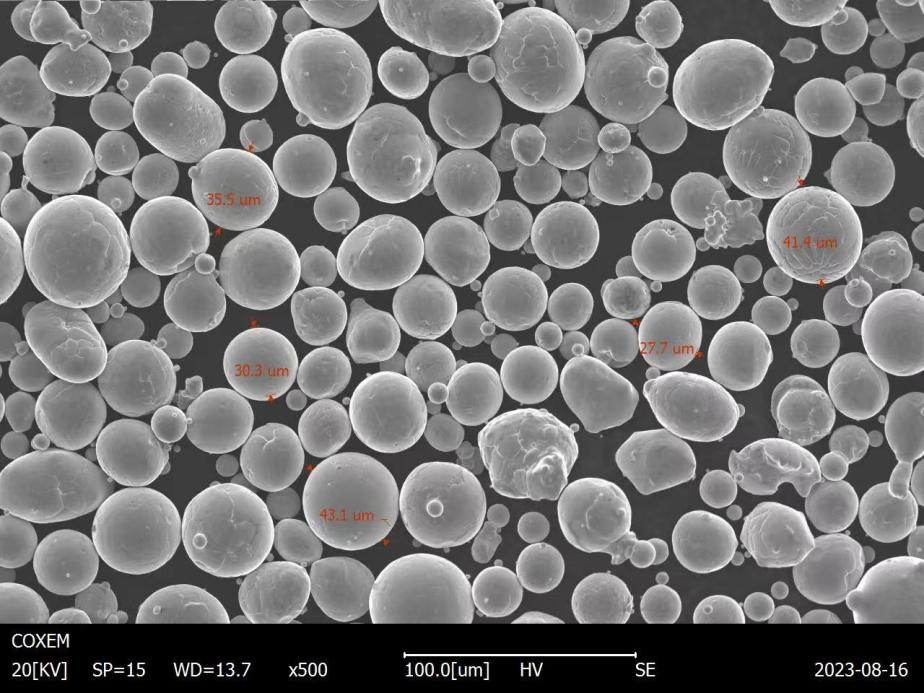
Why AM users specify Hastelloy X spherical powder
Additive manufacturing opens a design window that conventional sheet fabrication, casting, or machining may not match economically. Complex cooling paths, integrated flanges, weight reduction pockets, lattice-reinforced thin sections, and one-piece combustor subassemblies are all easier to realize in powder-bed or directed-energy routes. That is why Hochtemperatur-Oxidationsbeständigkeit often becomes the lead performance criterion when engineers evaluate Hastelloy X for AM rather than treating it as a generic nickel powder.
Core characteristics that define the alloy
The core traits of Hastelloy X include excellent oxidation resistance up to high service temperatures, good resistance to carburizing and nitriding atmospheres in many industrial heating environments, useful ductility after fabrication, and consistent weldability. These traits are why the alloy remains relevant even as newer superalloys have appeared. According to Begriffe gemäß ISO/ASTM 52900, additive manufacturing process selection should always be tied to material behavior, and Hastelloy X is a clear example of an alloy whose service value depends as much on post-build condition as on nominal chemistry.
In nickel superalloy AM, alloy selection is rarely about printability alone; it is about whether the printed microstructure can be heat treated into a stable high-temperature condition.
How Hastelloy X differs from adjacent AM powders
Hastelloy X is more oxidation-focused than many corrosion-led nickel alloys and generally more weldable than highly strengthened, precipitation-hardened turbine materials. Compared with Alloy 625, it is usually preferred for hotter gas-path and furnace-facing conditions. Compared with Alloy 718, it sacrifices some room-temperature and intermediate-temperature strength potential in exchange for a more oxidation-stable, fabrication-friendly profile in hot structural service.
Chemische Zusammensetzung
The chemistry of Hastelloy X is central to its behavior in additive manufacturing and end use. Nickel forms the matrix, chromium provides oxidation resistance, molybdenum contributes strong solid-solution strengthening, and iron moderates composition and cost while supporting fabricability. Controlled residual levels of carbon, manganese, silicon, sulfur, and phosphorus are also important because they influence hot cracking tendency, carbide formation, weld response, and long-term stability.
Typical composition of Hastelloy X nickel alloy powder
| Element | Typical wt% | Main Metallurgical Role | Effect on AM and Service Performance |
|---|---|---|---|
| Ni | Bilanz | Matrix element | Provides austenitic stability, toughness, and high-temperature corrosion resistance |
| Cr | 20.5–23.0 | Oxidationsbeständigkeit | Forms protective oxide scale and improves hot gas resistance |
| Fe | 17.0–20.0 | Matrix modifier | Supports fabricability and cost balance while contributing to strength |
| Mo | 8.0–10.0 | Solid-solution strengthening | Raises elevated-temperature strength and improves resistance to aggressive environments |
| Co | 0.5–2.5 | Strength/stability support | Helps hot-strength retention and thermal stability |
| W | 0.2–1.0 | Secondary strengthening | Adds high-temperature strength contribution in some melts |
| C | 0.05-0.15 | Hartmetall-Former | Influences grain-boundary carbides, creep response, and weld behavior |
| Mn | ≤1.0 | Deoxidation aid | Supports melting practice and process cleanliness |
| Si | ≤1.0 | Deoxidation / residual control | Excess can affect weldability and oxide formation |
| P + S | Low residuals | Impurity control | Minimizing these reduces hot cracking risk and embrittlement |
Nickel is the foundation of the alloy’s microstructure, keeping the matrix stable across a broad temperature range. Chromium is critical because it allows the alloy to develop a protective oxide film in hot oxidizing gases, which is one reason combustor and furnace designers continue to consider it. Molybdenum then reinforces the matrix through solid-solution strengthening, improving elevated-temperature strength without relying on a heavy precipitation-hardening response.
Role of carbon and carbide chemistry in Hastelloy X AM powder
Carbon is not merely a residual in Hastelloy X. In controlled amounts, it contributes to carbide formation that can help high-temperature strength, especially along grain boundaries after proper thermal exposure. Too much carbon, however, can worsen cracking susceptibility during welding or AM solidification and may also alter ductility after service exposure.
Why composition control matters in powder form
In powder metallurgy and additive manufacturing, surface area is high and contamination risks are real. Oxygen, nitrogen, and trace chemistry shifts can influence wetting, laser absorption, cracking behavior, and the final heat-treatment response. Buyers comparing Hastelloy X with broader nickel superalloy powder options should therefore evaluate both bulk composition and powder cleanliness rather than relying on nominal alloy name alone.
Physikalische und mechanische Eigenschaften
Hastelloy X is not chosen because it is the strongest nickel alloy at room temperature. It is chosen because its properties remain useful after prolonged thermal exposure and because it resists oxidation better than many structural alternatives in hot gas environments. For AM engineers, that means the material must be evaluated across density, melting range, tensile properties, hardness, thermal conductivity, and service temperature behavior as a whole rather than through one headline strength number.
Typical properties of Hastelloy X nickel alloy powder and consolidated alloy
| Eigentum | Typischer Wert | Einheit | Prüfnorm / Prüfbedingungen |
|---|---|---|---|
| Dichte | 8.22 | g/cm³ | Typical nominal alloy density |
| Solidus | 1260 | °C | Typical composition-dependent value |
| Liquidus | 1355 | °C | Typical composition-dependent value |
| Zugfestigkeit | 730–900 | MPa | Typical room-temperature wrought or HIP/heat-treated condition |
| Streckgrenze (0.2%) | 300–420 | MPa | Typical room-temperature condition |
| Dehnung | 30–45 | % | Typical solution-treated condition |
| Härte | 180–260 | HB / HV equivalent range | Condition dependent |
| Elastischer Modul | 205–220 | GPa | Room-temperature typical |
| Wärmeleitfähigkeit | 9–12 | W/m-K | Near room temperature, typical |
| Oxidation Service Range | Up to about 1100–1200 | °C | Environment and exposure dependent |
These values should be read as typical ranges, not purchase-spec guarantees. Printed density, hot-isostatic-pressing response, grain size, residual porosity, and solution annealing history all change the property profile. In practice, mechanical values for AM parts are often reported after stress relief, HIP, or solution heat treatment because the as-built condition may contain residual stress and anisotropy.
Elevated-temperature behavior of Hastelloy X components
The defining strength of the alloy is its usefulness in high-temperature environments where oxidation and thermal cycling would rapidly degrade ordinary stainless steels. It retains workable tensile properties at elevated temperature and resists scaling well enough for many combustor and industrial heating duties. That is why engineers often choose thermal stability in oxidizing atmospheres as the deciding attribute.
Weldability and crack sensitivity in AM
Hastelloy X is generally regarded as weldable, but that does not mean crack-free AM behavior is automatic. Powder-bed fusion of the alloy can show hot cracking or solidification cracking if scan strategy, energy density, support design, and heat treatment are not well controlled. The material is more forgiving than some highly strengthened nickel superalloys, but it still requires a qualified process window.
Thermal conductivity and design implications
Its thermal conductivity is modest compared with copper alloys or aluminum alloys, which matters in cooling-dominated designs. Thin walls and internal channels may therefore be more important in Hastelloy X AM parts than they would be in a more conductive material. This design flexibility is one reason users may benchmark it against copper-based thermal management powders when deciding whether heat resistance or heat extraction is the primary requirement.
Technische Daten und verfügbare Güteklassen
Hastelloy X nickel alloy powder is typically supplied by chemistry class, powder production route, and particle size distribution rather than by a single universal AM grade code. In practice, buyers specify PSD, flow characteristics, morphology, oxygen level, and applicable inspection methods alongside chemistry. Standards cross-reference is also important because AM procurement often blends traditional nickel-alloy material specifications with powder test standards and internal print qualification protocols.
Typical Hastelloy X nickel alloy powder grades
| Supply Grade / Condition | PSD-Bereich | Scheinbare Dichte | Zapfstellendichte | Hall-Strömung | Oxygen / Sphericity / Cross-Reference |
|---|---|---|---|---|---|
| HX-PBF15-45 | 15-45 µm | 4,4–5,0 g/cm³ | 5,0–5,8 g/cm³ | 14–20 s/50 g | O typically ≤0.08 wt%; high sphericity; LPBF-focused |
| HX-PBF15-53 | 15-53 µm | 4,5–5,1 g/cm³ | 5,1–5,9 g/cm³ | 14–19 s/50 g | O typically ≤0.08 wt%; common laser bed fraction |
| HX-DED45-105 | 45-105 µm | 4,6–5,2 g/cm³ | 5.3–6.0 g/cm³ | 12–18 s/50 g | O typically ≤0.06 wt%; coarser DED feed |
| HX-SPRAY53-150 | 53-150 µm | 4.7–5.3 g/cm³ | 5,4–6,1 g/cm³ | 12–17 s/50 g | O typically ≤0.06 wt%; cladding / spray use |
| Standards Context | - | ASTM B212-Verfahren | ASTM B527 method | ASTM B213 method | Chemistry often aligned to AMS / ASTM / internal superalloy specs |
The finest powder cuts are typically used for laser powder bed fusion because they spread more evenly and can support thinner layer thicknesses. Coarser grades are favored for directed energy deposition, laser cladding, and thermal spray-type applications where feed stability and deposition rate matter more than fine recoating behavior.
Test methods used for Hastelloy X AM powder
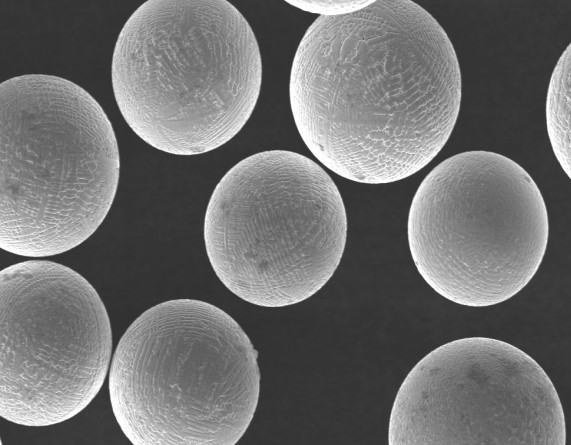
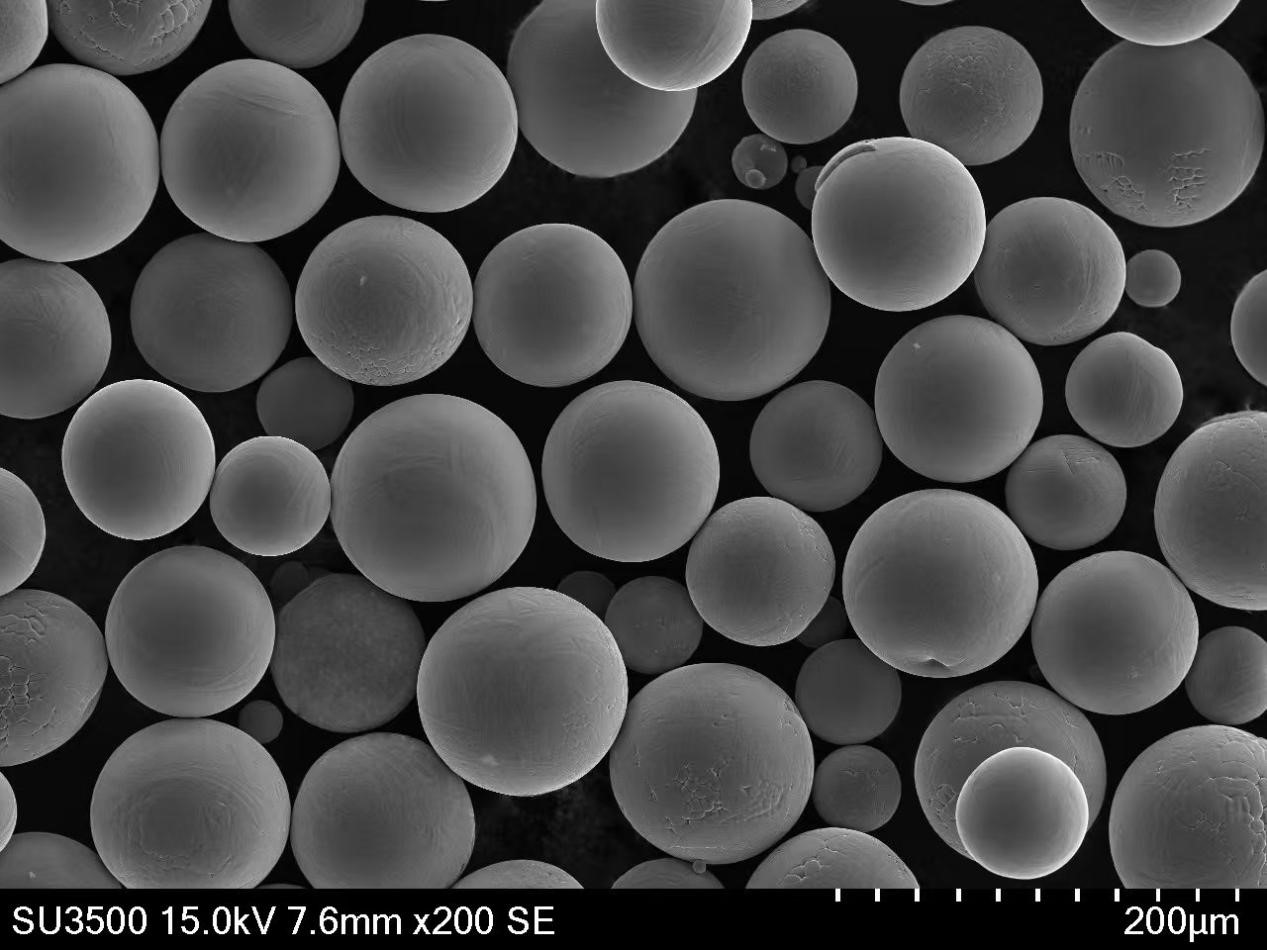
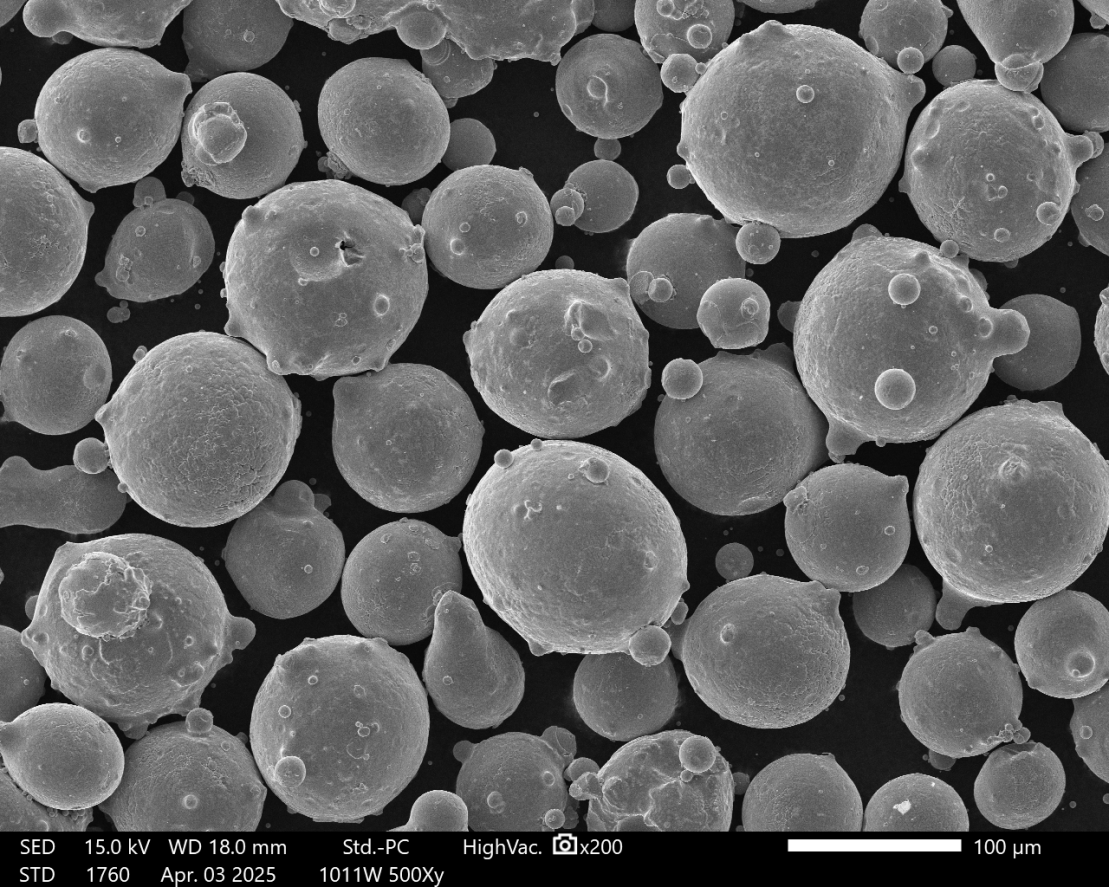
Powder characterization generally includes sieve or laser diffraction PSD, Hall flow, apparent density, tap density, oxygen and nitrogen analysis, and particle-shape review under microscopy. The ASTM B213 Hall flow standard is commonly referenced for free-flowing metal powders, while the ASTM B214 sieve analysis method remains relevant for particle size classification in many purchasing packages.
How standards are applied in real procurement
Because Hastelloy X is used in demanding heat-resistant hardware, companies often supplement published standards with internal print qualification requirements. Those may include build density thresholds, crack inspection criteria, heat-treatment windows, and tensile testing in both room-temperature and elevated-temperature conditions. The result is that powder approval is usually tied to a specific machine platform and parameter set, not just to a certificate of analysis.
Supply forms and lot controls
AM users typically prefer vacuum- or inert-melted spherical powder with narrow PSD, low satellites, and low oxygen. Repeatability from lot to lot is especially important for Hastelloy X because thermal processing after printing can amplify small differences in microsegregation or defect population. In aerospace-adjacent projects, traceability down to melt lot and atomization batch is often expected.
Herstellungsprozess
The route used to produce Hastelloy X powder affects far more than appearance. Particle shape, internal porosity, surface oxide, satellite content, and chemistry uniformity all influence powder flow, recoating consistency, melt-pool stability, and the final crack tendency of printed parts. For that reason, AM buyers usually evaluate the atomization process as part of the material specification rather than as a back-end manufacturing detail.
Process comparison for Hastelloy X spherical powder
| Prozess | Sphärizität | Sauerstoffaufnahme | PSD-Steuerung | Durchsatz | Relative Kosten |
|---|---|---|---|---|---|
| Gaszerstäubung (GA) | Hoch | Gering bis mäßig | Gut | Hoch | Mittel |
| PREP | Sehr hoch | Sehr niedrig | Gut | Mittel | Hoch |
| VIGA | Hoch bis sehr hoch | Niedrig | Sehr gut | Mittel | Mittel-hoch |
| EIGA | Sehr hoch | Sehr niedrig | Sehr gut | Mittel | Hoch |
| Wasserzerstäubung | Gering bis mäßig | Höher | Breite | Hoch | Niedrig |
Gas-atomized Hastelloy X nickel alloy powder
Gas atomization is the most common route for commercial Hastelloy X AM powder because it balances productivity, cost, and particle quality. Under carefully controlled inert gas conditions, GA can produce highly spherical powder with acceptable flowability and low oxygen pickup for laser and DED applications. For many industrial users, GA is the default choice unless the part requires a particularly stringent cleanliness profile.
PREP, VIGA, and EIGA trade-offs
PREP typically delivers excellent sphericity and very low contamination because droplets are produced from a rotating consumable electrode rather than a free-pouring melt stream. VIGA and EIGA can also produce very clean spherical powder and are often chosen for premium alloy programs where chemistry consistency and oxide control are critical. In Hastelloy X, these routes may reduce variability in crack-sensitive builds, but they usually raise powder cost compared with standard GA production.
Why water atomization is uncommon for high-end Hastelloy X AM powder
Water atomization is economical, but it usually produces more irregular particles, rougher surfaces, broader PSD, and higher oxygen levels. Those characteristics can be acceptable in press-and-sinter applications, yet they are generally less desirable for laser powder bed fusion where flow, packing, and stable melting are essential. This is why sphärische Pulvermorphologie is treated as a functional requirement, not a cosmetic one, in most Hastelloy X AM supply chains.
Post-atomization handling and reuse
After atomization, powder is normally sieved, blended, sampled, and packed under controlled conditions. Reuse strategy also matters: repeated thermal exposure in the build chamber can gradually shift oxygen content, satellite fraction, and fine-particle distribution. Teams using Hastelloy X for critical hot-zone components typically set powder-refresh limits and requalification rules early in process development rather than treating reuse as an afterthought.
Anwendungen nach Branche
Hastelloy X nickel alloy powder is not a universal powder for every high-temperature part. It is most relevant where oxidation resistance, thermal-fatigue tolerance, and manufacturable complex geometry intersect. The industries that rely on it tend to be those that expose hardware to hot gases, combustion byproducts, or long thermal cycles while still demanding precise shape control and weldable repair options.
Aerospace and gas-turbine hardware
Aerospace is the most recognizable application area for Hastelloy X. Combustor liners, transition pieces, afterburner parts, flame holders, seal carriers, and hot-air ducting are representative examples because these components see severe thermal exposure but not always the same loading profile as turbine disks or single-crystal blades. AM is particularly attractive when intricate cooling features or low-volume replacement parts are needed.
Industrial furnace and thermal-processing equipment
The alloy is also widely relevant to industrial heating systems. Furnace trays, muffles, retorts, burner nozzles, heat shields, and hot-zone fixtures benefit from oxidation resistance and fabricability. In many plants, complex replacement geometry or rapid refurbishment cycles make additive manufacturing attractive for specialized thermal-processing hardware.
Oil, gas, and energy systems
In energy systems, Hastelloy X may be used where high temperature and chemically aggressive combustion products overlap. Burner assemblies, thermal oxidizer components, and selected hot gas duct parts are typical examples. While some oil and gas applications prioritize wet corrosion resistance and may lean toward 625 or C-276, Hastelloy X becomes more relevant when elevated-temperature oxidation and structural service dominate the design brief.
Automotive, motorsport, and propulsion development
Low-volume motorsport and advanced propulsion programs frequently value rapid iteration. Exhaust-side prototypes, burner test hardware, turbo-related hot structures, and high-temperature brackets can benefit from a weldable nickel alloy that prints into complex geometry and survives repeated thermal cycling. In such programs, AM shortens development loops by enabling one-piece builds that would otherwise require multiple formed and welded sections.
Medical and general industrial tooling
Medical use is not the classic home for Hastelloy X, but the alloy may appear in heat-resistant fixtures, sterilization-adjacent tooling, or specialized process hardware rather than implantable parts. More broadly, it is used in industrial jigs, brazing fixtures, and high-temperature test rigs. Companies reviewing their material strategy often compare it with titanium alloy powder grades for weight savings or consult broader industrial AM application examples to decide whether heat resistance, corrosion resistance, or lightweighting should lead the selection.
Vergleich mit alternativen Materialien
Choosing Hastelloy X means rejecting some alternatives that may be stronger, cheaper, or more corrosion-resistant in different environments. The alloy occupies a practical middle ground for hot oxidizing service where a weldable, printable nickel alloy is needed. A sound comparison therefore looks at density, high-temperature strength retention, oxidation behavior, printability, corrosion profile, and relative cost together.
Hastelloy X nickel alloy powder versus alternative AM alloys
| Material | Dichte (g/cm³) | Kernkompetenz | Relative Kosten | Druckbarkeit | Corrosion / Oxidation Profile |
|---|---|---|---|---|---|
| Hastelloy X nickel alloy powder | 8.22 | Hot-strength retention plus oxidation resistance | Hoch | Gut bei qualifizierten Parametern | Excellent oxidation; good broad high-temp resistance |
| Inconel 718-Pulver | 8.19 | Higher strength via precipitation hardening | Mittel-hoch | Sehr gut | Good oxidation; not the first choice for the hottest oxidizing combustor zones |
| Inconel 625-Pulver | 8.44 | Broad corrosion resistance and good weldability | Hoch | Sehr gut | Excellent wet corrosion; somewhat less optimized for sustained hottest gas service |
| Haynes 230 Pulver | 8.97 | Excellent long-term thermal stability | Sehr hoch | Mäßig bis gut | Outstanding oxidation and carburization resistance |
| Stainless 316L powder | 7.99 | Economy and easy printability | Niedrig | Ausgezeichnet | Good general corrosion, but much weaker in high-temperature oxidizing duty |
Compared with Inconel 718, Hastelloy X is usually the better choice for combustor-like oxidizing service, even though 718 may post higher strength after age hardening in lower-temperature regimes. Compared with Inconel 625, Hastelloy X generally has the stronger identity as a hot-gas and furnace-facing alloy, whereas 625 is often selected for mixed corrosion and moderate heat. Haynes 230 can outperform it in some extreme thermal exposures, but cost and sourcing may be less favorable. Against 316L, the comparison is straightforward: stainless steel prints easily and costs less, but it does not belong in the same class for demanding hot-zone duty.
How designers usually make the final choice
The practical decision often comes down to environment first, then strength, then manufacturability. If the part sees hot oxidizing gas and repeated thermal cycling, Hastelloy X moves up the list quickly. If the environment is chloride-bearing liquid corrosion, a different nickel alloy may be better; if peak strength at moderate temperature is dominant, 718 often wins.
Unser Unternehmen
Shanghai Truer Technology Co., Ltd., operating am-printing.com, was established in 2009 and created its additive manufacturing business in 2019. According to its published company information, the company integrates 3D printing powder-making equipment and services with metal powder supply, including Selective Electron Beam Melting equipment, Plasma Rotating Electrode Process powder-making equipment, and Gas Atomization capability, and it lists product families such as TiNi, TiTa, TiAl, TiNbZr, CoCrMo, plus nickel-based, cobalt-based, titanium-based, copper-based, aluminum-based, and stainless steel spherical powders. The same profile states that it serves processes including SLM, SEBM, DED, laser cladding, powder metallurgy, MIM, HIP, cold and hot spraying, welding, and coating, with end-use coverage in 3C electronics, hand tools, remote control cars, medical, aerospace, and nuclear power; its broader background is outlined in the company’s supplier profile and history.
FAQ
Q1. Is Hastelloy X nickel alloy powder good for laser powder bed fusion?
Yes, provided the powder is spherical, low in oxygen, and matched to a qualified parameter set. The alloy is widely considered printable, but it can show crack sensitivity if scan strategy, support design, and post-build heat treatment are not carefully controlled.
Q2. What is Hastelloy X nickel alloy powder mainly used for?
Its main use is in high-temperature components exposed to oxidizing gases, such as combustor hardware, furnace parts, transition ducts, and thermal-processing fixtures. It is usually selected when geometry complexity and elevated-temperature oxidation resistance matter more than maximum age-hardened strength.
Q3. How does Hastelloy X compare with Inconel 718 powder?
Hastelloy X generally offers a more oxidation-focused profile for hot-zone service, while Inconel 718 is better known for higher precipitation-hardened strength at lower temperature ranges. For combustor-type parts, Hastelloy X is often the more natural fit; for heavily loaded structural parts, 718 may be preferred.
Q4. Does Hastelloy X nickel alloy powder require heat treatment after printing?
In most AM workflows, yes. Stress relief, HIP, and solution treatment are commonly used to reduce residual stress, close porosity, and stabilize the microstructure before final service, especially for parts that must survive thermal cycling.
Q5. What particle size is typical for Hastelloy X AM powder?
For laser powder bed fusion, common commercial cuts include 15–45 µm and 15–53 µm. Directed energy deposition and cladding usually use coarser fractions such as 45–105 µm because deposition rate and feed consistency matter more than thin-layer spreading.
Q6. What should buyers ask for before ordering Hastelloy X nickel alloy powder?
They should ask for full chemistry, oxygen and nitrogen limits, PSD data, apparent density, Hall flow, morphology images, and the recommended heat-treatment route for the intended process. For critical parts, buyers should also request evidence of density, crack control, and tensile performance in the final processed condition, and where qualification support is needed, they may also contact the supplier through the technical inquiry page.