簡単な回答
Spherical AlSi10Mg aluminum powder is a pre-alloyed aluminum-silicon-magnesium feedstock designed for powder-based metal additive manufacturing. It is widely chosen for 3D printing because it offers a strong combination of low density, good flowability, stable laser processability, useful as-built strength, and dependable corrosion resistance. For lightweight parts with complex geometry, especially in aerospace, automotive, tooling, and industrial hardware, the alloy often delivers the best overall balance between printability, weight reduction, and post-processing efficiency.
What Is spherical AlSi10Mg aluminum powder
Spherical AlSi10Mg aluminum powder is an aluminum alloy powder in which aluminum is the base metal, silicon is the primary alloying element, and magnesium is added in a smaller amount to support strengthening. In additive manufacturing, the grade is typically supplied as a pre-alloyed, gas-atomized spherical powder for laser powder bed fusion, directed energy deposition, and other powder-fed processes that require controlled morphology and predictable melting behavior.
The name AlSi10Mg is shorthand for an aluminum alloy containing about 10 wt% silicon with a modest magnesium addition. Metallurgically, that composition places it within the Al-Si foundry-style alloy family rather than the higher-strength wrought families such as 2xxx or 7xxx. That distinction matters because Al-Si alloys are generally more tolerant of rapid solidification, which is one reason AlSi10Mg became one of the first aluminum grades to gain broad traction in metal AM.
Why spherical powder morphology matters
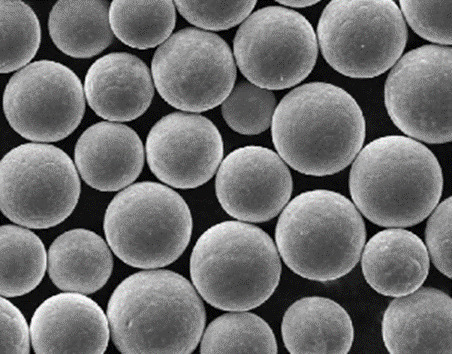
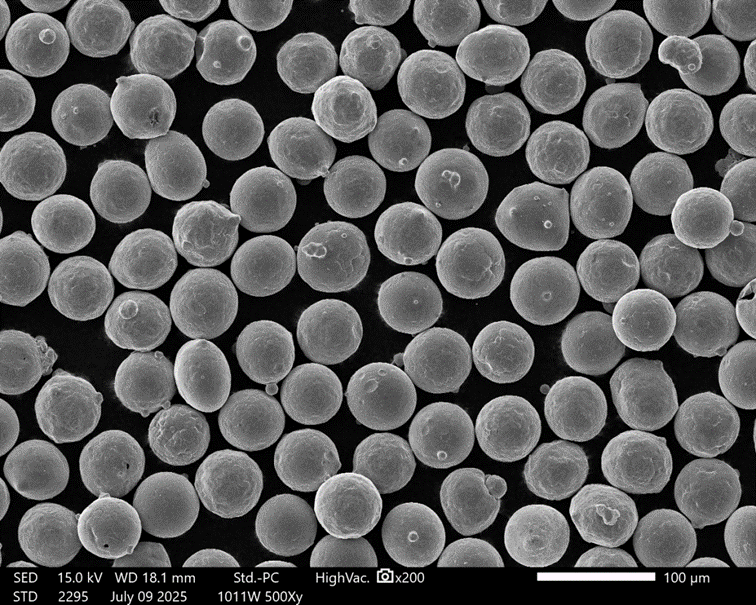
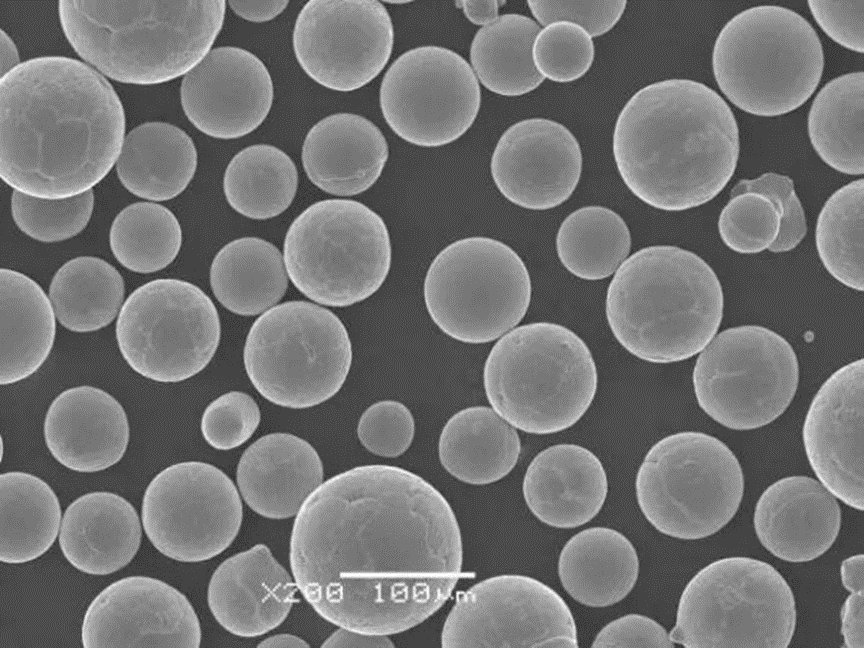
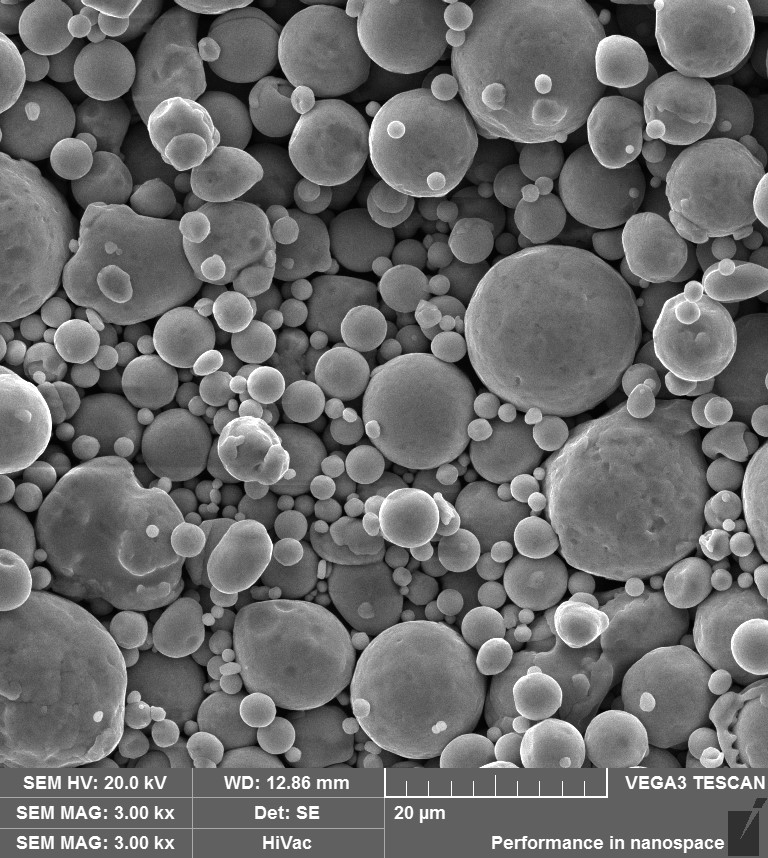
In additive manufacturing, particle shape is not a cosmetic detail. A spherical powder spreads more evenly across the build plane, packs more consistently, and usually flows more reliably through feed systems than irregularly shaped particles. That improves layer uniformity, reduces the likelihood of recoater interference, and helps maintain stable melting conditions over long builds.
For AlSi10Mg, this is especially important because aluminum powders naturally form oxide films on their surfaces. If the powder is overly irregular, satellite-heavy, or poorly classified, those surface effects combine with poor packing behavior and can reduce final part density. 粉末形態 therefore has a direct connection to print quality, not just handling convenience.
Where AlSi10Mg sits in the aluminum AM alloy family
Within metal AM, AlSi10Mg is often treated as the benchmark aluminum grade for general structural lightweighting. It does not deliver the highest strength among all aluminum systems, and it is not the best choice for elevated-temperature service compared with nickel superalloys. Its advantage is that it achieves a practical middle ground: relatively easy processing, low mass, good corrosion behavior, and properties that remain useful after heat treatment and machining.
That positioning explains why engineers often start with AlSi10Mg when qualifying aluminum AM. If the part works in AlSi10Mg, it can move quickly into prototype or low-volume production. If the application demands higher conductivity, higher heat resistance, or higher specific strength, then the material selection process expands to copper, titanium, or other alloy families.
Historical context in additive manufacturing
The popularity of AlSi10Mg in AM comes from a straightforward metallurgical logic. Silicon-rich aluminum alloys have long been valued in casting because they resist hot cracking and fill complex shapes effectively. Additive manufacturing creates different thermal conditions than casting, but the same alloy characteristics remain useful under fast solidification. As laser powder bed fusion matured, AlSi10Mg became one of the most validated aluminum feedstocks because it repeatedly showed a workable balance of density, accuracy, and process stability.
In aluminum additive manufacturing, the most commercially successful alloy is often the one that prints consistently before it chases the highest possible strength.
化学組成
The chemistry of AlSi10Mg is simple enough to be familiar, but every element has a defined function. In practice, users care about more than nominal alloy composition: they also pay close attention to oxygen, residual contamination, and lot-to-lot consistency, because powder surface condition strongly affects AM performance.
| エレメント | Typical Content (wt%) | Common Range (wt%) | 冶金上の役割 | AMの関連性 |
|---|---|---|---|---|
| アルミニウム(Al) | バランス | 残り | Base matrix, low density, corrosion resistance | Provides lightweight structural platform |
| ケイ素 (Si) | 9.0–11.0 | 9.0–11.0 | Improves fluidity, reduces hot cracking, refines eutectic structure | Supports stable melting and good printability |
| マグネシウム (Mg) | 0.20–0.45 | 0.20–0.45 | Enables precipitation hardening and raises strength | Improves post-build mechanical response |
| 鉄(Fe) | ≤0.55 | Typically low | Residual impurity; excessive levels can form brittle intermetallics | High Fe can reduce ductility |
| 銅(Cu) | ≤0.05 | Usually very low | Minor residual element | Excess may reduce corrosion resistance |
| マンガン (Mn) | ≤0.45 | Usually low | Secondary modifier of intermetallic morphology | Can influence microstructure subtly |
| 亜鉛 | ≤0.10 | Usually low | 残留不純物 | Controlled to maintain consistency |
| チタン(Ti) | ≤0.15 | Usually low | Possible grain-refining residual | May influence nucleation behavior |
| 酸素 (O) | Process controlled | Kept low for AM | Surface oxide indicator rather than nominal alloying addition | Critical for powder cleanliness and fusion quality |
Silicon as the printability enabler
Silicon is the central reason AlSi10Mg performs so well in metal AM. It lowers the alloy’s sensitivity to hot cracking, supports better melt pool stability than many stronger aluminum systems, and contributes to a fine, rapidly solidified microstructure. In practical production terms, high-silicon aluminum grades are simply easier to keep within an acceptable process window.
Magnesium and strength development
Magnesium is present at a much lower percentage than silicon, but it plays an outsized role in final properties. After suitable thermal exposure, Mg-containing precipitates contribute to hardening and help lift yield and tensile strength beyond the as-built condition. This is why printed AlSi10Mg can move from a good prototype material to a fully usable engineering alloy when post-processing is well controlled.
Residual elements and powder discipline
Residuals such as Fe, Cu, Mn, and Zn are typically limited rather than intentionally targeted. Their main significance is control. A buyer evaluating spherical AlSi10Mg aluminum powder should look beyond the chemistry certificate to ask whether the supplier also controls oxygen pickup, handling atmosphere, and sieving practice, because those factors often matter as much as trace residuals in determining print consistency.
物理的および機械的特性
AlSi10Mg is attractive because it offers useful mechanical performance at very low density. In most AM use cases, the property discussion centers on the relationship between weight, strength, conductivity, and post-build response rather than on any single maximum value.
| プロパティ | 代表値 | 単位 | Test Standard / Reference Basis |
|---|---|---|---|
| 密度 | 2.65–2.68 | g/cm³ | Typical dense alloy value |
| ソリダス温度 | 557–570 | °C | Typical alloy reference range |
| 液相線温度 | 595–610 | °C | Typical alloy reference range |
| Ultimate Tensile Strength, As-Built | 320–430 | MPa | Typical AM coupon range |
| Yield Strength, As-Built | 180–260 | MPa | Typical AM coupon range |
| Ultimate Tensile Strength, Heat Treated | 380–460 | MPa | Typical stress-relieved / aged condition |
| Yield Strength, Heat Treated | 220–300 | MPa | Typical stress-relieved / aged condition |
| 破断伸度 | 3–10 | % | Process and heat treatment dependent |
| 硬度 | 95–130 | HB / HV equivalent range | Typical printed condition range |
| 熱伝導率 | 110–150 | W/m-K | 一般的な室温の範囲 |
| 弾性係数 | 68–76 | GPa | Typical aluminum alloy range |
Density and lightweight design value
The most obvious advantage of AlSi10Mg is mass reduction. At roughly 2.67 g/cm³, it is far lighter than steels, cobalt alloys, nickel superalloys, and copper alloys. When engineers combine that low density with lattice design, topology optimization, or integrated channels, they can remove substantial assembly weight without changing part function.
Strength behavior in printed and heat-treated states
As-built AlSi10Mg often provides enough strength for prototype and low-load service directly off the machine, especially after stress relief. For more demanding applications, heat treatment can improve yield and tensile properties, though the exact outcome depends on scan strategy, porosity level, and microstructural coarsening during the thermal cycle. The resulting property window is not as high as premium wrought aerospace aluminum, but it is broad enough for many production AM parts.
Thermal conductivity and functional parts
Thermal conductivity is one of the reasons AlSi10Mg remains relevant outside purely structural applications. It cannot compete with copper in absolute heat transfer, but it often performs well enough for lightweight heat sinks, electronics housings, and cooled tooling inserts. Definitions used across powder-bed AM workflows are generally aligned with ISO/ASTM additive manufacturing terminology, while property benchmarking and measurement practice are commonly informed by NIST engineering materials resources.
Why published properties vary by source
Mechanical data for AlSi10Mg often appear inconsistent across catalogs, papers, and qualification documents because test conditions are rarely identical. Build orientation, layer thickness, laser power, hatch spacing, support design, stress relief, hot isostatic pressing, and machining allowance all influence results. A realistic specification should therefore treat published values as typical ranges, not absolute promises.
仕様および取り扱いグレード
Commercial powder specifications for AlSi10Mg are normally built around process fit. A powder that works well in one machine or layer thickness may not be optimal in another, even if the chemistry is correct. That is why buyers evaluate particle size distribution, apparent density, tap density, flow behavior, and oxygen content together rather than separately.
Common spherical AlSi10Mg aluminum powder size cuts
For laser powder bed fusion, the most common size distributions are 15–45 µm and 15–53 µm. These cuts are fine enough to support thin layers and detailed geometry while retaining acceptable flowability. Coarser distributions such as 20–63 µm or 45–105 µm are more frequently selected for thicker layers, directed energy deposition, or related thermal spray-style applications.
| Grade / Reference | Typical PSD (µm) | 見かけ密度 (g/cm³) | Tap Density (g/cm³) | Hall Flow (s/50 g) | 酸素含有量 | Sphericity / Standards Note |
|---|---|---|---|---|---|---|
| 上質なLPBFグレード | 15-45 | 1.30–1.55 | 1.55–1.78 | 14–22 | Low, typical controlled AM level | High sphericity for fine layers |
| 標準LPBFグレード | 15-53 | 1.28–1.52 | 1.52–1.75 | 15-23 | Low, typical controlled AM level | General-purpose powder-bed grade |
| Mid-Range AM Grade | 20-63 | 1.32–1.58 | 1.56–1.80 | 14–21 | Low, typical controlled AM level | Balanced spreadability and packing |
| DED / クラッディンググレード | 45-105 | 1.40–1.70 | 1.65–1.92 | 12–19 | Controlled for route | Coarser spherical feedstock |
| Wide-Cut Engineering Grade | 53-150 | 1.45–1.75 | 1.70–1.95 | 11–18 | Route dependent | Often used outside LPBF |
| Standards Cross-Reference Row | Product specific | Measured per method | Measured per method | Measured per method | Product specific | Typically specified with ASTM powder tests plus ISO, AMS, GB, and DIN purchasing references |
Standards logic and cross-reference practice
There is no single universal AM powder specification that covers every AlSi10Mg purchasing case, so users usually build a layered requirement set. Chemistry may be aligned to internal alloy limits, particle size may be verified by sieve analysis or laser diffraction, and flowability may be measured using methods listed within the broader ASTM standards organization. In international sourcing, GB and DIN references may appear in purchasing documents alongside ASTM or ISO terminology, even when the final acceptance criteria are customer specific.
Available grade strategy by process route
A fine LPBF powder is usually chosen when small features, thinner walls, and improved surface finish matter most. A slightly wider distribution may give better packing efficiency and powder economy in larger builds. Coarser grades are more suitable when powder delivery, catch efficiency, or melt pool volume matter more than surface resolution.
Reuse, blending, and qualification concerns
Powder reuse is common in metal AM, but AlSi10Mg reuse must be monitored carefully. Repeated thermal exposure and air handling can shift oxygen content, alter fines content, and change flow behavior. Any serious production program should define sieve practice, virgin-to-recycled blend ratio, exposure limits, and retest intervals before the first qualified build is released.
製造工程
The phrase spherical AlSi10Mg aluminum powder usually implies gas atomization, because that route offers the best combination of morphology, productivity, and commercial availability. Still, understanding alternative powder-making routes helps buyers interpret pricing, cleanliness, and suitability for different AM processes.
Gas atomization as the mainstream route
In gas atomization, molten pre-alloyed AlSi10Mg is poured through a nozzle and broken into droplets by high-velocity inert gas. Those droplets solidify rapidly in flight, producing near-spherical particles that can later be sieved into application-specific fractions. The process is widely used because it supports relatively high throughput and generates morphology that fits the needs of powder bed fusion.
For aluminum alloys, atmosphere control is crucial. Aluminum is reactive, and poor inerting can raise oxygen pickup or worsen surface oxide condition. A well-controlled gas atomization line therefore combines melt cleanliness, atomization stability, classification discipline, and protected packaging.
PREP and where it fits
Plasma Rotating Electrode Process forms powder by melting the edge of a rapidly rotating electrode with plasma or another energy source. The centrifugal force ejects droplets that solidify into highly spherical powder. PREP is especially valued for very clean, low-satellite powder in reactive high-value alloys, but it is less commonly the default route for AlSi10Mg because the economics are less favorable than gas atomization for this material family.
VIGA and EIGA in specialty powder production
Vacuum Induction Melting Inert Gas Atomization, or VIGA, combines vacuum melting with inert gas atomization. It can improve melt cleanliness and reduce contamination risk before atomization begins. Electrode Induction Melting Gas Atomization, or EIGA, avoids some contact points between the melt and refractory materials, which can be useful for very sensitive alloy systems even though it is less central to mainstream AlSi10Mg supply.
| プロセス | 球形度 | Oxygen Pickup Risk | PSDコントロール | スループット | 相対的なコスト | Typical Relevance to AlSi10Mg |
|---|---|---|---|---|---|---|
| ガスアトマイズ(GA) | 高い | Low with good inert control | 良い~非常に良い | 高い | 中程度 | Primary industrial route |
| プラズマ回転電極プロセス(PREP) | 非常に高い | 低い | 中程度 | 低~中程度 | 高い | Technically possible, less common commercially |
| VIGA | 高い | Very low to low | 良い~非常に良い | 中~高 | 中~高 | Cleaner-melt gas atomization option |
| EIGA | 高い~非常に高い | 非常に低い | グッド | 中程度 | 高い | Specialty route for sensitive alloys |
| 水の霧化 | 低~中程度 | より高い | 中程度 | 高い | 低い | Generally unsuitable for high-end LPBF aluminum |
Trade-offs that buyers should actually compare
For most purchasers, the best route is not the most exotic route; it is the route that delivers consistent powder at the required cost and volume. Gas atomization usually wins because it balances sphericity, controlled oxygen, commercial scale, and acceptable pricing. When buyers compare AlSi10Mg with neighboring materials from a broader aluminum powder category, they often find that powder-making route and screening discipline are as important as the alloy label itself.
業界別の用途
AlSi10Mg succeeds in industries where lightweight design, geometric freedom, and manufacturing consolidation create measurable value. It is less about replacing every machined aluminum component and more about enabling shapes and functions that conventional processing handles poorly.
Aerospace and unmanned systems
Aerospace users print AlSi10Mg for brackets, housings, instrumentation mounts, ducts, covers, and other secondary structures where low mass matters. In unmanned aerial systems, every gram saved can improve endurance or payload capacity. The alloy is also attractive because it supports internal stiffening features and integrated mounting details without the cost of multi-piece fabrication.
Automotive and motorsport
Automotive applications include structural brackets, prototype housings, thermal management parts, lightweight fixtures, and motorsport components. In EV development, the alloy is useful for compact enclosures and heat-related hardware where weight reduction and design iteration are both valuable. Because AlSi10Mg prints more easily than many other aluminum systems, it is often used early in development and sometimes retained for serial low-volume production.
Tooling, fixtures, and production aids
Many factories use lightweighting as a productivity tool rather than as a vehicle-performance target. Robotic end effectors, hand-held jigs, checking fixtures, and ergonomic supports all benefit from reduced mass. AlSi10Mg is well suited to these parts because it is machinable after printing and can incorporate topology-optimized ribs, vacuum channels, or cable-routing features directly into the build.
Energy, industrial equipment, and electronics
Industrial equipment makers specify AlSi10Mg for customized housings, sensor carriers, thermal supports, and compact flow components. The alloy’s corrosion resistance is usually adequate for indoor industrial service, and its thermal conductivity can be useful in electronics packaging. When conductivity or wear demand shifts, engineers may instead compare it with copper alloy AM feedstocks or harder material families.
Medical-adjacent and cross-sector prototyping
Although titanium dominates load-bearing implants, AlSi10Mg appears in device housings, lab tooling, and lightweight non-implant hardware. It is also a common cross-sector prototype alloy because it allows designers to test weight-sensitive geometry quickly before deciding whether a final program needs titanium, steel, or a more specialized feedstock from a broader titanium powder lineup.
代替材料との比較
Selecting AlSi10Mg becomes easier when it is compared directly with alternative AM powders. The alloy is not the best in every category, but it occupies a very strong position when the design objective is balanced performance rather than an extreme requirement.
| 素材 | 密度 (g/cm³) | 一般的な筋力レベル | 印刷適性 | 耐食性 | 相対的なコスト | 最適なユースケース |
|---|---|---|---|---|---|---|
| spherical AlSi10Mg aluminum powder | 2.65–2.68 | Moderate to high for AM aluminum | 非常に良い | グッド | 中程度 | Lightweight structural and thermal-functional parts |
| Ti-6Al-4V粉末 | 4.40–4.45 | 高い | グッド | 素晴らしい | 高い | High-specific-strength aerospace and medical parts |
| 316Lステンレス鋼粉末 | 7.90–8.00 | 中程度 | 素晴らしい | 非常に良い | 中程度 | General-purpose corrosion-resistant components |
| インコネル718粉末 | 8.10–8.20 | High, especially at temperature | グッド | 素晴らしい | 高い | High-temperature and severe-service parts |
| CuCrZr / copper alloy powder | 8.80–8.96 | 低~中程度 | 中程度 | グッド | 中~高 | High-conductivity thermal and electrical hardware |
Where AlSi10Mg has the clearest advantage
AlSi10Mg is usually the most rational choice when the part must be light, printable, corrosion resistant, and reasonably strong without moving into premium material costs. It is particularly effective for support structures, housings, brackets, channels, and integrated assemblies where design freedom matters as much as material strength. In these cases, process stability can outweigh the appeal of stronger but less forgiving alloys.
Where alternative materials outperform it
If the requirement is extreme conductivity, copper alloys are superior. If the requirement is sustained high-temperature strength, nickel superalloys are the correct class. If the requirement is the highest specific strength for critical aerospace or medical parts, titanium generally offers more headroom. That is why AlSi10Mg should be treated as a highly capable general-purpose aluminum AM powder, not as a universal metal powder solution.
当社
Shanghai Truer Technology Co., Ltd was established in 2009 and created its additive manufacturing business in 2019. Operating am-printing.com, the company integrates powder-making equipment and powder supply for metal additive manufacturing, including Selective Electron Beam Melting equipment, Plasma Rotating Electrode Process powder-making equipment, and gas atomization-related capabilities. Its published powder portfolio includes TiNi, TiTa, TiAl, TiNbZr, CoCrMo, and broader nickel-based, cobalt-based, titanium-based, copper-based, aluminum-based, and stainless steel spherical metal powders used in SLM, SEBM, DED, laser cladding, powder metallurgy, MIM, HIP, cold and hot spraying, welding, and coating. The company also states that it operates a joint innovation center for metal 3D printing with laboratories and external experts and serves industries including 3C electronics, hand tools, remote control cars, medical, aerospace, and nuclear power; additional corporate background is outlined on its company background page and sector coverage is summarized in its application sectors overview.
よくあるご質問
Q1. Is spherical AlSi10Mg aluminum powder the most common aluminum AM powder?
In many powder bed fusion environments, yes. It is one of the most established aluminum feedstocks because it combines low density, relatively forgiving printability, and useful post-heat-treatment performance. Many qualification programs use it as the starting point for aluminum AM.
Q2. Why is spherical AlSi10Mg aluminum powder preferred over irregular aluminum powder?
Spherical particles generally spread more evenly, flow better, and pack more consistently into thin powder layers. That improves recoating stability and supports better part density. Irregular powders may work in some powder metallurgy applications, but they are less suitable for demanding powder-bed AM.
Q3. What particle size is best for spherical AlSi10Mg aluminum powder in LPBF?
The most common ranges are 15–45 µm and 15–53 µm. These cuts balance powder flow, layer quality, and feature resolution for many commercial LPBF systems. The ideal choice still depends on machine settings, layer thickness, and target surface finish.
Q4. Can AlSi10Mg printed parts be heat treated after building?
Yes. Stress relief is common to reduce residual stress, and additional aging-style treatments may be used to improve strength and hardness. The exact thermal schedule should be validated carefully because it can also change ductility, conductivity, and dimensional stability.
Q5. Is spherical AlSi10Mg aluminum powder suitable for aerospace components?
Yes, especially for secondary structures, brackets, housings, ducts, and lightweight hardware. It is valued in aerospace primarily for mass reduction and manufacturability rather than for matching the highest strengths available in titanium systems. Qualification requirements will still depend on the specific part class and inspection regime.
Q6. What should buyers check before ordering spherical AlSi10Mg aluminum powder?
Buyers should verify chemistry, particle size distribution, oxygen level, apparent density, tap density, flowability, morphology, and packaging condition, not just the alloy name. They should also match the powder cut to the intended process, such as LPBF or DED, and define how reused powder will be monitored. In production AM, consistent lot-to-lot behavior is often as important as nominal composition.